
Shin Jin Mei | 信心銘
(or Mind of Absolute Trust, Faith in Mind, Xinxin Ming)
by Third Patriarch Jianzhi Sengcan
Commentary by Sensei Michael
“Shin Jin Mei,” also known as “Faith in Mind” or “Mind of Absolute Trust,” underscores the importance of trusting the direct experience of mind before false views obscure the true mind's inherent perfection. Like a jewel reflecting its brilliance, Shin Jin Mei invites us to gaze deeply into the mirror of our own consciousness, illuminating the truths that lie within. With its graceful simplicity and poetic elegance, this sacred composition guides us towards a direct encounter with the boundless nature of our true selves.
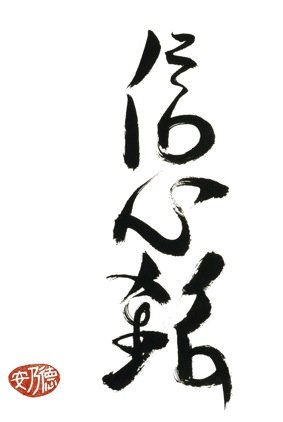
The Text:
The Great Way isn’t difficult for those who are unattached to their preferences. Let go of longing and aversion, and everything will be perfectly clear. When you cling to a hairsbreadth of distinction, heaven and earth are set apart. If you want to realize the truth, don’t be for or against. The struggle between good and evil is the primal disease of the mind. Not grasping the deeper meaning, you just trouble your mind's serenity. As vast as infinite space, it is perfect and lacks nothing. But because you select and reject, you can’t perceive its true nature. Don’t get entangled in the world; don’t lose yourself in emptiness. Be at peace in the oneness of things, and all errors will disappear by themselves.
If you don’t live the Tao, you fall into assertion and denial. Asserting that the world is real, you are blind to its deeper reality; denying that the world is real, you are blind to the selflessness of all things. The more you think about these matters, the farther you are from the truth. Step aside from all thinking, and there is nowhere you can’t go. Returning to the root, you find the meaning; chasing appearances, you lose their source.
At the moment of profound insight, you transcend both appearance and emptiness. Don’t keep searching for the truth, just let go of your opinions. For the mind in harmony with the Tao all selfishness disappears. With not even a trace of self-doubt, you can trust the universe completely. All at once you are free, with nothing left to hold on to. All is empty, brilliant, perfect in its own being. In the world of things as they are, there is no self, no non-self. If you want to describe its essence, the best you can say is “Not-two.”
In this “Not-two” nothing is separate, and nothing in the world is excluded. The enlightened of all times and places have entered into this truth. In it there is no gain or loss; one instant is ten thousand years. There is no here, no there; infinity is right before your eyes.
The tiny is as large as the vast when objective boundaries have vanished; the vast is as small as the tiny when you don’t have external limits. Being is an aspect of non-being; non-being is no different from being. Until you understand this truth, you won’t see anything clearly. One is all; all are one. When you realize this, what reason for holiness or wisdom? The mind of absolute trust is beyond all thought, all striving, is perfectly at peace, for in it there is no yesterday, no today, no tomorrow.
Commentary by Sensei Michael Brunner:

The title, translated as “Faith in Mind” or “Mind of Absolute Trust”, underscores the importance of trusting the direct experience of mind before false views obscure the true mind's inherent perfection.

Soon, as the notion of a gaining idea dissolves, we settle into practice.
Release your grip - return to the moment. This is our practice.

If we want to see the Way clearly, it is important to drop all of our conceptions and expectations of it.

Perhaps we might meditate more to cultivate greater equanimity in an effort to attain the True Way. But in doing this, we miss the 'deep meaning' of the Way and our efforts are 'to no purpose'.

There is no way to describe this - it has to be experienced.

Instead, be serene in the oneness of things, savor the full interconnectedness of this present infinite moment, and dualism vanishes by itself.
Any attempt to conceptualize the Way creates its antithesis. Thus we tarry in dualism.

People often try to stress the absolute as a 'right' concept - and dualism as 'wrong'. This is not the nature of oneness.
When we put away wordiness and intellection, the universe opens up and there is nowhere we cannot pass freely. All in this very present moment.

Just as we return to the breath when we sit meditation, let's return to the root throughout our day and experience wholly and directly.

The small self working furiously to make sense of inside and outside is put to rest and we recognize the boundlessness of our true and original nature.

When we are focused on the concepts created by the factions of small mind, there is a connecting-the-dots exercise to construct a reality out of nothingness.

When we cherish our opinions and conceptual constructs, we in essence abide with dualism.
This is the Big Mind revealed in equanimity - no disturbance.

Here we see the Absolute from the position of the Relative - where all is interconnected and comprises the Whole.

From the perspective of the Absolute, each and everything contains the myriad ten thousand things - thus there is no separation as the two are not distinguished.

By staying here in this moment, and acting skilfully with what comes up, we put away concepts of easy and hard. Just allow for what is needed in the here and now.

If we can stay awake and abide with what is coming up for us, experiencing directly, things follow their own courses.

We find that a narrative separated from truth and reality requires a lot of work to keep afloat.

Rather than developing an attitude of discrimination towards what is coming up and labeling it as "good" or "bad", and thus cleaving it from the Bodhisattva path of the Mahayana - be present with it.

When we can be open and operate with what is at hand without prejudice, we manifest wisdom fully and are One with the Way.

Ignorant of transcendent Oneness, we attach to particular objects. Since nothing has individual self-existence, this is nothing but clinging to illusions.

The real intention here is to cultivate a beginner's mind - approaching what is coming up directly before concepts and preconceived notions take over the narrative and rob us of openness.

Initially, in ignorance we create concepts - we break what is coming up for us into contrivances so they are easier for us to 'grip'.

All the deluded dreams of the small self can and will cease if we can cut off their mind-runway.

Suddenly the trappings of the small self seem so trivial when they are seen from the perspective of interconnectedness, that they are simply forgotten.

We like to know the why of things - to apprehend causes and conditions so we can reliably predict what will happen next, or so we can recreate conditions to deliver desired results.

When we find the Mind harmonious with the Way, subject and object are shot through.