Gyōji (行持) — Continuous Practice | PART FIVE
“The Yellow Emperor and other Chinese emperors such as Yao and Shun were secular people, yet they lived in thatched houses and were an example for their nation. In a book by the Chinese writer Shih-tsu it says, “If you wish to see the practice of the Yellow Emperor, take a look at Hekung Palace. If you wish to see the practice of the emperors Yao and Shun, take a look at Tsung-ts’ao Palace. The Yellow Emperor’s reception hall in Hekung Palace was roofed with thatch. Emperor Shun’s reception hall in Tsung-ts’ao Palace was also roofed with thatch.”
Keep in mind that both Hekung and Tsung-ts’ao were thatched with straw. Now, when we compare the Yellow Emperor, Emperor Yao, and Emperor Shun with ourselves, the difference is as great as that between heaven and earth. Even so, they used straw thatch for their reception halls. When even secular people reside in thatched dwellings, how can those who have left home life behind to be monks possibly aim at dwelling in lofty halls or elegant mansions? How unbecoming that would be! People of old would dwell under a tree or live in a forest, for these were the residences that both laymen and monks desired. The Yellow Emperor was a disciple of the Taoist Kuang-cheng of Mount Kung-tung. Kuang-cheng himself lived in a cave within Kung-tung Mountain. Today in Great Sung China, many heads of state and high-ranking ministers have carried on with this significant custom of emperors. As a consequence, even secular folk moiling about in their delusions do the same. How could those who have left home life behind to be monks possibly be inferior to secular folk who moil about in their delusions, or be as muddied by defiling passions as such folk? Among the Buddhas and Ancestors of the past, many received offerings of alms from celestial beings. Even so, once They had realized the Way, the eyes of the celestial beings could not see Them, and demons had no way to find Them.
We need to clarify this point. When celestial beings and demons keep to the daily conduct of Buddhas and Ancestors, they have a path by which they can approach the Buddhas and Ancestors. And, in that Buddhas and Ancestors far surpass celestial beings and demons, such celestial beings and demons have nothing by which to look up at Those who are so far off, so it is difficult for them to approach the vicinity of an Ancestor of the Buddha. As Nansen once said about himself, “The training and practice of this old monk has lacked vigor, so I have been spotted by demons.” Remember, to be spotted by a demon who has done no training is due to your lacking vigor in your own training and practice.
Once, in the community of the Venerable Monk Wanshi Shōgaku of the Great White Mountain, one of the guardian deities said, “I heard that the Venerable Monk Wanshi has been residing on this mountain for over ten years, but whenever I have come to the Abbot’s reception room to try to see him, I am never able to enter and still do not know what he looks like.” Here, truly, we can see evidence of an exemplary person who has realized the Way. His temple on Mount Tendō was originally a small one. While the Venerable Monk Wanshi was in residence there, he refurbished what had once been a Taoists’ shrine, a female monks’ temple, and a scholars’ temple, and turned them into what is now Keitoku-ji Temple.
After the Master’s death, the court secretary Wang Pai-hsiang compiled a record of the practices and deeds of the Master. A person once said to him, “You should have recorded the fact that the Master usurped a Taoist shrine, a female monks’ temple, and a scholars’ temple in establishing the present-day temple on Mount Tendō.” Pai-hsiang replied, “No way! Such matters are not relevant to the merits of a monk.” Many people at that time praised Pai-hsiang for this. Keep in mind that questions such as the one asked above are a function of secular thinking and are not relevant to the merits of a monk.
Speaking more generally, from the very first moment that we begin to walk on the Buddha’s Way, we far surpass the three worlds of desire, form, and beyond form that ordinary people and those in lofty positions occupy. You should closely investigate the fact that Wanshi was not being manipulated by the three worlds, nor was he visible to the three worlds. You should do your utmost to thoroughly explore through your training the arising of body, speech, and mind, along with your inner experiences and the outer conditions that affect you. From the start, the meritorious activity of the Buddhas and Ancestors has great benefit in spiritually helping ordinary people as well as those in lofty positions. Even so, such people do not recognize that the ceaseless practice of Buddhas and Ancestors is helping to rescue them from their suffering. In ceaselessly practicing the Great Way of the Buddhas and Ancestors now, do not get into discussions about great hermits and small hermits. Do not talk about someone’s being sharp-witted or thick-headed. Simply discard fame and gain forever and do not get all tied up in worldly things. Do not let time slip away. Put out the fire that is burning atop your head. Do not wait for some great enlightenment experience, for the great enlightenment is synonymous with our everyday tea and meals. Do not aspire to ‘non-enlightenment’, for non-enlightenment is synonymous with the precious pearl concealed within the king’s topknot. Simply, should you be attached to home and homeland, separate yourself from ‘my home and my homeland’. Should you have bonds of affection, separate yourself from ‘my bonds of affection’. Should you have a good reputation, rid yourself of ‘my reputation’. Should you have wealth, rid yourself of ‘my wealth’. Should you own cultivated fields and gardens, rid yourself of ‘my cultivated fields and gardens’. Should you have family, separate yourself from ‘my family’. And you need to let go of ‘my not having such things as fame and gain’, as well. In ridding yourself completely of ‘I have’, the principle of also ridding yourself of ‘I do not have’ is clear. This is nothing other than the matter of ceaseless practice. Your letting go of fame and gain throughout your whole lifetime will be your ceaselessly putting into practice the One Matter, for it is this ceaseless practice that is as endless as the life of Buddha. Once you have established this ceaseless practice here and now, your ceaseless practice will be done by the ceaseless practice itself. And, you should love and respect your body and mind which are imbued with this ceaseless practice.”
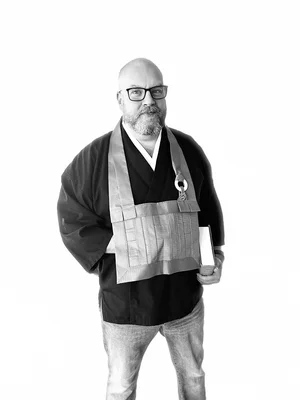
SENSEI MICHAEL BRUNNER COMMENTARY
This section removes any remaining place we might try to stand. It is no longer about how practice looks, or even how it is sustained, but about what is still being held onto as we move through it.
There is a direct confrontation here with how we organize our lives. Even those fully immersed in worldly power lived simply, without excess, without constructing an identity around what they possessed. This is not being held up as an ideal to imitate, but as a mirror. It shows us clearly how much of our life is still structured around accumulation, around securing something for ourselves, around maintaining an image or position.
Ceaseless practice cannot function where something is being protected. The moment something becomes “mine,” the Way is divided. It does not matter whether it is wealth, reputation, relationships, or even the idea of having nothing. The structure is the same. There is something being claimed, something being reinforced, something being carried forward.
This is why visibility becomes such an important point here. The one who is still organizing their life around a self can be found, can be grasped, can be moved by conditions. The one who has let go of this completely cannot be located in that way. There is nothing to seize, nothing to manipulate, nothing to draw out. This is not disappearance in a mystical sense, but the absence of anything that can be hooked into.
So the instruction becomes very precise. Let go of what is being held as “mine.” Not partially, not in stages, and not only in obvious ways. Let go of the subtle forms as well. The identity that forms around letting go. The position of being someone who practices. Even the sense of lacking something must be released.
At the same time, this is not pointing to withdrawal or disengagement. It brings everything back into the immediacy of this life. There is no waiting for a future realization, no reliance on a coming experience that will resolve things. What we call enlightenment is not separate from the activity of this moment as it is being lived.
When this is seen clearly, the path simplifies. There is nothing to accumulate and nothing to protect. There is only the ongoing work of releasing what is being held, again and again, until nothing remains that stands apart from the functioning of the Way.