Gyōji (行持) — Continuous Practice | PART FOUR
“The revered monk Jōshū Shinsai of Kannon-in Monastery was in his sixty-first year before he gave rise to the intention to realize the Truth and therefore began to seek the Way. Carrying his bottle gourd filled with water and his monk’s traveling staff, he set out in search of a Master. He traveled far and wide in all directions, constantly saying to himself, “If even a child of seven has spiritually surpassed me, I shall explore the Matter with him or her accordingly. If even an old man of a hundred has not yet spiritually reached where I am, I shall instruct him accordingly.”
It was with this attitude of mind that he did his utmost for twenty years to study Nansen’s Way. At the age of eighty, he was installed as Abbot of Kannon-in Monastery, east of Jōshū City, and for forty years he spiritually guided ordinary people as well as those in loftier positions. Since he never sent out letters soliciting donations, his Monks’ Hall was not large, lacking both a hall for the temple officers in front and a washstand in back. One time, the leg on his meditation platform broke. He tied a piece of charred firewood to it with some rope and, for years, went on using it for his training and practice. The temple officers wished to replace the leg, but Jōshū would not permit it. We should learn from this venerable Old Buddha’s customary ways of doing things.
Jōshū lived in Jōshū Prefecture from his eightieth year on, after receiving the Transmission of the Dharma. He had received the authentic Transmission of the True Teaching, and people called him the Venerable Old Buddha. Those who had not yet received the authentic Transmission of the True Teaching must surely have been less imposing than Master Jōshū, and those who had not yet reached the age of eighty must surely have been more robust than he was. So how are those of us who are in our prime, yet still spiritually unimpressive, to equal one who is so deeply revered? Simply, by striving to do our utmost in ceaselessly practicing the Way. During those forty years, he did not accumulate worldly goods, and there was no rice or other grain in storage. Sometimes, chestnuts and acorns would be gathered and meted out for food; sometimes, one meal would be stretched out to cover a couple of days. These were truly the customary ways of a dragon elephant in the past, ways of training that we should aspire to.
One day, Jōshū addressed his community, saying, “If you did not depart from the monastery even once in your lifetime and did not speak for five or ten years, no one should call you a mute. And after that, how could even the Buddhas do anything for you?” This points to ceaseless practice.
Keep in mind that even though your not talking for five or ten years might give you the look of being dumb, and even though you might not talk due to your efforts not to depart from the monastery, still, you would not be a mute. The way a Buddha speaks is no different. Those who cannot hear the voice with which a Buddha speaks will fail to understand that someone who is not mute has gone beyond talking. Consequently, the most wondrous practice within ceaseless practice is ‘not departing from the monastery’. The phrase ‘not departing from the monastery’ completely encapsulates the expression ‘letting go of things’. The most foolish of people do not recognize a non-mute person, and do not help others to know ‘such a one’ as a non-mute person. Even though no one prevents them from doing so, they do not help others to know ‘such a person’. Pitiful indeed are those who have not heard that to be a non-mute is to be someone who has realized the state of ‘being just what one is’, or who do not even recognize that there is such a state of ‘being just what one is’. Never abandon the ceaseless practice of not departing from the monastery. Do not be blown east and west by the prevailing winds. Even if you do not pay attention to the spring breezes and the autumn moons for five or ten years, there will be the Way that is free from delusions concerning sounds and forms. How one arrives at that Way is beyond our ability to know and understand. You should explore through your training just how precious each moment of your ceaseless practice is. Do not entertain doubts that the practice of not talking may be something vain and meaningless. Ceaseless practice is the one monastery that we enter, the one monastery that we emerge from, the one monastery that is the path left by flying birds, and the one monastery that is the whole universe.
Mount Daibai is located in Keigen Prefecture. Goshō-ji Monastery was established on this mountain, and Meditation Master Daibai Hōjō was its founder. The Master was a man from Jōyō in Hubei Province.
While training in Baso’s community, Hōjō once asked the Master, “Just what is Buddha?”
Baso replied, “Your very mind is Buddha.”
Hearing this phrase, Hōjō immediately experienced the great realization. As a consequence, he climbed to the summit of Mount Daibai to be apart from human society. Living alone in a hermit’s thatched hut, he survived on pine nuts and wore clothing he made from lotus leaves. On this mountain was a small pond, in which lotuses were plentiful. For more than thirty years he pursued the Way by doing seated meditation. He neither met anyone nor heard about any human affairs whatsoever, and he forgot about the passing years, seeing only the mountains around him turning now green, now yellow. You can imagine how wretched the winds and frosts were.In doing seated meditation, the Master would place an eight-inch high iron pagoda atop his head, as if he were wearing a jeweled crown. By endeavoring to keep this pagoda from dropping off, he kept from falling asleep. This pagoda is still in his monastery today, and it is listed in the inventory of the temple’s storehouse. Until his death, this is how he tirelessly trained in the Way.
He had been passing the months and years in this manner when, one day, a monk from Enkan’s community arrived. The monk had come to the mountain in search of a suitable traveling staff, but he had wandered off the mountain path and fortuitously came upon the Master’s hermitage.
Unexpectedly, he encountered the Master, whereupon he asked him, “Venerable monk, how long have you been living on this mountain?”
The Master replied, “All I have seen is the mountains about me now dyed green, now dyed yellow.”
This monk then asked him, “In what direction should I go to find the path out of the mountains?”
The Master said, “Go by following the stream.”The monk was struck by this response. So, when he returned, he told Enkan what had happened. Enkan said, “Some years ago when I was with Baso in Chiang-hsi Province, I once met a certain monk, but I don’t know what happened to him later. I wonder whether he could be that monk.”
Later, when Enkan sent the monk to invite the Master for a visit, the Master would not leave the mountain. Rather, he composed a poem in reply:
Broken down yet living still, a withered tree aslant amidst the chill forest,
How many times have I met the spring, my heart unswerving?
Woodcutters pass this monk by, without even a backward glance,
So why does the carpenter eagerly desire to seek me out?The upshot was he did not pay Enkan a visit. Afterwards, he decided to move deeper into the recesses of the mountain, whereupon he composed the following poem:
From this pond, the lotus leaves I have taken for wear have known no end,
And from a few trees, the pine cones have supplied for my meals more than enough.
Now people from the world have discovered my dwelling place,
So I shall move my reed abode to enter a seclusion ever more deep.Finally, he moved his hermitage further into the mountains.
One day, Baso had a monk go and expressly ask Hōjō, “Venerable monk, in former times when you went in deepest respect to train under Baso, what was the underlying principle you obtained from him that you then came to dwell on this mountain?”
The Master answered, “Baso turned directly to me and said, ‘Your very mind is Buddha,’ and then I came to dwell upon this mountain.”
The monk then said, “These days his Buddha Dharma is different.”
The Master asked, “In what way is It different?”
The monk replied, “Baso now says, ‘What is not mind is not Buddha.’”
The Master responded, “That old fellow! I swear there is no end to his bewildering people! Even if that ‘What is not mind is not Buddha’ of his is so, well, I’ll stick with ‘Your very mind is Buddha.’”When the monk reported to Baso what Hōjō had said, Baso replied, “The Plum has fully ripened.”
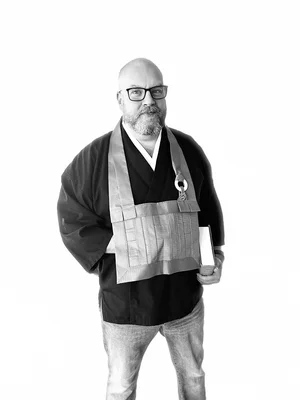
SENSEI MICHAEL BRUNNER COMMENTARY
We are given Jōshū here not as an idea of practice, but as a life that has been entirely given over to it. He does not begin early, does not assume anything about where realization should occur, and does not position himself above or below anyone. At sixty-one, he sets out with a very particular attitude: if someone sees more clearly than he does, he will learn from them, regardless of who they are; if someone does not, he will respond accordingly. This already removes the usual structure we rely on. There is no fixed hierarchy, no reliance on status, no attempt to secure himself in a position. There is only the willingness to meet what is in front of him completely.
What follows is not dramatic. It is not the story of attainment as we usually imagine it. It is twenty years of steady engagement, and then decades more of teaching and living in the same way. Even after receiving transmission, nothing changes in the way we might expect. He does not accumulate, does not build outwardly, does not secure comfort or recognition. The broken meditation platform remains broken. Food is uncertain. Conditions are simple, even austere. And yet nothing is lacking. This is not an aesthetic choice or an idealization of poverty. It is simply what practice looks like when it is not organized around gaining anything.
When he says that someone could remain in the monastery for a lifetime without speaking and not be called mute, he is pointing directly at the way we misunderstand expression. We assume that speech is what proves understanding, that articulation confirms realization. But here, the direction is reversed. The functioning of the Way is not dependent on speech at all. The one who does not speak has not lost anything, and the one who speaks has not necessarily gained anything. The voice of Buddha is not located in words, and those who cannot hear it will continue to search for it in sound.
This is where “not departing from the monastery” becomes critical. It is not about a physical location. It is about not stepping outside of what is already functioning as the Way. The moment we divide experience into what counts and what does not, into what is practice and what is not, we have already departed. To remain is not to confine ourselves, but to stop wandering into abstraction, into preference, into the constant movement of trying to position ourselves somewhere else. Not departing is letting go of that movement entirely.
And then we are shown Daibai. The realization is immediate—“your very mind is Buddha”—and yet what follows is not display, not teaching, not expansion. It is thirty years of sitting, alone, without reference to the world. The mountains change color. Time passes without being counted. Practice does not become something to be shared or demonstrated. It simply continues. Even when invited, he does not descend. There is no need to bring this into relation with recognition or validation.
What ties all of this together is not the form it takes, but the absence of self-positioning within it. Whether in a monastery, in the mountains, speaking or not speaking, teaching or not teaching, nothing is being added to what is already complete. Ceaseless practice is not located in any of these conditions. It is what is functioning through them when nothing extra is being imposed.
So the question comes back again, more sharply now: where do we think practice is not? Because wherever we are still dividing, still setting something aside, still imagining that the Way is happening somewhere else or under different conditions, that is exactly where we are departing from what has never been departed from.