Gyōji (行持) — Continuous Practice | PART THREE
“The Sixth Chinese Ancestor was a woodcutter in the district of Hsinning. He could hardly have been called an intellectual. While just an infant, he lost his father, and he grew up under the care of his aged mother. He worked as a woodcutter in order to support her. Whilst standing at a crossroads one day, he overheard one line of a Scripture being recited, and immediately parted from his mother in order to seek the Great Dharma. He was a great vessel for the Truth, of a caliber rarely met in any generation. His pursuit of the Way was unique among human beings. To cut off one’s arm is easy enough, but to sever himself from someone he loved must have been exceedingly difficult indeed. He would not have abandoned his filial obligations lightly.
He joined in with Daiman Kōnin’s assembly, where he pounded rice day and night, neither sleeping nor resting for eight months. In the middle of one night, he received the direct Transmission of Bodhidharma’s kesa and alms bowl. Even after he had obtained the Dharma, he still carried his stone mortar around with him, and for eight years he continued his rice pounding. Even when he entered the world in order to help ferry people to the Other Shore by giving expression to the Dharma, he did not set aside his stone mortar. This is ceaseless practice that is rare in any generation.
Kōzei Baso did seated meditation for twenty years and received the Intimate Seal from Nangaku. It has never been said that he set aside the practice of seated meditation after the Dharma was Transmitted to him and he began to help rescue others. When people first came to train under him, he always helped them to personally obtain the Mind seal. He was invariably the first to arrive for the monks’ communal work periods. He did not let up even after he became old. Those today who follow Rinzai are in Baso’s lineage.
Our revered Ancestor Ungan and the monk Dōgo were both exploring the Matter under Yakusan. Having made a vow together, they did not put their sides to their mats for forty years, so committed were they to thorough and unadulterated practice. Later, when Ungan personally Transmitted the Dharma to Tōzan Ryōkai, Tōzan remarked, “Desiring to realize Wholeness, I have been doing my utmost for twenty years to put the Way into practice by doing seated meditation.” That Way of his has now been Transmitted far and wide.
During the time while Ungo Dōyō was living in a hermitage on Three Peak Mountain, he was receiving nourishment from the Celestial Kitchen. Once when Ungo was paying a visit to Tōzan, his spiritual doubt was settled through his realization of the Great Matter, after which he returned to his hermitage. When a celestial messenger came looking for Ungo to bring him nourishment once again, the celestial being could not see him, despite searching for three days. Ungo no longer needed to rely on the Celestial Kitchen, for he had made the Great Matter his sustenance. Try to emulate his determination to comprehend the Truth.
From the time when Hyakujō Ekai was serving as an attendant monk to Baso until that evening when he entered nirvana, there was not a single day when he did not endeavor to work for the benefit of the monastic assembly and for the benefit of other people. Meditation Master Hyakujō was already an old monk of long standing when, thank goodness, he said, “A day when I do not work is a day when I do not eat.” He still endeavored to do communal work just the same as those in their prime. The community felt sorry for him, but, though they expressed their pity for him, the Master would not quit. Finally, one day when he came to the communal work, the monks had hidden his tools and would not return them to him, so the Master did not take any food that day. His intention was to express his regret at not being able to participate in the monks’ communal work. This story has become known as Hyakujō’s “One day without work is one day without food.” The traditions found in Rinzai’s lineage, as well as the traditions found in Buddhist monasteries far and wide, are, for the most part, based on the ceaseless practice of Hyakujō’s profound principles.
When the revered monk Kyōsei Dōfu was Abbot in his temple, the deities of the place were never able to see the Master’s face because they had no reliable means by which to do so.
In former times, Meditation Master Gichū of Mount Sanpei received nourishment from the Celestial Kitchen. After he encountered Daiten Hōtsū of Chōshū Province, the celestial beings sought Gichū out, but were unable to find him.
The later revered monk of Mount Daii, Chōkei Daian, would say of his sojourn with Isan on the same mountain, “I stayed with Isan for twenty years. I supped on Isan food. I urinated Isan urine. But I did not explore Isan’s Way. I have merely been able to raise one unsexed water buffalo that, all day long, is completely out in the open.”
Keep in mind that he raised that one unsexed water buffalo by means of his twenty years of ceaseless practice with Isan, who had himself continually explored the Matter within Hyakujō’s community. Without fuss, quietly emulate his actions over those twenty years, and do not at any time forget them. Even though there are many people who explored Isan’s Way, there must have been only a few whose ceaseless practice was their ‘not having explored Isan’s Way’.”
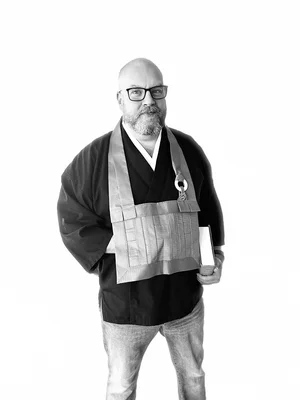
SENSEI MICHAEL BRUNNER COMMENTARY
We are shown here, again and again, what ceaseless practice actually looks like when it is lived. Not as an idea, not as something spoken about, but as a life that does not step outside of the Way at any point.
The Sixth Ancestor is not presented as someone refined, educated, or prepared. He is a woodcutter, supporting his mother, living an ordinary life. And yet, upon hearing a single line, he leaves everything behind to seek the Dharma. Not casually, not as a passing interest, but completely. What is striking is not just that he realizes something, but that nothing about his life becomes separate from practice. He pounds rice day and night, without rest, and even after receiving transmission, he does not set this aside. The mortar stays with him. Practice does not end with realization. It is revealed as what his life already is.
This pattern continues throughout. Baso does not abandon seated meditation after realization. Hyakujō does not retire from work when he is old. Ungan and Dōgo do not relax their effort after years of training. Again and again, what is shown is that realization does not remove the conditions of practice. It removes the separation that would allow us to step away from them.
This is where we tend to misunderstand. We imagine that realization will complete something, that it will allow us to rest, to arrive, to finally stand somewhere stable. But what is being shown here is the opposite. There is no standing apart. There is no moment where practice is finished. What we call realization only deepens the necessity of practice, because it removes the illusion that there was ever somewhere else to go.
And this is why these stories are so grounded. They are not describing extraordinary states or rarefied experiences. They are describing lives. Working, eating, aging, persisting, continuing. The Way is not found apart from these things. It is expressed through them.
Even the accounts of celestial beings losing sight of practitioners point to this. When something is no longer being held as an object, no longer being performed or grasped, it cannot be located in the way we expect. Practice becomes so complete, so integrated, that it disappears as something separate.
Then it turns once more. After twenty years with a teacher, Chōkei says he did not explore the Way. At first this sounds like failure. But what is being revealed is something else entirely. Ceaseless practice is not about accumulating understanding, not about collecting insights, not about being able to say what has been attained. It is about living in such a way that nothing is held onto as something separate.
So the instruction becomes very quiet, but very direct. Do not imitate the outer form. Do not try to replicate the conditions. But do not overlook what is being shown. A life where nothing is set aside. A life where realization is not something possessed, but something that must continuously function.
And this brings it right back to us. Not whether we understand these stories, not whether we admire them, but whether we are still holding parts of our life outside of practice. Whether we are still imagining that there is a point where we will arrive and be finished.
Because what is being shown here leaves no room for that. There is only this life, unfolding, and the question of whether we are living it completely, without holding anything back.