Gyōji (行持) — Continuous Practice | PART TWO
“Our benevolent spiritual father, Great Master Shakyamuni Buddha, had been observing ceaseless practice deep in the mountains from the nineteenth year of His life until His thirtieth year, when there arose the ceaseless practice by which He realized the Way simultaneously with the great earth and its sentient beings. Up through the eightieth year of His life, He was still doing ceaseless practice in the mountains, and in the forests, and in the monasteries. He did not return to His father’s royal palace or assume governance over the prosperity of the nation. For clothing, He kept to the large sanghati robe—the kind that monks still wear—and He did not exchange it for another type of robe for the rest of His life. He did not exchange His alms bowl for another one during His lifetime, and He never stayed alone, not even once in a day. He did not reject so much as a single worthless alms offering from either ordinary folk or those in lofty positions, and He bore with patience the insults of non-Buddhists. In sum, His whole life was ceaseless practice. It can never be said that the Buddha’s examples of washing His robe and accepting alms for His food were not ceaseless practice.
The Eighth Indian Ancestor, the Venerable Makakashō, was the Venerable Shakyamuni’s Dharma heir. Throughout his life he completely devoted himself to the ceaseless practice of the twelve zudas. The twelve zudas are as follows:
(1) Not to accept personal invitations from people, but to go on alms round for one’s food each day. Also, not to accept money with which to purchase even part of a monk’s meal.
(2) To lodge overnight on a mountain and not to stay in the dwelling of ordinary folk, in a highly populated district, or in some town or village.
(3) Not to beg people for clothing. Also, not to accept any clothing that is offered by people, but simply to take the clothing of the dead that has been discarded at gravesides.
(4) To lodge under a tree within some field, whether cultivated or not.
(5) To eat one meal per day. This is sometimes called sunka sunnai.
(6) Not to lie down, day or night, but simply to sleep while sitting up or to do walking meditation when drowsy. This is sometimes called sunnai sashakyō.
(7) To possess only three robes and never to have an extra robe. Also, not to sleep wrapped in a blanket.
(8) To reside in cemeteries and not to take up permanent residence in Buddhist temples or among people. To do seated meditation and seek the Way while looking directly at the skulls and bones of the dead.
(9) To desire merely to live by oneself, without desiring to meet other people or to sleep amidst a group of people.
(10) To eat the raw fruits of trees and plants first, and then to eat one’s cooked food. After having finished eating one’s cooked food, to not then eat the raw fruits of trees and plants.
(11) To be content to sleep out in the open, without seeking shelter under some tree.
(12) Not to eat meat. Also, not to eat processed milk products or apply hemp oil to one’s body.These are the twelve zudas. The Venerable Makakashō did not regress or turn away from these throughout his whole lifetime. Even though the Tathagata’s Treasure House of the Eye of the True Teaching was directly Transmitted to him, he did not step back from practicing these zudas.
The Buddha once said to him, “You are already one who is old in years, so you should eat what the other monks eat.”
The Venerable Makakashō replied, “If I had not met the Tathagata in this lifetime, I would have been a pratyekabuddha. I would have resided all my life in mountains and forests. Fortunately, I encountered the Tathagata in this lifetime and have been blessed with the beneficence of the Dharma. Even so, in the end, I will not eat as the other monks in the community eat.”
The Tathagata praised him for that.On another occasion, because Makakashō had been ceaselessly practicing these zudas, his body had grown emaciated. When the assembly of monks saw him, they belittled him. Thereupon, the Tathagata cordially summoned Makakashō and made room for him on half His seat. The Venerable Makakashō sat down on the Tathagata’s seat. You need to keep in mind that Makakashō was a senior monk of long standing in the Buddha’s assembly. We cannot fully enumerate the ways in which he ceaselessly practiced for his whole life.
The Tenth Indian Ancestor, the Venerable Barishiba, once vowed that for the rest of his life he would not let his ribs touch his mat. Even though he was eighty-six years old, he did his utmost in practicing the Way and was soon given the one-to-one Transmission of the Great Dharma. Because he did not let his days and nights idly slip by, he was given the one-to-one Transmission of the True Eye of Enlightenment after barely three years of effort. The Venerable One had been in his mother’s womb for sixty years, and when he was born, his hair was already white. Because he kept to his vow not to lie down like a corpse, he was called ‘The One of Venerable Ribs’. In the dark, he would release a radiance from his hands by means of which he was able to read the Scriptures and thereby procure the Dharma. This was a strange and wondrous trait that he was born with.
The One of Venerable Ribs was almost eighty years old when he renounced home life and dyed his robes.
A young man who lived in the area asked him, “You foolish, decrepit old man, how can you be so dim-witted? Besides, those who leave home life to become monks have two kinds of undertakings: first, they learn how to meditate; second, they chant the Scriptures. You are now feeble and senile, so there is no way for you to progress by doing either. To put it simply, you will carelessly muddy up the waters and will fill your stomach with alms offerings to no purpose.”The One of Venerable Ribs, upon hearing these rebukes and snide remarks, then thanked the man and made a vow, saying, “I will not let my ribs touch my mat until I have thoroughly mastered the fundamental meaning of the Tripitaka, cut off all craving for anything within the three worlds of desire, form, and beyond form, obtained the six marvelous spiritual abilities, and equipped myself with the eight kinds of detachment from delusion.”
From that time on, there was not even one day that he did not practice walking and seated meditation, as well as practicing mindful meditation while standing still. During the day, he investigated and learned the Scriptures and Their underlying principles; at night, he calmed his discriminatory thinking and cooled down his active mind. Continuing on in this way for three years, he explored and thoroughly mastered the Tripitaka, cut off his craving for the three worlds, and attained the wise discernment which arises from the three forms of clarity. People at that time, out of deep respect, gave him the name of the One of Venerable Ribs.
The One of Venerable Ribs left the womb after having first spent sixty years there. Surely he must have been doing his best even whilst in the womb. After he left the womb, it was almost eighty years before he sought to leave home life and explore the Way. This was a hundred and forty years after he was conceived! Truly, he was an extraordinary person, and even so, he was a decrepit old man who must have been more decrepit and more old than anyone else. He had already attained old age whilst still in the womb, and he was advanced in years since having left the womb. Even so, he paid no heed to the slanderous and snide remarks made by people of his time and single-mindedly kept to his vow, never turning away from it. Who could possibly think it would be an easy task to try to emulate his spiritual wisdom?
Do not regret your reaching old age. It is difficult to know what this thing called life really is. Is a person ‘really living’ or ‘not really living’? Is a person ‘old’ or ‘not old’? The four perspectives are completely different; all the various types of perspectives are different as well. Just concentrate on your intention and make your utmost effort to pursue the Way. In your pursuit of the Way, train as if you were facing a life-and-death situation: it is not simply your pursuit of the Way within life-and-death. People today have become so foolish as to set aside their pursuit of the Way upon reaching the age of fifty or sixty, or upon reaching seventy or eighty. Although we are naturally aware of how long we have lived, this is simply the human mind energetically engaged in discriminating and has nothing to do with studying the Way. Do not concern yourself with being in the prime of life or having reached old age. Just be single-minded in exploring the Way thoroughly and diligently, for then you will stand shoulder-to-shoulder with the One of Venerable Ribs.
Do not always be lamenting the fact that you will end up as a pile of dirt in a graveyard. Do not spend your time worrying about it. If you do not single-mindedly devote yourself to reaching the Other Shore, who will rescue you? When people are aimlessly wandering about in the wilderness like skeletons without a Master, they need to cultivate right perception so that they may fashion an eye for themselves.”
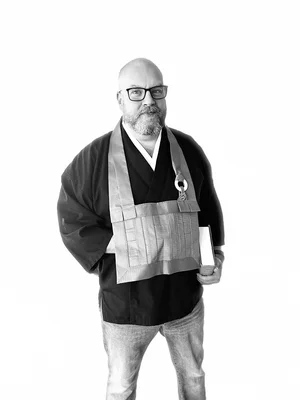
SENSEI MICHAEL BRUNNER COMMENTARY
We move here from principle into embodiment. It is one thing to speak about ceaseless practice. It is another thing to begin at eighty-six.
What is being shown here is not heroism. It is not the story of someone exceptional, someone with unusual capacities or favorable conditions. It is the story of someone who was told, plainly and publicly, that it was too late. That the window had closed. That the effort would be wasted. And who heard that, thanked the person who said it, and continued.
This is where we tend to get stuck. Not because we lack sincerity, but because we are still handing the question of whether to practice over to our circumstances. We are still waiting for conditions to align. Still carrying a quiet belief that there is a right time, a better moment, a version of ourselves that would be more ready. And that belief is exactly what Barishiba walked through without stopping.
The thank-you matters. He does not argue. He does not defend himself. He does not wait to be proved right. He takes the full weight of the dismissal and finds in it, not an obstacle, but a clarification. This is not equanimity as performance. It is what happens when the question of whether conditions are favorable has already been set aside.
So the emphasis shifts. Not "Are my conditions right for practice?" but "What am I still waiting for?" Because whatever we are waiting for, whatever we are using as the reason this moment is not quite the moment, that is exactly where we are holding the Way at a distance.
Three years. Beginning at eighty-six. Not three decades. Not a life of accumulated preparation. Three years of walking, sitting, standing, studying, stilling. The transmission comes not because the conditions were finally right, but because he stopped requiring them to be.
So again, it comes right back to us. Not whether we have enough time, or enough health, or enough clarity. But whether we are still letting those questions decide. Whether this moment, as it is, is being met completely, or whether we are still waiting for a better one to arrive.
Because the better moment is not coming. There is only this one. And Barishiba already showed us what to do with it.