Daigo (大悟) — Great Awakening | PART TWO
“Rinzai Gigen once said, “Were we to search great T’ang China for a single person who was not enlightened, it would be difficult to find that one.” Now what Great Master Rinzai is saying here is the very Skin and Flesh, Bones and Marrow of the genuine lineage, so there is no reason to expect that it is erroneous. What he calls ‘in great T’ang China’ means ‘everywhere his eyes can see’. And it has no connection with ‘the whole universe’, nor is it limited to some tiny bit of land. If we seek in any concrete place for a single person who is not enlightened, it will be difficult to find that one. The self that was one’s self yesterday was not unenlightened, and the self that is another’s self today is not unenlightened. Should you seek among the mountaineers or fisherfolk of past or present, ultimately you will still not find any who are unenlightened. Should you trainees explore Rinzai’s words in this manner, you will not have spent your time in vain.
Even so, you should also explore through your training the intentions of the Ancestors of our Sōtō Zen tradition. In short, just for the moment, I would like to discuss something with Rinzai: If you, Rinzai, know only that an unenlightened person is hard to find and do not know that an enlightened person is also hard to find, this is still not enough to be affirmed, and it is difficult to say that you have thoroughly explored even the matter of an unenlightened person being hard to find. Even though, in seeking for someone who is not enlightened, it is hard to find even one, did you ever encounter a person who was half-enlightened, and whose countenance and genial demeanor were impressive in their openness? Even though, in your seeking for one person in great T’ang China who was unenlightened, you found it difficult to find even one, do not consider this to be the end of the matter. You should have tried looking for two or three great T’ang Chinas within a single person or within half a person. Is such a one difficult to find? Is such a one not difficult to find? When someone is in possession of the chief purpose for which we train, that person can be trusted as a thoroughly enlightened Ancestor of the Buddha.”
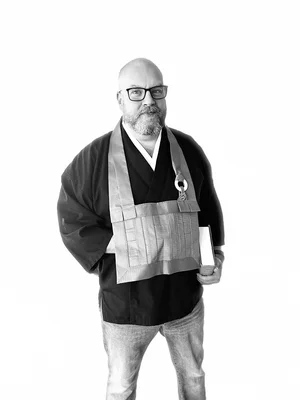
SENSEI MICHAEL BRUNNER COMMENTARY
Rinzai says that if you searched all of great T’ang China, you would have a hard time finding a single person who is not enlightened. Consider this well. When we hear it, we may be tempted to hear it as a statement about others, about a world filled with awakened people. But what is being pointed to here is much more intimate. “Great T’ang China” is everywhere your eyes land. It is this field of experience as it is appearing, right now. So the question is not about other people at all. It is about the way we are seeing, and the way we are dividing what is already present. You must include everything.
When we try to locate someone who is not enlightened, we are already working within an ideological that assumes such a thing can be found. Look again, directly and without relying on that structure, and nothing presents itself as “unenlightened”. Not because everyone has attained something, not because everyone is secretly perfected, but because the division itself does not hold up. The moment we try to fix someone as lacking, we are already standing outside of what is here, imposing a framework that cannot touch it.
This cuts through time as well. The self we imagine we were yesterday cannot be found as “unenlightened,” and the person in front of us right now cannot be fixed as such either. These are ideas we apply in order to stabilize what is fluid, to make what is immediate into something we can evaluate and manage. But what is here does not present itself in those terms unless we impose them.
It would be easy to stop there and say that everything is enlightened, we can just rest in that conclusion. This teaching does not allow for settling. If it is difficult to find someone who is not enlightened, then it is equally difficult to find someone who is enlightened. Now the other side collapses. Because the moment we try to locate “enlightenment” as something real, something possessed, something that can be identified and secured, it disappears in exactly the same way.
What is being removed here are the conceptual divisions we rely on. We want to stand somewhere in relation to enlightenment, either lacking it or having it, moving toward it or holding onto it. But neither position can be sustained when we look closely. There is no place to stand in that way.
We are asked whether we have ever encountered someone who seems partially realized, someone open, steady, compelling in their presence. We know this experience. We compare ourselves, we aspire, we measure. But even this is not it. The moment realization becomes a quality that can be possessed, displayed, or gradually accumulated, it has already been turned into an object within thought.
Then the text pushes beyond even the idea of individuals. It asks whether we can find two or three great T’ang Chinas within a single person, or even within half a person. At this point, the entire way of locating things begins to break down. What is here cannot be contained within one or many, within self or other, within any stable category we try to apply. It does not divide itself in the way we divide it.
So the issue is not whether enlightenment is difficult to find or easy to find. The issue is whether we are still trying to find it at all, as if it were something separate from this immediate life. When the text speaks of someone who possesses the chief purpose of training, it is not pointing to a status or an attainment. It is pointing to a life no longer organized around gaining and losing, no longer structured around preference, no longer measuring itself against an idea of realization.
Nothing has been added. Nothing is missing. What we call actualization is simply the realization that life is functioning completely, without being divided by the frameworks we habitually impose on it. Let it go and join in!