Daigo (大悟) — Great Awakening | PART THREE
“Kegon Kyūjō was a Dharma heir of Tōzan. Kyūjō was his personal name. A monk once asked him, “What is it like when a person who has experienced the great realization returns to being deluded?”
The Master replied, “A broken mirror does not shed its light again: it would be difficult for a fallen blossom to climb back up on the tree.”
This question is indeed the essential question, and it provides an excellent opportunity for giving Teaching to one’s community. Had this question not been raised in the assembly at Kegon Monastery, it would not have been expounded, and had it not been answered by one of Tōzan’s Dharma heirs, the response would not have been so inspired. This must truly be the training monastery of a fully enlightened Ancestor of the Buddha.
As to a person who has experienced the great realization, we cannot say that the great realization has been with that person from the outset, nor has that person, upon experiencing the great realization, stored it up somewhere outside or apart from himself, nor is the great realization something encountered in the human world only by those who are in the last stages of old age. Such a person does not forcibly drag it out of himself, yet, without fail, such a one experiences the great realization. Such a one does not treat merely an absence of delusion as the great realization.
Neither does such a one aim at becoming a deluded person first so that he may then plant and sprout the seeds of the great realization. Moreover, although a person of great realization experiences the great realization, a person of great delusion also experiences the great realization. Just as there are persons of great realization, so there are Buddhas of great realization, and there is earth, water, fire, wind, and space in the great realization, and there are pillars of the temple and stone lanterns in the great realization. We are now raising questions about those who have experienced the great realization. The question about those who have experienced the great realization being capable of reverting to delusion is asking something that truly needs to be asked. And Kegon does not shun the issue, for he cherishes the old ways in monastery life, since they are the meritorious ways of the Buddhas and Ancestors.
Let us focus for the moment on the following questions: When one who has experienced the great enlightenment reverts to delusion, will that person be exactly the same as one who has not experienced the great realization? At the time when one who has experienced the great enlightenment reverts to delusion, does that person take the great realization and make it into something delusory? Does the person revert to delusion by taking some delusion from within someone or someplace else and then use it to cover up his great realization? Also, does the person who has experienced the great realization as a whole person, then destroy his great realization when he reverts to delusion? And also, does what is called ‘the reversion to delusion of a person who has experienced the great realization’ treat the holding onto an instance of great realization as being a reversion to delusion? You need to explore these questions thoroughly, one by one. Further, is it the great realization on the one hand and a reverting to delusion on the other hand? Be that as it may, you need to know that, in your commitment to your spiritual exploration through training, you will learn that a person who has experienced the great realization has reversions to delusion. You need to know that the great realization and reversion to delusion are intimately connected matters.
Accordingly, ‘taking a thief to be our child’ does not describe ‘reverting to delusion’, nor does ‘taking our child to be a thief’ describe ‘reverting to delusion’. The great realization will be ‘taking a thief to be a thief’, whereas reverting to delusion is ‘taking our child to be our child’. ‘Adding a bit too much to what is large’ is the great realization, whereas ‘taking a bit away from what is little’ is what reverting to delusion is. As a consequence, when we search for and try to comprehend a person who has reverted to delusion, we will encounter someone who has experienced the great realization. We need to carefully scrutinize, right now, whether we ourselves are deluded or not, for it is by this that we humbly encounter the Buddhas and Ancestors.
The Master said, “A broken mirror does not shed its light again: it would be difficult for a fallen blossom to climb back up on the tree.”
At that moment, the great realization is like becoming Buddha, and reverting to delusion is akin to being an ordinary human being. Truly, the great realization is boundless, and the reversion to delusion is boundless. There is no delusion that obstructs the great realization.
The great realization of all Buddhas is Their attaining the great realization for the sake of sentient beings: the great realization of sentient beings is their attaining the great realization of all Buddhas. This realization is beyond self and beyond other. It is not something that comes to us from somewhere outside, yet it fills in the ditches and fills up the valleys everywhere. It is not something that departs from us, yet it is incompatible with any pursuit after some ‘other’.”
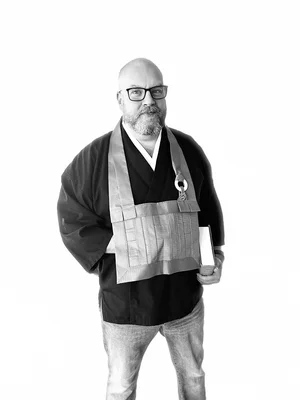
SENSEI MICHAEL BRUNNER’S COMMENTARY
The question that gets raised here cuts right into a subtle assumption we carry. Once there is realization, does it stay? Can it be lost? Can someone “fall back” into delusion? And the image that’s given, a broken mirror that does not reflect again, a fallen blossom that does not return to the branch, seems to point in a very particular direction. It sounds final. It sounds like something has happened that cannot be undone.
But we have to be careful not to turn that into another position we stand in. Not to hear this as saying there is some fixed state called realization that replaces delusion once and for all. Because the moment we hear it that way, we are already back in the same structure we’ve been working within, trying to sort experience into before and after, into having it and losing it.
What is being pointed to here is not a state that is acquired and then preserved. It is not something that is stored, not something that belongs to a person, not something that can be carried forward or lost. It is not even something that stands in opposition to delusion. So when it says that a person of great realization still experiences delusion, this is not a contradiction. It is cutting through the idea that realization removes something from life or places us outside of it.
Delusion and realization are not two separate territories that we move between. They are not two conditions that alternate. They are intimately connected because both are just what this mind is doing, right now. The problem begins the moment we try to isolate one from the other, to claim realization and reject delusion, or to imagine that delusion is something that must be eliminated in order for realization to remain.
So the question is turned back on us: What is this that we are calling delusion? What is it that we are calling realization? Are we taking something whole and dividing it in order to make sense of it? Are we trying to secure ourselves in one side and avoid the other?
When it says that in searching for someone who has reverted to delusion we encounter someone who has experienced the great realization, this is not paradox for its own sake. It is pointing to the fact that we cannot step outside of this life and sort it cleanly into categories that hold. The moment we look directly, what we find does not match the framework we brought to it.
This is also why it speaks of the thief and the child. We are so used to trying to sort our inner lives into what is 'valuable' and what is 'stolen.' We think the 'child' is our true nature and the 'thief' is our ego, and we spend our lives trying to protect one from the other. But the text suggests something more radical. Realization is simply 'taking a thief to be a thief.' It is the clarity that sees the movement of thought, the movement of the 'self,' without needing to dress it up as something holy or dismiss it as something broken. When we stop trying to make the thief into a child, or fearing that our child is actually a thief, the division vanishes. We are no longer guarding a treasure; we are simply awake to the house as it is.
So the work is not to resolve this into a clean answer. It is to examine, right here, whether we are creating a division and then suffering within it. Whether we are trying to locate ourselves as enlightened or unenlightened, as having something or lacking something. And to see how that very movement is what obscures what is already functioning.
Ultimately, we encounter the Buddhas and Ancestors through this examination. Not by arriving somewhere else, not by fixing ourselves, but by seeing clearly what we are doing right now, and no longer adding anything on top of it.