“The Great Way that Buddha after Buddha has Transmitted has continued on without interruption, and the merits of training that Ancestor after Ancestor has revealed have spread far and wide. As a result, having fully manifested the great realization and having attained the Way without necessarily realizing that They have done so, They reflect on what They have realized and take delight in it. Then, emerging from Their realization, They let go of it and act freely, for this is what the everyday life of Buddhas and Ancestors is. They have the twenty-four hours of the day, which They use for whatever needs to be taken up; They have the twenty-four hours of the day, which They use for whatever needs to be laid aside. And They take delight in mudballs, as well as in Their heartfelt and spirited commitment, which this skeleton key has opened. From the time of Their great realization on, Buddhas and Ancestors invariably go to the ultimate in Their spiritual training and exploration, which fully manifests in this manner. At the same time, the full attainment of the great realization is not to be construed as what a Buddha or an Ancestor is, nor is one’s fully being a Buddha or an Ancestor to be construed as attaining the great realization in full. The Buddhas and Ancestors spring forth from the bounds of the great realization, and the great realization is one’s Original Face that springs forth from a place above and beyond ‘Buddha’ and ‘Ancestor’.
At the same time, the inborn abilities of human beings are of many kinds. For instance, there are those who innately know what life really is. Once born, they free themselves from the sufferings and delusions of living. That is, through their own bodily existence they thoroughly master what life really is, beginning, middle, and end. And there are those who realize the Truth through learning. They undertake study and ultimately master themselves. In other words, they thoroughly exhaust the skin and flesh, bones and marrow of learning. And there are those who know what Buddha is. They go beyond those who realize the Truth through living and those who realize the Truth through learning. They transcend the bounds of self and other, are unbounded in the here and now, and are beyond having opinions when it comes to knowing self and other. That is to say, they have a knowledge that has no teacher. They are not dependent on a good spiritual friend, nor on Scriptural writings, nor on the nature of things, nor on external forms; they do not try to open up and turn themselves around, nor do they try to be interdependent with others; rather, they are completely transparent, with nothing hidden. Of these various types, do not conclude that one is smart and another dull. Each type fully manifests the merits from their training.
As a consequence, you would do well to explore through your training whether there are any beings, sentient or non-sentient, who cannot come to know the Truth simply by living their daily life. Any who have come to know the Truth through living life will have come to realize that Truth as the result of their living an everyday life. Once they have awakened to the Truth, they will reveal It in their everyday lives as they do their training and practice throughout their lives. Thus, the Buddhas and Ancestors, who are already Trainers and Tamers of Human Beings, have come to be called ‘Those who have fully realized what life really is’ because They have fully grasped what realization means. It will be your realization of what life is that leads you to partake of the great realization, because it will manifest from your study of Their realization.
Accordingly, They have experienced the great realization by accepting the three worlds of desire, form, and beyond form; They have realized the great realization by accepting all the hundreds of things that sprout up; They have realized the great realization by accepting the four elements; They have realized the great realization by accepting the Buddhas and Ancestors; They have realized the great realization by accepting Their own spiritual question. All of Them, altogether, have accepted the great realization, and experienced the great realization as well. The very moment when realization occurs is ‘the now’.”
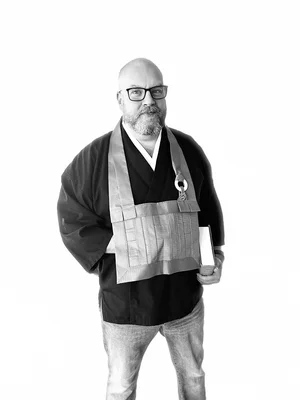
SENSEI MICHAEL BRUNNER’S COMMENTARY
The Great Way that Buddha after Buddha has transmitted has continued on without interruption, not as something preserved in texts or held in institutions, but as something lived, directly, in this infinite-present moment. The realization that is being pointed to here is not something that appears once and is secured. If you see it this way you've divided time and space into countless suffering forms. It is something that expresses itself continuously, through the activity of living itself. When it says that Buddhas and Ancestors have fully manifested realization without necessarily realizing that they have done so, it is pointing to the fact that this is not self-conscious in the sense of the small self. It is not something we step outside of and confirm. There is nowhere to stand outside. It is functioning before that movement begins.
There is a subtle turn here that is easy to miss. They reflect on what they have realized and take delight in it, but then they let go of it and act freely. That means even realization (or perhaps particularly realization) is not something to hold onto. It is not something to build an identity around or something to return to. The moment it becomes something we possess, it has already been reduced. So the life of Buddhas and Ancestors is not defined by holding realization, but by not clinging even to that. It is expressed in how they move through the day, how they take up what needs to be taken up and lay aside what needs to be laid aside, without hesitation and without reference to a fixed self.
This is why it says they take delight in mudballs (kuso-dango). The not so subtle allusion here would be clear to his audience: these mudballs are what one uses to cleanse after defication. There is no separation between what we would call sacred and ordinary. The same realization that is spoken of here is present in the most basic, immediate aspects of life. What is being opened is not a higher realm, but the removal of the division that separates one thing from another. The “skeleton key” is not something added. It is the dropping away of what was obscuring what has always been available.
How we meet this Truth varies. Whether one realizes the Way through the 'skin and marrow' of study, or through the raw grit of daily living, or through a 'knowledge that has no teacher,' the result is the same transparency. One path is not 'smart' and another 'dull.' Awakening doesn't care about your IQ or your library; it only cares about your willingness to be 'completely transparent, with nothing hidden.' Whether you are a scholar or a laborer, the merit of your training manifests fully the moment you stop trying to 'turn yourself around' and simply stand where you are.
At the same time, there is a clear warning. The full attainment of realization is not what a Buddha or Ancestor is, and being a Buddha or Ancestor is not defined by attaining realization. This cuts off the tendency to turn realization into a goal or an identity. Buddhas and Ancestors do not emerge because they have achieved something. They arise from within this realization, and even that cannot be fixed as a position. It says this realization springs forth from a place beyond Buddha and Ancestor. That means even those categories cannot contain it.
So what we are being shown is not something to reach. It is something already functioning, already expressing itself, before we divide it, before we name it, before we try to secure it. The moment we try to make it into something we have or something we are, we have already stepped outside of it. But when nothing is being held onto, not even realization itself, what remains is this life, moving freely, without obstruction.