Gyōji (行持) — Continuous Practice | PART EIGHT
“When the Venerable Monk Nangaku Ejō was training under Daikan Enō, he attended on Enō for fifteen autumns. As a consequence, it was possible for him to be given the Transmission of the Dharma and the Precepts personally, just as if water from one vessel were being poured into another vessel. We should most dearly cherish the everyday behavior of this former Ancestor. The winds and frosts that plagued him during those fifteen autumns must have been many indeed. Even so, he persisted in practicing the Way purely and simply, and he is a paragon for us trainees of the present day. In winter, he slept alone in an empty hall with no coal for his stove. In the cool of summer nights, he would sit alone by his moon-lit window having no candle. Even though he did not know everything and understood only half of what he knew, he had nothing further to learn about non-attachment. This was surely due to his ceaseless practice.
Speaking more generally, once we have discarded our greed for fame and our love of gain, it is simply a matter of striving to do the practice ceaselessly, day after day. Do not disregard this intention. Nangaku’s saying, “When you explain what something is like, you have already missed the bull’s-eye,” reflects eight years of his ceaseless practice. It is this ceaseless practice that people of both past and present treat as rare and that both the clever and the inept earnestly desire.
While Great Master Kyōgen Chikan was cultivating his practice under Isan, he tried several times to give expression to the Way but was unable to do so. Deploring this, he burned his books and became the monk who served gruel and rice to his fellow monks, and so he passed his years, month after month. He later went to Mount Butō in search of old traces of National Teacher Echū. He built a thatched hermit’s hut and, casting everything aside, he lived tranquilly and apart from human society.
One day, when he was sweeping off his walkway, he happened to hit a pebble, which struck a cane of bamboo. Upon hearing the sound it made, he suddenly realized the Way. He then took up residence as Abbot of Kyōgen-ji Temple, where it was his wont never to replace his one alms bowl and his one set of clothes. He dwelt amidst a landscape of strange rock formations and crystal springs, spending the rest of his life in secluded repose. Many traces of his practice still remain at his temple. It is said that it was his custom not to come down from the mountain.
Great Master Rinzai was a Dharma heir of Ōbaku. He was in Ōbaku’s community for three years, during which time he devoted himself purely to pursuing the Way. Upon instruction from the Venerable Bokushū Chin, he asked Ōbaku three times what the Great Intent of the Buddha Dharma is, whereupon he tasted the Master’s staff again and again, for sixty blows. Still, his determination did not flag. When he went to Daigu, under whom he had his Great Realization, it was at the instruction of both venerable monks, Ōbaku and Bokushū. When it comes to the great heroic figures who have inherited the Dharma seat of the First Chinese Ancestor, Rinzai and Tokusan are usually spoken of. Even so, how could Tokusan possibly be considered the equal of Rinzai? Truly, someone like Rinzai is not to be corralled with the herd. Those who have been considered outstanding in recent times cannot even compare with those who were in the herd during Rinzai’s time. It is said that his practices and deeds were pure and single-minded, and that his ceaseless practice was outstanding. Were we to try to imagine how many forms and how many ways his ceaseless practice had, none of us could come close to the mark.
While Rinzai was residing with Ōbaku, he and Ōbaku took to planting pine and cedar trees together. On one occasion, Ōbaku asked him, “What is the use of planting so many trees here, deep in the mountains?”
Rinzai replied, “First, to make something with a tasteful appearance for the benefit of the monastery, and second, to make signposts for the benefit of others coming later.” Thereupon, he took his hoe and struck the ground twice with it.
Ōbaku held up his traveling staff and said, “You are like this now, but you have indeed already tasted thirty blows from my staff.”
Rinzai gave out with a ho-hum sigh.
Ōbaku said, “Our tradition will flourish in the world, with many coming to you.”So on the basis of this, we should realize that even after he had realized the Way, he brought along a hoe in his own hands for planting such things as cedars and pines. It may have been because of this that Ōbaku said, “Our tradition will flourish in the world, with many coming to you.” It must indeed be that the old traces of ‘the trainee who planted pines’ pointed directly to the one-to-one Transmission of Ōbaku and Rinzai. Ōbaku, likewise, planted trees alongside Rinzai. In the past, Ōbaku displayed the ceaseless practice of leaving his assembly behind and going off to mix in with the laborers at the Daian Training Temple where he cleansed the halls. He cleansed the Buddha Hall, as well as the Dharma Hall. He did not expect his ceaseless practice to cleanse his heart and mind and he did not expect his ceaseless practice to cleanse his innate brightness. It was around this time that he met Prime Minister P’ei.
Great Master Seppō Gison was a Dharma heir of Tokusan. During his time in Tokusan’s community, he served as the monk in charge of cooking the rice. One day, when the rice was ready, he went to the Dharma Hall, but Tokusan had not yet arrived. Seppō returned to the kitchen and ate the rice himself. When Tokusan later came to the kitchen and asked what had happened to the rice, Seppō replied, “I ate it.” Tokusan said, “You will surely attain realization.” Later, Seppō did indeed attain realization under Tokusan.
Afterwards, Seppō resided on Mount Seppō, where he continued his ceaseless practice. Even when he became old, he did not cease from doing communal work. He himself would gather firewood and carry water, just like the younger monks. When the monks expressed concern for him, he replied, “A day without work is a day without food.” Thus, he upheld Hyakujō’s spirit of ceaseless practice.
Meditation Master Tokusan Senkan was known for his strict discipline and unwavering commitment to practice. When he first arrived at Ryūtan’s place, he was full of intellectual understanding, but Ryūtan extinguished his lantern, plunging him into darkness. At that moment, Tokusan realized the futility of relying solely on intellectual knowledge and committed himself to ceaseless practice.
After his realization, Tokusan burned his commentaries on the Diamond Sutra, declaring that even profound teachings are like a single hair in the vast sky. From then on, he devoted himself entirely to practice, without clinging to words or concepts.
Great Master Gutei was known for raising one finger whenever he was asked about the Dharma. This simple gesture embodied his ceaseless practice. One day, a young attendant imitated him by raising a finger. When Gutei heard of this, he cut off the boy’s finger. As the boy cried out in pain, Gutei called to him, and when the boy turned, Gutei raised his finger. At that moment, the boy realized the Way.
This story illustrates that ceaseless practice is not limited to formal activities but is present in every action and response.
Great Master Ummon said, “Every day is a good day.” This expression is not merely a statement but a manifestation of ceaseless practice. Each day, each moment, is complete in itself when lived through practice.
Thus, the ceaseless practice of the Buddhas and Ancestors is not confined to a single form or method. It is the continuous unfolding of the Way in every moment. Whether sitting, standing, walking, or lying down, whether speaking or remaining silent, ceaseless practice is always present.
Therefore, do not waste even a single moment. Each day is a precious opportunity to practice. Do not wait for a special time or place. Practice here and now, without interruption.
This is the ceaseless practice of the Buddhas and Ancestors.”
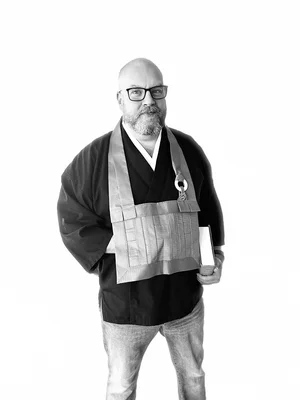
SENSEI MICHAEL BRUNNER COMMENTARY
We are brought here to the living continuity of ceaseless practice, not as a principle, but as something carried, embodied, and transmitted through actual lives. What is being shown is not a single way of practicing, but a consistency that runs through all of them, regardless of form, temperament, or circumstance.
Nangaku Ejō, who trained under Daikan Enō, did not arrive quickly or easily. Fifteen years of attending, of enduring conditions, of continuing without securing anything for himself. What is emphasized is not what he attained, but how he lived. Cold, heat, uncertainty, partial understanding, none of these interrupted practice. That is what is being transmitted. Not completion, but continuity.
Kyōgen presents something different, but it points to the same place. Unable to express the Way, he lets go of the attempt entirely. He burns his texts, gives up the effort to grasp through understanding, and lives simply, quietly, without positioning himself. Then realization occurs, not through accumulation, but through release. What follows is not display or expansion, but a life that remains simple, continuous, without adding anything back in.
Rinzai shows another dimension. Three years of direct, uncompromising training under Ōbaku, receiving blow after blow without turning away. Even after realization, there is no departure from practice. He plants trees. He works. He continues. The Way is not located in the moment of realization, but in the fact that nothing is set aside afterward. Even the act of planting pines becomes the transmission itself, extending forward for those who will come later.
Seppō, cooking rice, eating it when the teacher does not arrive, then continuing on to realization, shows that nothing is outside of practice. Later, even in old age, he continues to carry water and gather firewood. Not as an example, not as something to prove, but because practice has not been divided from life. The statement “a day without work is a day without food” is not a rule. It is a direct expression of ceaseless practice.
Tokusan cuts through reliance on understanding. His realization comes when what he depends on is extinguished. Afterward, he burns his commentaries, not out of rejection, but because they are no longer needed. Practice continues without leaning on explanation.
Gutei’s single finger appears simple, but it is complete. Not a teaching in the conventional sense, but a direct expression that does not vary. Even the harshness of cutting the boy’s finger is not separate from practice. It is not something outside the Way. It reveals how immediate and uncompromising this functioning is.
Ummon’s “every day is a good day” gathers all of this without summarizing it. It does not mean that conditions are always favorable. It means that each day, as it is, is complete when it is lived without division. Nothing needs to be added. Nothing needs to be removed.
What runs through all of these is not a method, not a personality, not a style of practice. It is the absence of interruption. Whether in hardship, simplicity, work, silence, teaching, or not teaching, nothing is being held apart from the Way. There is no moment where practice stops and something else begins.
So the point lands very directly. Ceaseless practice is not something we adopt. It is not something we perfect. It is what is revealed when nothing is excluded, nothing is postponed, and nothing is held back.
And so it comes right here. Not in the lives of these Ancestors, but in this life. This day. This moment. The question is not how they practiced, but whether we are still dividing what has never been divided.