CHAPTER 15
HAPPINESS
15:1. Happy indeed we live, friendly amidst the hostile. Amidst hostile men we dwell free from hatred.
15:2. Happy indeed we live, friendly amidst the afflicted by craving. Amidst afflicted men we dwell free from affliction.
15:3. Happy indeed we live, free from avarice amidst the avaricious. Amidst the avaricious men we dwell free from avarice.
15:4. Happy indeed we live, we who possess nothing. Feeders on joy we shall be, like the Radiant Gods.
15:5. Victory begets enmity; the defeated dwell in pain. Happily the peaceful live, discarding both victory and defeat.
15:6. There is no fire like lust and no crime like hatred. There is no ill like the aggregates of existence and no bliss higher than the peace of Nibbana.
15:7. Hunger is the worst disease, conditioned things the worst suffering. Knowing this as it really is, the wise realize Nibbana, the highest bliss.
15:8. Health is the most precious gain and contentment the greatest wealth. A trustworthy person is the best kinsman, Nibbana the highest bliss.
15:9. Having savored the taste of solitude and peace of Nibbana, pain-free and stainless he becomes, drinking deep the taste of the bliss of the Truth.
15:10. Good is it to see the Noble Ones; to live with them is ever blissful. One will always be happy by not encountering fools.
15:11. Indeed, he who moves in the company of fools grieves for long. Association with fools is ever painful, like partnership with an enemy. But association with the wise is happy, like meeting one’s own kinsmen.
15:12. Therefore, follow the Noble One, who is steadfast, wise, learned, dutiful and devout. One should follow only such a man, who is truly good and discerning, even as the moon follows the path of the stars.
CHAPTER 16
AFFECTION
16:1. Giving himself to things to be shunned and not exerting where exertion is needed, a seeker after pleasures, having given up his true welfare, envies those intent upon theirs.
16:2. Seek no intimacy with the beloved and also not with the unloved, for not to see the beloved and to see the unloved, both are painful.
16:3. Therefore hold nothing dear, for separation from the dear is painful. There are no bonds for those who have nothing beloved or unloved.
16:4. From endearment springs grief, from endearment springs fear. From him who is wholly free from endearment there is no grief; whence then fear?
16:5. From affection springs grief, from affection springs fear. From him who is wholly free from affection there is no grief; whence then fear?
16:6. From attachment springs grief, from attachment springs fear. From him who is wholly free from attachment there is no grief; whence then fear?
16:7. From lust springs grief, from lust springs fear. From him who is wholly free from craving there is no grief; whence then fear?
16:8. From craving springs grief, from craving springs fear. From him who is wholly free from craving there is no grief; whence then fear?
16:9. People hold dear him who embodies virtue and insight, who is principled, has realized the truth, and who himself does what he ought to be doing.
16:10. One who is intent upon the Ineffable, Nibbana, dwells with mind inspired by supramundane wisdom, and is no more bound by sense pleasures—such a man is called “One Bound Upstream.”
16:11. When, after a long absence, a man safely returns from afar, his relatives, friends and well-wishers welcome him home on arrival.
16:12. As kinsmen welcome a dear one on arrival, even so his own good deeds will welcome the doer of good who has gone from this world to the next.
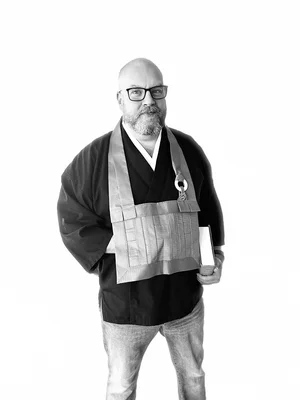
SENSEI MICHAEL COMMENTARY
CHAPTERS XV-XVI | HAPPINESS & AFFECTION
Chapter fifteen begins with a comforting promise: happiness is always available; even in the midst of hostility, craving, and avarice. The text does not say that we become happy once hostile people disappear, once craving has vanished from the world, or once everyone around us becomes generous. It says that happiness is present when we are no longer governed by those movements ourselves. Happiness is not something we manufacture by arranging the world correctly. It is naturally present before the grasping small self begins clinging to conditions and insisting that something must be added, removed, or defeated before we can be at peace.
This is why we can say, “Happy indeed we live, we who possess nothing.”Possessing nothing does not mean that we have emptied our houses, abandoned our relationships, or renounced every object we use. It means that we are no longer grasping at things and ideas as though they can finally secure the self. We can have possessions without being possessed by them. We can have views without building an ideological fortress out of them. When we stop holding so tightly, something remarkable happens: in possessing nothing, we inherit everything. The world is no longer is carved up into mine and yours, and nothing needs to be dragged inside and forced to belong.
Victory begets enmity because victory requires someone to lose. The karmic self loves this arrangement. It wants to be right, to prevail, to establish itself through dialectical annihilation, and then it is surprised when conflict continues! If I require another person’s defeat in order to secure myself, then I have already created the conditions for resentment, retaliation, and further division. The peaceful person discards both victory and defeat, not because nothing matters, but because harmony cannot finally be built on the need to triumph over what we have placed outside ourselves.
Lust, hatred, hunger, conditioned things, contentment, and Nibbana can be heard as variations on one activity: grasping. Hunger in this sense is not merely the body asking for food. It is the persistent feeling that what is here is not enough, that something more must be acquired before we can finally rest. Craving keeps moving the horizon. We get what we wanted, and almost immediately the mind begins constructing the next deficiency. Contentment interrupts that movement. It is the capacity to meet this moment without first requiring it to become something else.
This is why the Dhammapada calls contentment the greatest wealth. Wealth usually means having enough stored away that we no longer need to be afraid, but there is no amount of accumulation that can finally guarantee that. Things change, bodies fail, and circumstances refuse to remain obedient. Contentment is a different kind of wealth because it does not depend on permanence. It emerges when the small self stops demanding that the world provide the security it cannot provide. Then joy no longer has to wait for favorable conditions.
The verses on solitude and the company of the wise are not instructions to withdraw from people we dislike and surround ourselves only with those who confirm us. We have already seen how dangerous that kind of exclusion can become. Solitude is the freedom that appears when we are no longer continually negotiating our identity through the reactions of others. The wise companion helps us because they do not merely reinforce the karmic structures we have already built. They can point out where we are clinging, where certainty has hardened, where we have again mistaken the house for home. This is why companionship in practice matters. A true teacher or spiritual friend does not simply make us comfortable; they help us return to what is living.
Chapter sixteen then moves directly into affection, and these verses can sound troubling if we hear them as a condemnation of love. To be clear: they are not telling us not to love. They are warning us about what happens when love becomes ownership. The moment I take someone I love and quietly make them part of the structure that stabilizes me, fear enters the relationship. If you are mine, then I can lose you. If your presence is necessary for me to remain who I believe myself to be, then every change becomes a threat. Grief and fear spring not from love itself, but from the grasping that attempts to hold love still.
Love as ownership binds. Love as a verb sets everything it comes in contact with free. When I no longer need to possess you, I can finally meet you. I can respond to who you are rather than to the role I have assigned you in the construction of myself. I can care deeply without requiring you to remain unchanged. I can allow you to move, grow, suffer, flourish, leave, return, become something I did not anticipate, and still meet you from intimacy rather than possession. Love becomes activity rather than acquisition.
The repetition in these verses: endearment, affection, attachment, lust, craving, is important because the cycle can be subtle. What begins as simple affection can grow into a demand. We cherish someone, then begin to imagine that our relationship gives us a claim upon them. We cherish an idea, then begin defending it. We cherish a role, then fear losing it. In each case, the problem is not that something matters to us. The problem is that we try to make what matters into something we can hold.
The person described as “One Bound Upstream” is moving against this ordinary karmic current. The stream of craving carries us toward acquisition, possession, defense, and fear. To move upstream is not to wage war against life, but to refuse to be carried automatically by the habits that turn intimacy into grasping. It is another expression of heedfulness: seeing the movement as it begins and declining to let it determine where we must go.
Then the chapter gives us the image of someone returning home after a long absence and being welcomed by relatives and friends. We have encountered this movement before. The karmic self spends its life traveling, searching for something outside the present field that will finally complete it. We look for the right possession, the right identity, the right relationship, the right view, the right spiritual experience. Yet the deepest movement of practice has never been toward somewhere else. It is a return to the True Nature that was present before the search began.
The text says that one’s good deeds welcome one home, and we do not need to imagine a karmic bank account waiting for us somewhere in the future. The life we cultivate becomes the life we inhabit. Every time we loosen our grasp, every time we choose harmony over victory, every time we meet what is here without insisting that it become something else, we are changing the stream itself.
Happiness, then, is not the reward for finally getting what we want. It is what becomes visible when the demand to possess our life begins to fall away. We possess nothing, and because nothing has been placed outside the field of our life, nothing is missing. Love ceases to be something we hold and becomes something we do, and in setting what we love free, we discover that we were never separate from it in the first place.