CHAPTER 13
THE WORLD
13:1. Follow not the vulgar way; live not in heedlessness; hold not false views; linger not long in worldly existence.
13:2. Arise! Do not be heedless! Lead a righteous life. The righteous live happily both in this world and the next.
13:3. Lead a righteous life; lead not a base life. The righteous live happily both in this world and the next.
13:4. One who looks upon the world as a bubble and a mirage, him the King of Death sees not.
13:5. Come! Behold this world, which is like a decorated royal chariot. Here fools flounder, but the wise have no attachment to it.
13:6. He who, having been heedless, is heedless no more, illuminates this world like the moon freed from clouds.
13:7. He who by good deeds covers the evil he has done illuminates this world like the moon freed from clouds.
13:8. Blind is the world; here only a few possess insight. Only a few, like birds escaping from the net, go to realms of bliss.
13:9. Swans fly on the path of the sun; men pass through the air by psychic powers; the wise are led away from the world after vanquishing Mara and his host.
13:10. For a liar who has violated the one law of truthfulness, who holds in scorn the hereafter, there is no evil that he cannot do.
13:11. Truly, misers fare not to heavenly realms; nor, indeed, do fools praise generosity. But the wise man rejoices in giving, and by that alone does he become happy hereafter.
13:12. Better than sole sovereignty over the earth, better than going to heaven, better even than lordship over all the worlds is the supramundane Fruition of Stream-Entry.
CHAPTER 14
THE BUDDHA
14:1. By what track can you trace that trackless Buddha of limitless range, whose victory nothing can undo, whom none of the vanquished defilements can ever pursue?
14:2. By what track can you trace that trackless Buddha of limitless range, in whom exists no longer the entangling and embroiling craving that perpetuates becoming?
14:3. Those wise ones who are devoted to meditation and who delight in the calm of renunciation—such mindful ones, Supreme Buddhas, even the gods hold dear.
14:4. Hard is it to be born a man; hard is the life of mortals. Hard is it to gain the opportunity of hearing the Sublime Truth, and hard to encounter is the arising of the Buddhas.
14:5. To avoid all evil, to cultivate good, and to cleanse one’s mind—this is the teaching of the Buddhas.
14:6. Enduring patience is the highest austerity. “Nibbana is supreme,” say the Buddhas. He is not a true monk who harms another, nor a true renunciate who oppresses others.
14:7. Not despising, not harming, restraint according to the code of monastic discipline, moderation in food, dwelling in solitude, devotion to meditation—this is the teaching of the Buddhas.
14:8–9. There is no satisfying sensual desires, even with the rain of gold
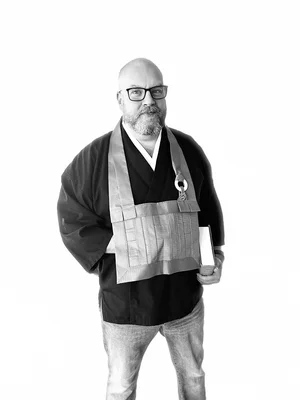
SENSEI MICHAEL BRUNNER COMMENTARY
CHAPTERS XIII-XIV | THE WORLD & THE BUDDHA
Chapter thirteen asks us to examine the world we are actually inhabiting. Much of the time, we are not living in the immediacy of what is here, but in a karmically created reality assembled from judgment, fear, desire, memory, ideology, and certainty. We take what appears and immediately begin making something of it, deciding what it means, where it belongs, whether it threatens us, whether it confirms us, and what must happen next. Before long, we are no longer responding to the living world at all. We are responding to the world we have created and then mistaken for reality.
This is why the Dhammapada compares the world to a bubble and a mirage. A bubble is not nothing. A mirage is not nothing. Both appear, both function, and both can be experienced, but neither possesses the solidity we imagine. The problem comes when we take this conditioned world and make our home there. The decorated royal chariot appears again, beautiful and impressive, but still subject to decay. We can appreciate the chariot, use the chariot, even delight in its beauty without imagining that it can carry a permanent self. The fool flounders because the karmic world has become solid. The wise person sees through it without needing to destroy it.
The movement of practice is what I sometimes call shifting your gaze. We shift our gaze away from the karmically constructed reality we have been defending and toward the Dharmakaya, the Dharma-body, the living reality that has been present the entire time. Nothing new has to be manufactured. We do not need to create enlightenment and install it where delusion used to be. The text gives us the image of the moon emerging from behind the clouds. The moon was not created when the clouds moved. It was already shining. In the same way, heedfulness does not manufacture some new sacred world. It allows us to see what our karmic constructions have obscured.
This makes the verses about the person who was heedless and becomes heedful especially important. The Dhammapada does not condemn the person who has been lost. It says that when heedlessness ends, that person illuminates the world like the moon freed from clouds. We are not trapped by what we have done or by what we have believed ourselves to be. The karmic stream has tremendous momentum, but it is not destiny. The moment we shift our gaze, the whole field changes because we are no longer feeding the same construction. Good deeds can cover what has been evil, not because the universe is keeping some ledger and we have finally balanced the account, but because each act changes the direction of the stream.
The chapter then tells us that the world is blind and only a few possess insight. We should be careful not to hear this as spiritual superiority. The moment we imagine ourselves among the few enlightened people looking down upon the blind world, we have built another karmic world and moved into it. Blindness is the inability to recognize our own construction as construction. Insight begins when we recognize how easily our judgments become reality, how quickly our certainty becomes a prison, and how readily we turn our own manufactured knowledge into a surrogate for living wisdom.
This is where the image of the bird escaping the net returns. Earlier we saw the swan leaving one lake after another and the bird crossing the sky without leaving a track. Here again, freedom has something to do with becoming untraceable to the structures that once confined us. The wise are led away from the world after vanquishing Mara, but Mara is not defeated by traveling somewhere else. Mara loses our trail when craving, aversion, and conjecture no longer determine where we must live. The karmic self keeps looking for another place to establish itself, another identity, another certainty, another view from which it can say, this is me and that is the world. When there is no fixed abode, there is nothing for Mara to follow.
Chapter fourteen takes this image further and asks, “By what track can you trace that trackless Buddha of limitless range?” The Buddha cannot be traced through the ordinary coordinates of karmic identity because there is no longer a fixed self being defended from moment to moment. This does not make the Buddha vague or absent. It makes the Buddha completely available to circumstances. Without needing to preserve a particular identity, wisdom can respond freely. The Buddha is trackless because no fixed construction can finally contain awakened activity.
The Dhammapada then gives us one of the clearest summaries of Buddhist practice: “To avoid all evil, to cultivate good, and to cleanse one’s mind, this is the teaching of the Buddhas.” Here we encounter the movement that comes to us in Zen as the Three Pure Precepts, which we teach in transformed form as our Three Transformative Touchstones: Maintain Wonder, Include Everything, and Allow Compassion to Arise. To avoid evil is to Maintain Wonder, refusing to substitute the karmically created reality of our judgments and certainties for the living truth before us. To cultivate good is to Include Everything, meeting the whole of what is present rather than dividing the world according to what serves or threatens the small self. As that division softens, the mind is cleansed not because we have somehow made reality pure, but because we have stopped obscuring its purity through grasping, rejection, and separation, allowing compassion to arise naturally from the intimacy of what is here. These are not three separate moral commands imposed from outside. They describe a single movement of practice, the shifting of our gaze from karmic construction toward the Dharmakaya and the compassionate activity that naturally flows from seeing clearly.
The verses on craving make the same point from another direction. Even a rain of gold coins cannot satisfy sensual desire because craving is not finally asking for an object. It is asking the world to stabilize the self. We imagine that one more possession, one more experience, one more recognition, one more certainty will finally make the house secure. But the house itself is the problem. Craving keeps rebuilding it. When the Dhammapada says that the disciple delights in the destruction of craving, this does not mean becoming incapable of joy. It means discovering a joy that no longer depends upon the world continuously confirming the karmic self.
Then the chapter turns toward refuge. Driven by fear, people seek refuge in hills, woods, groves, trees, and shrines. We do the same thing in countless forms. We seek safety in money, relationships, status, ideology, institutions, teachers, religious identities, and even our own understanding of the Dharma. None of these are necessarily wrong. The problem is asking them to become an ultimate refuge, something that will finally protect the constructed self from impermanence.
To take refuge in Buddha, Dharma, and Sangha cannot simply mean replacing one external certainty with another. Buddha, Dharma, and Sangha point us toward the living reality in which suffering can be seen clearly and the activity that creates suffering can cease. The Buddha points to awakening, the Dharma points to the truth of what is here, and the Sangha gives us the living field in which practice is supported, challenged, transmitted, and embodied. These refuges matter precisely because they do not ask us to hide from life. They continually return us to it.
This is why the Four Noble Truths appear here. Suffering must be experienced, not theorized about from a distance. Its arising must be recognized in the very activity of grasping, rejecting, dividing, and constructing. Its cessation becomes possible when we stop feeding that activity, and the path is the continuous cultivation of a life capable of doing so. Refuge is not escape from suffering into a protected religious world. Refuge is entering so completely into reality that suffering can no longer hide behind the structures we have built around it.
The chapter closes by praising the arising of Buddhas, the teaching of Dharma, harmony in the Sangha, and reverence for those who have passed beyond sorrow. There is a danger here if we turn reverence into worship of something outside ourselves, but there is also a danger in imagining that we need no one. Teachers matter. Sangha matters. Lineage matters. Dharma has always moved through relationship. Someone points. Someone receives. Someone verifies. Someone carries the gift onward. But every true teacher ultimately points beyond themselves, away from another karmic refuge and toward the living truth that is already present.
The world of karmic construction is compelling because we built it ourselves! We know every room. We know where the walls are, and we know what keeps the roof standing. Practice asks us to shift our gaze. When we stop staring at the house and turn toward the Dharmakaya, the world is no longer something we must conquer, possess, understand, or escape. It becomes the very field in which Buddha activity is already unfolding.