THROW IT AWAY — GEN’YŌ’S ONE THING (SHŌYŌROKU CASE 57)
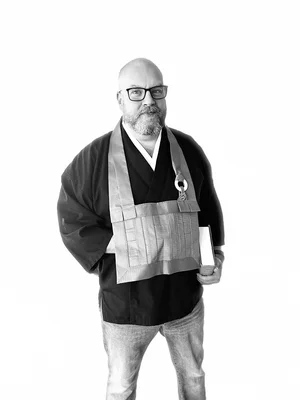
A teisho given by Sensei Michael Brunner, Abbot of One River Zen in Ottawa, IL on January 18, 2026
When I teach the precepts, I have to regularly remind students that the precepts are formless—that they’re not some new mental construct we use to judge the relevance of our lived experience, but something we use to step into our lived experience in a way that is skilled. But of course, they’re always implicit in the moment.
If you take the precept, for instance: Don’t discuss the faults of others.
Tough precept. It’s actually reflective and reflexive. We feel compelled, somehow, on some occasions, to correct others in an effort to extricate ourselves from association with their perceived errors.
But in doing that, we actually wind up having their perceived errors cling to us even harder. If you look at it closely—what kind of person calls another human being defiled? Or, to put it more plainly, what kind of person calls another person a jerk? All of a sudden, it crops right in. You see how futile it is to do that.
And yet, we keep thinking that if we’re able to label it even more plainly—one last time—make that one last fine distinction, then finally everything will come into sharp relief conceptually and we will have solved the problem. We can somehow escape it through the very trapdoor that got us into the conundrum in the first place.
So we keep proceeding over and over again along the same lines, in this continuous loop.
There’s a case in the Shōyōroku. It’s the fifty-seventh case. And the preface to the assembly points directly to this conundrum we’re talking about.
It says:
Fiddling with shadows, toiling with forms.
It’s not understood that forms are the basis for shadows.
Raising the voice to quiet an echo,
It’s not known that the voice is the root of the echo.
You don’t ride an ox to look for an ox. This is using a wedge to remove a wedge.
How can you avoid this error? How, indeed?
If the root is perceived conceptual division, then how will more division ever get to the truth? Why is it so hard to let go? Why is it so hard? Why do we have to keep saying, Well no, no—if I just turn this Rubik’s Cube one more time, it’ll all come into sharp focus, and then I can put it down.
So we keep turning it over and over again. And the colors keep getting more and more scrambled.
How do we drop all of that and just embody wisdom?
Shōyōroku, Case 57 — Gen’yō’s One Thing
That brings us to the case:
Attention—the monk Gen’yō asked Jōshū, “When there’s not one thing, what then?”
Jōshū replied, “Throw it away.”
Gen’yō said, “With not one thing, what is there to throw away?”
Jōshū remarked, “Then carry it off.”
So Gen’yō asks, When there’s not one thing, what then? He’s sitting here with some kind of precision, trying to envision some point where he’ll finally get down to the conceptual root, the absolute basis—where he’ll be able to cut through it and there will be nothing left.
But it’s just an idea of nothing being left.
When there’s no object to point to, no clear fault to name, no self to name it, no error, in essence, to put to right—what then?
Jōshū looks at him and says, Throw it away.
Throw it away.
Gen’yō doesn’t—because he can’t. Or maybe it’s more accurate to say he won’t. He just can’t let it go, this line of interrogation, this way of trying to put things together and make them make sense.
He’s riding an ox to try to find an ox.
So he says, With not one thing, what is there to throw away?
He can’t escape this. He’s raising the voice to quiet the echo. He’s already turned not one thing into something—something to hold, something to stand on, something to understand. Some absolute basis, not of reality, but of the idea of reality.
He’s making mental sandcastles and wondering why he can’t open the door and go live in them.
And because he refuses to let that go, Jōshū points to the only thing that’s possible in that situation.
If you won’t let go, then you have no option but to take it with you.
Carry your understanding. Carry your idea of emptiness. Carry your not one thing.
You see what happens.
In a way, that’s exactly how discussing the faults of others works.
We say we’re clarifying. We say we’re correcting. We say we’re naming what’s wrong. But what we’re really doing is trying to put distance between ourselves and what we fear being associated with.
When that doesn’t work, we try again. We refine the language. We make the label sharper, more accurate, more justified—one last time—hoping it will release us.
But the root is still a conceptual idea of separateness.
The root is still division.
Jōshū says the only way to win that game is not to play it. Let it go.
And when you do let it go, you don’t have to explain emptiness. You don’t have to explain interdependence. You don’t even have to explain enlightenment.
It manifests right there before you.
The hope is that the strategy will eventually exhaust itself by you throwing yourself wholeheartedly into it. But if you’re going to do that, then do it. Do it until you yourself die trying.
Just make that happen sooner rather than later.
Because there’s a world that needs you to engage. There’s a world that needs us to get out of our ivory towers, out of our mind games, and into the very real work that needs to be done.
There’s an appreciatory verse for every case in the Shōyōroku.
It says:
Be inattentive to careful moves and you lose to the opponent.
Learn for yourself—it’s a shame to be surrounded due to carelessness.
The game ended; an axe handle at the waist has rotted.
Washing clean a bumpkin, sporting with hermits.
This verse refers to an old story of a woodcutter who happened upon two immortals playing a game of go. He was so captivated by the game—so focused on the correctness of the moves and the skill of the play—that he didn’t notice time itself passing.
When the game finally ended and he reached for his axe to return to work, he found the wooden handle had rotted away to dust.
That’s the cost of our obsession with conceptual correctness. With ideation.
It doesn’t always look like rumination over the self, past harms, past hurts—though often it does. Sometimes it looks like a very engaging conversation about Dōgen. Sometimes it takes the form of sitting and giving a teishō about a kōan.
Sometimes it’s just time to put it down.
That axe handle is organic. It’s not getting any stronger by our indecision. We spend our lives watching the game—who’s right, who’s wrong—labeling saints and sinners, thinking we’re making progress.
But while we’re refining our judgments and playing go in our minds, the very tool we were given to work with—this life—is being squandered.
It turns to dust.
We lose our lives to the careful move of our judgments, our labels, our ideas—even our idea of enlightenment.
And then we’re washed clean—not by purity, not by correctness—but by exhaustion.
The bumpkin just sits there, sporting with hermits.
Nothing left to throw away.
Nothing left to carry.
And when you see that, the very thing that requires your attention is right in front of you.