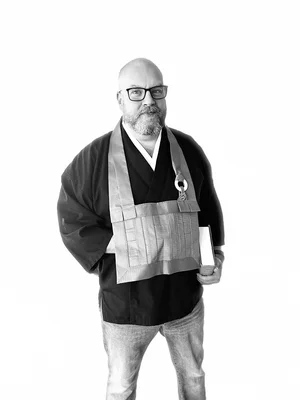
A Dharma Talk on the Dhammapada (Verses 1–5)
Happy New Year to you all.
I’m incredibly honored to be here today to give this talk to the Sangha. We had a wonderful service this morning and a wonderful sit together, and it’s always a powerful opportunity to practice together — whether online or in person.
I want to quickly thank Sensei for allowing me to do this. I’m especially thankful that he took it easy on me and only gave me the Dhammapada as a topic — just a seminal Buddhist text, one of the original teachings of the Buddha himself.
And even then, Sensei said, “Let’s just do Chapter One, verses one through five.”
Phew. Slam dunk. I can truly handle that. <laughs>
These verses cover the importance of the mind, using the mind to defend against suffering, cause and effect, and how to overcome hatred. Basically, they are full in themselves and not lacking in guidance.
The verses come in pairs — one and two, three and four — and are capped with verse five. Poetically and efficiently, they present huge truths in a very digestible way.
Stepping back for a moment, speaking broadly of the Dhammapada, the translator of the version I’m using today, Eknath Easwaran, says:
“If everything else were lost, we would need nothing more than the Dhammapada to follow the way of the Buddha.”
He goes on to add:
“These verses can be read and appreciated simply as wise philosophy. As such, they are part of the great literature of the world. But for those who would follow it to the end, the Dhammapada is a sure guide to nothing less than the highest goal life can offer — self-realization.”
For today, the wisdom of the 123 words of verses one through five will be our collective map on this journey toward self-realization.
As a quick aside — this was probably the second book I bought at the beginning of my practice. My beginner’s mind was frankly blown away and overwhelmed, but overwhelmingly intrigued. I highlighted all over it and read it again and again.
If you notice the section I’m doing today, I highlighted it a year and a half or more ago — so I clearly found something important in it even then.
I’ll go ahead and read the verses now. You’ll notice the repetition and the form they take.
Verse One:
“Our life is shaped by our mind.
We become what we think.
Suffering follows an evil thought
as the wheels of a cart follow the ox in the dry.”Verse Two:
“Our life is shaped by our mind.
We become what we think.
Joy follows a pure thought
like a shadow that never leaves.”Verse Three:
“He was angry with me.
He attacked me.
He defeated me.
He robbed me.
Those who dwell on such thoughts
will never be free from hatred.”Verse Four:
“He was angry with me.
He attacked me.
He defeated me.
He robbed me.
Those who do not dwell on such thoughts
will surely become free from hatred.”Verse Five:
“For hatred can never be put an end to by hatred.
Love alone can.
This is an unalterable law.”
As I mentioned before, these five verses alone cover topics that could each deserve their own series of talks. So today I’d like to be more refined and focus specifically on the first two verses — on the mind.
It’s incredible, the interplay between simplicity and complexity within the mind. I suppose it’s the perfect Zen paradox.
Take beginner’s mind, for instance.
That seems simple enough: approach life without concepts of familiarity. Drop off categories and preconceptions. Be fully present with your intentions.
This presence is empty and able to accept all things fully.
Okay — I got it.
But why is this so challenging?
The difficulty is that setting intentions and staying present are straightforward conceptually, but relentlessly challenged by infinite outside influences. Our once pure intentions quickly get hijacked by delusive thoughts. We cling to what we wish life was instead of what life is.
So we return to the text — as a guide, as a compass.
When we lose sight of where we are, we come back to the map.
Another text we studied back in 2025, Shinjinmei, begins with something like:
“The Great Way is not difficult — just avoid picking and choosing.”
Or, simply: avoid preferences.
This line works directly alongside the opening verses of the Dhammapada.
Zen is great for this. If one text doesn’t land for you, another often points to the same truth in a way that’s more digestible.
Our mind’s ability — or inability — to avoid living as a series of preferences directly correlates to self-realization.
When we stew in the gap between our preferences and reality, presence vanishes. We lament the differences instead of opening to them.
So we return to the breath.
Return to the present moment as it manifests — right now.
What can be so difficult about:
“Our life is shaped by our mind. We become what we think.”
Is the sheer number of potholes that try to separate us from Buddha-nature — from wonder.
There may be seventy-five moments on your commute alone that disturb the mind.
That guy who cut you off thirteen blocks ago is still in your head.
You know what the text says — but what you’re thinking is something far less enlightened.
And then there’s social media.
Even the most skilled practitioners must direct attention to intention and practice wise speech and compassion.
Hot takes and bold opinions decorate our screens, creating endless obstacles to inner peace.
Imagine how difficult this is for someone with little training.
Even in zazen — in posture, balanced, breathing upright like a tree — mind weeds pop up, as Shunryu Suzuki says.
Pain becomes louder.
The room feels too warm.
Should I listen to metal or jazz on the way home? (Not autobiographical at all.)
Even zazen isn’t free from interference.
And yet — the direction is simple and clear:
“Our life is shaped by our mind. We become what we think.”
Suffering follows negative thought.
Joy follows pure thought.
As we go through our days, we return — again and again — to breath and intention.
We wipe away excess noise and meet each moment fully.
Look at the moon — not the finger pointing at it.
If you can carry the simplicity of these verses into daily life and apply them directly, there’s no doubt you’ll deepen your practice.
But practicing the simple doesn’t mean it’s easy.
It takes ardor and diligence to navigate mind weeds.
This morning on my drive here — nearly an hour to think — my mind wandered:
“I’ve never given a talk here before.”
“What if it’s a train wreck?”
“Will I do this responsibility justice?”
It would have been easier to push it off.
Sound familiar?
I needed only to return to the subject of this talk — to the mind — to regain focus and sit before you now.
It truly is incredible: the interplay between simplicity and complexity.
Stay here.
Stay present.
Observe the mind weeds.
Return to breath.
Return to intention.
There’s a reason we call it practice.
It’s a new year — so please set your personal intentions.
And lastly, I firmly believe that the answers to the intense division and lack of compassion in our world can be found in these five verses.
The path is laid out clearly.
But it still requires dedication.
Anzan is a student of Sensei Michael Brunner, Abbot and founding teacher of One River Zen, a Sōtō Zen Buddhist temple and community center dedicated to meditation practice, study, and compassionate action.