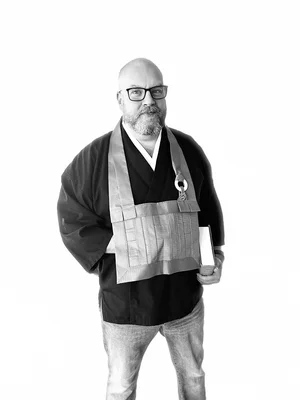
Transcript of the third lecture in a four-part series on the Dhammapada delivered by Sensei Michael Brunner at One River Zen in Ottawa, IL
I want to begin with something I think happens to all of us. Actually, it probably happens to us several times a day. Most of the time, we don’t even know it’s happening to us. Something occurs. Someone says something to us. We get an email. Maybe somebody doesn’t show up and do what we expected them to do. Something changes in our body, changes in our work, in one of our relationships. And almost instantly, we make something out of it. We decide what it means. We decide whether it’s good or bad. We decide what it says about us. Then, having constructed that reality, we begin responding to what we constructed rather than what’s present, or what’s occurred.
And this can be extraordinarily subtle because from inside the construction, it doesn’t feel constructed. It just feels true. Someone doesn’t answer our message within a few minutes. We know why. They’re upset with us. They don’t respect us. Something’s changed. We know all of this despite the remarkable fact that the only thing that has actually happened is that somebody hasn’t answered a message yet. And now we’re living in a completely separate universe, a totally different world. And once we move into that world, we start acting from it. Maybe we send another message. Maybe we become more defensive. Maybe we withdraw. Maybe we spend the next hour carrying on a conversation in our head with a person who’s not even there.
This is the movement we’ve been closely examining throughout the Dhammapada. In the beginning, there’s mind. Mind encounters experience and begins constructing something from it. That construction is not necessarily a problem. We have to construct. We need names. We need distinctions and ideas in order to function in ordinary life. The problem begins when we forget that we’ve constructed it. We mistake the house for reality and allow the house to determine how we live.
The portion of the Dhammapada we work with this week, chapters nine through seventeen, takes that problem and pushes it out into the world of action. The question is no longer simply, how does the mind construct experience? The question becomes, what happens when we live from that construction? This is where our Zen practice, or Buddhist practice, becomes profoundly ethical. I’m not talking about ethical because somebody handed us a list of rules and said that good Buddhists behave this way. Something much more intimate is happening. If the world I experience is being shaped by how I meet it, then how I participate matters enormously. My judgment matters. My speech matters. My actions matter because they don’t simply express the world I inhabit. They actually help create it.
So chapter nine begins with good and evil. I think we have to be careful with those words because we inherit a lot of baggage around them. We hear good and evil, the mind starts creating categories of good people and bad people. Maybe we imagine some great cosmic ledger where all the behavior gets recorded and eventually someone tallies up the score. Listen to the opening movement: “Hasten to do good. Restrain your mind from evil. He who is slow in doing good, his mind delights in evil.”
Don’t we hear this much, much more immediately? What if we get very intimate with this? To do evil is to take the karmic reality we’ve constructed and use it as a surrogate for the living truth that’s right before us. We stop meeting what’s here and begin acting instead from our judgments about it. We know who the enemy is. We know what they deserve. We know what must happen next. The world has been neatly divided, and now we simply begin acting out the consequences of that division.
Good operates differently. Good can only happen now because intimacy can only happen now. To do good is to enter fully into what’s here before our judgments have become more important than the life they’re judging. It is to allow wonder enough room that something besides our habitual karmic response becomes possible. It comes to life.
This is why the Dhammapada gives us a wonderful image of the water pot filling drop by drop. We like dramatic transformations. We like stories where somebody has one enormous awakening experience and everything changes. Most of our karmic life is not built that way. It accumulates, drop by drop. Every time I rehearse the resentment, the groove becomes a little deeper. Every time I preserve my injury, the story becomes a little more convincing. Every time I divide the world into me over here and the problem over there, I make that separation a little easier to inhabit the next time.
But the Dhammapada works in the other direction too. Every time I choose wonder over certainty, every time I include what I’d rather exclude, every time I allow compassion to determine the next movement, I change the stream. And every act touches the entire universe. It sounds very enormous and profound until we release it a little and recognize just how ordinary it is. Think about one angry sentence, one spoken in a household. One sentence can change the quality of an evening, a week. One sentence can change how somebody sleeps. How they sleep changes how they meet another person tomorrow. And on it goes. We have absolutely no idea where the final edge of one action lies. And the reason we have no idea is because there isn’t one. And that’s karma. It’s not punishment. It’s not a reward. It’s activity continuing.
Chapter ten then pivots from this picture and takes us directly into violence. And it begins, “All tremble at violence. All fear death. Putting oneself in the place of another, one should not kill or cause another to kill.” I guess at first blush you could look at this and think maybe it’s a teaching on empathy. I don’t think that penetrates the matter completely. It doesn’t go far enough. When we recognize our true nature, we begin to see ourselves reflected everywhere because there’s nothing outside.
In order to do violence in the first place, I have to create enough separation that another person’s suffering can become their problem rather than something arising within the field of my own lived experience. That’s the necessary first step. I have to make you sufficiently other. Once I’ve done that, all sorts of things become possible. I can humiliate you for your own good. I can hurt you because you deserve it. I can dismiss your suffering because your understanding is wrong. And every one of those moves depends on the same original construction: you over there, me over here.
We talked in this section extensively in the commentary about the Buddhist teaching of the two arrows. The first arrow is what life gives us. I think the Buddha’s phrase is, “when misfortune befalls.” Somebody harms us. We become sick. We lose something important. And with that, there’s pain. And then the second arrow strikes. Why did this happen to me? They shouldn’t have done that. This is unfair. I’ll never forgive them. Sometimes that second arrow is allowed to stick and fester for days, weeks, decades. The first arrow may not have been ours to choose, but the second one for sure is.
That’s why the Dhammapada gives us the image of the broken gong. Someone who no longer responds with vindictiveness is like a gong that’s been broken and no longer reverberates. We’re not suggesting that we live a life of quiet passivity. It doesn’t mean that we allow harm to continue. It means that we stop manufacturing the conflict after the event itself has already passed. We just refuse to keep ringing.
Around that time, we arrive at chapter eleven. The Dhammapada is now confronting us with another inconvenient truth. The body is impermanent, and we don’t want it to be. Intellectually, I think we all grasp this. We’ve touched it. Everybody in the room knows that bodies age and die. Yet an enormous portion of human life, and an enormous portion of our own human life, is spent trying to establish something permanent out of what is inevitably going to decay. We take great pains to identify with youth, to identify with health, and to identify as a personality. And then we’re surprised. We’re surprised and disappointed when things change.
This is pretty harsh medicine. The body is described as a painted image, a city built of bone, flesh, and blood. It tells us even the gorgeous royal chariot, the most precious vehicle of all, wears out. And it’s not that the teaching has a problem with the body. That’s not the point at all. The problem is not the body. The problem is the grasping. The problem is the striving. There are a few things to accept. The body is wondrous precisely as this impermanent activity. It breathes. It loves. It experiences pain. It appears for a while, blooms, and fades. The problem is asking it to provide something it can’t provide: a permanent foundation for an unchanging self.
Our true nature is ever-living and always present. The body, not so much so. Our true nature requires us to be actualized by what’s present, to step into the circumstances of life and to be the medicine, to be the compassion that’s required. That’s something to build on.
It brings us to one of the most extraordinary passages in the entire Dhammapada: “Through many a birth in samsara have I wandered in vain, seeking the builder of this house. Repeated birth is indeed suffering.” And then it goes on: “O house-builder, you are seen. You will not build this house again.”
Traditionally, I think the orthodox interpretation of this house-builder is craving. And I think that’s pretty much dead on the mark, provided we understand what craving is actually doing. Craving is continuously constructing an abode for the karmic self. We build with desire, with judgment, with clinging to a sense of identity. Something happens, and we immediately begin putting up walls to protect who I am, what I need, how things must be. And the house-builder does his finest work when we can’t see him working. We simply wake up inside the house and assume we found reality.
This is why, “O house-builder, you are seen,” is such an important teaching. Once you can actually see the construction happening, it can never exercise quite the same authority. You can still construct a self. In fact, you have to construct a self. I wouldn’t recommend the next time you get pulled over and they ask for your license and registration, telling them, “Well, technically, I have no permanent abiding self.” I don’t think things will go well, right?
We have to have a self to make our way in the world, but we also have to recognize where that self came into being. Handle it with that same measure of, how do you say it, lightness or joviality that went into constructing it.
This becomes particularly important as it returns to chapter twelve because sometimes the Buddhist teachings about self get flattened into some strange notion that we are somehow supposed to eliminate personality. Good luck with that. You will still have a name tomorrow. You will still have preferences. You will still have responsibilities. You will still be happy or cranky. The karmic self doesn’t evaporate because you have recognized it as constructed. The mistake is not having one at all. The mistake is confusing it with what we truly are.
We can use this constructed self skillfully. This constructed self can answer the phone, can present itself as a Zen teacher and teach students. It can mess up and make its apologies. It can become a vehicle through which wisdom responds to circumstances rather than a house in which we barricade ourselves.
And that’s why chapter twelve can tell us to watch ourselves, establish ourselves, and protect ourselves. No one else can do this practice for us. If you don’t practice, in a very real way, no one does. A teacher can point. There can be a sangha that supports you. The text can even offer the opening to a Dharma gate, but nobody can inhabit this moment in your place. Nobody can step into it.
At the same time, we have to be very careful because this can become another story of isolated selves managing their own private enlightenment. That isn’t it either. If I see someone who’s deluded, that delusion is not outside my field of life, outside of my lived experience. If something appears, it’s here. If conflict appears, it’s here. There’s no over there to put it. Amputation is not an option. Yeah, it’s full contact. I can’t simply cut away everything I’ve decided is troublesome and call the remainder enlightenment. That’s not what this is. It’s not a practice of subtraction. So the question becomes, how do I engage with what is here skillfully enough so that harmony can arise?
And the text gently guides us along to chapter thirteen, “The World,” which asks us to look at the world we’re actually inhabiting. The Dhammapada calls this world a bubble and a mirage. Now, it’s important to note that a bubble is not nothing and a mirage is not nothing. The question is whether we understand what we’re looking at and treat it accordingly.
Much of the time, we’re not living in the immediacy of what’s here. We’re living inside a karmically centered or created reality that is assembled from judgments, memory, certainty, axioms. We make the world, we forget we made it, and then we begin trying to survive inside of it. But it doesn’t fit. Well, parts have to get cut off if we’re going to try to constrain ourselves by it.
The movement of practice required here is what I’ve referred to before as shifting your gaze. We shift our gaze away from the myopic, karmically constructed view of reality that we’ve been defending and soften our gaze enough to include everything, to see the absolute basis of reality, the Dharmakāya, the Dharma body, the living reality that’s been present the entire time.
And in the text, we’re given the image of a moon emerging from behind the clouds. What happened to the moon? Nothing. The clouds moved. The moon didn’t become more luminous. No one polished it. We didn’t manufacture another moon and place it in the sky where the clouds used to be. It was already shining.
This is very important from the perspective of our Zen practice because we’re constantly trying to create what’s already here. We’re going to become peaceful. We’re going to become awakened. We’re going to try real hard, we’re going to become compassionate. And all the while, the thing that we’re seeking has never been absent. Our gaze has simply become fixed on what obscures it.
Chapter fourteen asks, “By what track can you trace the trackless Buddha of limitless range?” Where are you going to find that Buddha? What coordinates are you going to dial in? The Buddha is trackless because awakened activity is no longer being organized around the preservation of a fixed karmic identity. There’s no particular house that has to continually be rebuilt, defended, or decorated. That doesn’t make the Buddha less available. It makes Buddha activity completely available. It’s present in and out of circumstances.
Which leads to one of the clearest formulations of practice in the entire text: “To avoid all evil, to cultivate good, and to cleanse one’s mind. This is the teaching of the Buddhas.” Many of you will recognize that this has come through the lens of our Zen practice, through many, many years, as the Three Pure Precepts.
And we also teach them in our movement through the three transformative touchstones: Maintain Wonder, Include Everything, and Allow Compassion to Arise. These aren’t three moral commandments taped on the outside of our lives. They demonstrate the movement through which karmic construction loses its authority. If we maintain wonder, our certainty cannot replace what’s actually here. If we include everything, the division between what belongs and what doesn’t belong, inside and outside, collapses. And when those circumstances arise, we join the dance because it allows compassion to arise, because the life before us is no longer simply material. It’s not material or fodder for the small self to organize around itself. Instead, it becomes a canvas in which we paint a life, a life of compassion. It’s all one movement, shifting our gaze from the karmic construction toward the Dharmakāya.
And then the text turns to ideas and notions of refuge. People driven by fear seek refuge in the hills, in the woods, in the groves, in the shrines. It’s nice to see some things never change, yeah? We just have more modern shrines. We seek refuge in money. We seek refuge in status. We seek refuge in ideology.
I guess none of these things are in and of themselves wrong, as long as they’re in their proper place. Money is useful. I promise, I’ve seen it be useful. Institutions are useful. Ideas are useful. Commentaries are useful. But the moment we ask something conditioned to become our ultimate refuge, we’ve returned to the same problem Gautama discovered long before he ever sat beneath the Bodhi tree. We’re looking for permanent security among the things that are themselves impermanent.
So we don’t take refuge there. We take refuge in Buddha, Dharma, and Sangha. But even here, we have to be careful. If Buddha, Dharma, and Sangha simply become three more external objects that make us feel secure, then we haven’t left the front gate of the constructed self. The Buddha instead points to awakening. The Dharma points toward living truth. The Sangha gives us the field of relationship in which that truth is practiced, challenged, and embodied. That’s how it all comes to life. These refuges don’t protect us from life. They return us to it.
Then chapter fifteen makes a comforting promise. Happiness is always available, even in the midst of hostility, craving, and adversity. On its face, the claim seems very strange, right? “Happily indeed we live, friendly amid the hostile.” Interesting verse. It doesn’t say, happily indeed we live when all the hostile people finally straighten themselves out or we’re able to put them somewhere else. That would be convenient. It says happiness is available before the world cooperates with your idea of how it should be.
And this gets directly to the heart of our practice because happiness naturally is present before the grasping small self begins clinging and chokes it to death. The small self always adds terms and conditions. I can be happy when this dispute is settled. When my wife starts acting correctly, I can be at peace. When that person changes, I’ll finally relax. When I know what’s going to happen next.
And so we keep postponing our life, ever wandering but never quite coming home.
Then the text pivots. “Happily indeed we live, we who possess nothing.” Possess nothing. Maybe we immediately conjure up a view of us cleaning out the house and wearing burlap sacks. I don’t think that’s it at all. It means freedom from grasping at things and ideas as if they could secure us.
We can have possessions without being possessed by them. We can have views without building an ideological fortress out of them. And when we stop holding so tightly, something remarkable becomes possible. By possessing nothing, we inherit everything. Nothing has to be dragged inside the gate before it belongs. It’s already there.
The text continues: “Victory breeds enmity. The defeated dwell in pain.” Wait a minute. I thought we wanted to win. I guess in a sense we already know all this, right? And yet we’re addicted to winning because the karmic self wants to establish itself through a kind of dialectical annihilation. I know I am right because you’re wrong. I know I have succeeded because that person has failed. I know who I am because I have established what I am not. And it looks startlingly similar to you out there, yeah?
And then we’re shocked when conflict continues. When we develop some notion of righteous anger, which is an oxymoron, and all of our enmity begins to continue to haunt us. If my identity requires you to be defeated, you remain absolutely necessary, and I can’t get rid of you because I need you to continue to be a defeated person against whom I understand myself as victorious. What a trap. What a mess. So the peaceful person discards victory and defeat because harmony can’t be built through the need to triumph over what we’ve placed outside ourselves.
Then we turn the corner and chapter sixteen takes us into one of the most intimate places possible: love. But these verses can be a little troubling at first glance if we misunderstand them. “From affection springs grief. From affection springs fear.” Well, that doesn’t sound very promising. I don’t think too many love songs were written with those words. Maybe a few.
Are we supposed to stop loving people? No. The problem isn’t love here. The problem is love transformed into appropriation or ownership. Love as subjugation. The moment I take someone I love and make them part of the structure that stabilizes me, fear enters the relationship. If you are mine, then I can lose you. If your presence is required for me to remain the person I believe myself to be, then every change becomes a threat.
And so this type of love, this type of love as ownership, binds. But love in the right sense, love as a verb, love as practice, sets everything it comes in contact with free. There’s a very different kind of intimacy. When I no longer need to possess you, I can actually meet you. I can allow you to move, to change, to flourish, without requiring you to remain frozen in the role that I’ve assigned to you.
We can love without holding, perhaps better, without grasping. But that’s extraordinarily difficult because the karmic self wants guarantees from love. It wants to know that the beloved will stay, that the relationship will remain recognizable, that the person we love will continue participating in the reality that we’ve constructed together.
But life doesn’t sign that contract, yeah?
So either we cling more tightly, increasing the fear, or we loosen our grip and ease into a love spacious enough to let what we cherish be free.
The chapter ends with a person returning home after a long journey and being greeted by family and friends. I love that image, and I love it because by this point of the text, we know something about all of our traveling. The karmic self spends its life traveling. We look for the right possession, for the right relationship. We look for the right understanding. Always one more place. And the great irony is that the deepest movement of practice has never been toward somewhere else. It’s the return to our lives as they are. It’s the return to the true nature that was present before the search even began. And the life we cultivate becomes the life that we inhabit. The life we cultivate becomes the life we have.
And then, to drive that point home, the title of chapter seventeen is “Anger.” I think anger may be one of the clearest places where the entire teaching of this section becomes visible, although probably we’d rather skip over the chapter just based on its title. It’s important that we really step into this.
Anger is the way the karmic self does violence to the world in an attempt to force circumstances to conform to it. Something happens. It doesn’t fit our constructed reality. And so anger rises to close the gap, to set things all right. This shouldn’t be happening. You shouldn’t be doing this. The world shouldn’t be this way.
Anger begins dividing and applying force. And the Dhammapada uses the image of a chariot here, bringing a rolling chariot under control. I like that because anger has momentum. Once it begins moving, it picks up judgment, picks up memory, picks up justification. And pretty soon we’re being dragged by something we believe that we’re controlling.
But anger has a purpose. We should never lose sight of this. There’s nothing that doesn’t belong in our field of practice. It just has to be in there skillfully, right? We shouldn’t turn this teaching into another form of suppression. If a child’s being assaulted directly in front of me, anger may rise immediately, yeah. And it’s good because something has to be done. Anger can tell us something requires our attention. That’s important. The question is whether anger gets to decide what happens next.
I often tell people when we’re studying the precepts, particularly the one, “Do not indulge in anger,” that when anger rises, we should bow to it. “Ah, anger, my friend, you’ve come to visit. What’s brought you here today?” Ask it why it’s appeared, what it believes it’s protecting. Then thank it for its service, send it on its way, and take the reins yourself.
It’s enormously important because anger frequently dresses itself in the clothing of righteousness. Yeah? You see this one a lot. And the small self is extraordinarily talented at turning preference into principle. Sometimes justice really has been violated. But I think if you look a little more carefully, you’ll notice that sometimes we simply didn’t get our own way. And practice requires enough intimacy with our own mind to recognize the difference between those two.
There’s something almost comically contemporary about the passage when it says, “They blame those who remain silent. They blame those who speak much. They blame those who speak in moderation. There is none in the world who is not blamed.” Feels like those words could have been spoken today. Two thousand years later, apparently we have made very little progress in this area. Everybody gets blamed for everything.
If our actions are true, [unclear]. Then we need to also see the extension of it in that praise and blame are the continuance of the constructed self. We spend tremendous energy maintaining that continuance. We want to be understood correctly. We want to be judged fairly. We want people to participate in the version of ourselves that we’re trying to preserve.
Sometimes anger arises because somebody is declining the role that we’ve asked them to play. They don’t see us the way we want to be seen. So we try to force them. That’s the structure of anger. Reality doesn’t conform.
When that happens, the karmic self applies violence to close the discrepancy. Now, I’m not being so Pollyannish as to say that we are to ignore criticism. In fact, if there’s less self to protect, we become much more capable of receiving criticism. If something is true, we work with it. If it’s not true, we don’t need to build a whole other universe just to destroy it.
And the chapter ends with body, speech, and thought. The spirit of the entire section comes down to this. Karmic construction begins in the mind, but it doesn’t stay there. It moves into speech. It becomes action. Then those actions create conditions that return to us, and the stream continues. So restraint isn’t simply clenching our teeth and behaving nicely while the mind burns with hostility. We have to work at the source. We have to notice the construction while it’s being built. We have to notice the anger before it becomes the architect of our actions. We notice the moment we’re about to hand over the reins to anger.
And I think this is the arc of chapters nine through seventeen. We begin with evil and violence, looking at what happens when we substitute karmic construction for the living truth before us. Then we move through aging and the self, discovering that the house we keep trying to stabilize cannot finally become our home. It won’t hold us. Then we shift our gaze toward the Dharmakāya and discover that happiness, love, and skillful action become possible when we stop allowing that constructed self to govern the whole field.
Notice that none of this asks us to eliminate the self. It asks us to see the self very clearly. I still get what Dōgen is saying: to study the Buddha Way is to study the self. None of this asks us to become passive. It asks us to become dynamic, to actually engage and respond with the circumstances of our life from a place of prajñā, from a place of wisdom. None of this asks us to leave the world. It’s asking us to finally enter it. It’s a very different thing.
In the midst of all this constructing, and we’re going to continue constructing, it’s merely what mind does. Stories will arise. Identities will arise. Anger will arise. But once the house-builder’s been seen, we don’t have to move into every house that it builds. We can just use the house. We don’t need to mistake it for our home.
I think that’s the central question that we need to carry out of this section tonight. When something happens tomorrow, something unpleasant, something frightening, something that scratches the veneer of who we think we are, notice what comes next. Notice the house being built. Notice the world beginning to divide. Notice the hand that’s reaching for the reins. And before the whole karmic machine begins roaring down the road, just take a moment to relax and shift your gaze.
What’s actually here? What’s been added? What am I refusing to see?
And once those are seen rightly, seen clearly, then we’re in a position to actually see what this moment requires and to step into it and become that practice activity.
But first we have to stay with the questions.
Done correctly, though, good is no longer an abstraction. Compassion is not an ideal. And freedom is no longer something to be sought somewhere else. It’s all right here.
You’re already in it.