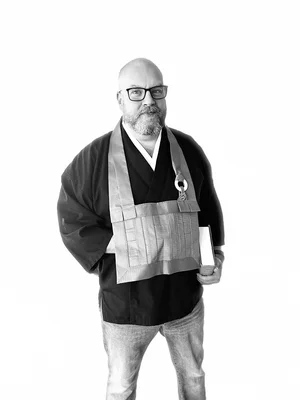
Transcript of the second lecture in a four-part series on the Dhammapada delivered by Sensei Michael Brunner at One River Zen in Ottawa, IL
We all come to practice, or came to practice at least initially, because something wasn’t quite right. Maybe we were anxious or angry. Maybe we were immersed in grief or just dissatisfied with our lives overall. So quite naturally, we can imagine what practice might do for us. Maybe meditation will make us calmer. Maybe Buddhism will make us wiser. Maybe we will become less reactive, more compassionate, more disciplined. We think that maybe if we work very hard at it, we’ll actually become some improved version of the person that we already are. And although it doesn’t necessarily ring true over the duration as we continue practicing, there’s nothing wrong with beginning that way, right? In a way, we almost have to know we’re sick before we can get to medicine. But you notice that the first eight chapters of the Dhammapada, at the beginning, undermine this whole self-improvement project that we’ve set out on. They ask us to consider whether practice is really about improving the person that we take ourselves to be, whether something much more radical is taking place here, right? We’re being asked to consider whether practice is really about improving this person at all, or whether the self that we’re trying to improve needs to be released. What if the self we’re trying to improve is something we’re just continuously manufacturing? What if this person we call “me” isn’t some fixed object waiting to be perfected, but an activity? In a way, we practice this notion of “I.” And moment after moment, mind is taking the raw material of our lives and creating the world and then creating a self to inhabit that world.
Before we go too much further, I want to say something about how we’re reading this text. As all of you know, I’m a Zen teacher, right? I’m not a Theravāda exegete. And so my hermeneutic is necessarily shaped by the tradition in which I practice and teach. And so I’m interested, of course, in what some of these ancient verses disclose when we bring them directly into the light of the activity of our own lives. But that sometimes means that when I hear words like karma or Māra or deathless or liberation, I’m probably hearing them a little bit differently than they might have been explained in a traditional Theravāda commentary. I’m not suggesting in any way that those traditional readings are wrong, nor am I trying to replace them. I’m basically asking a different question: What is this teaching doing right here, in this mind, in this moment? Zen’s always had a way of taking inherited Buddhist language and pressing it into direct experience. So it refuses to leave the Dharma at the level of doctrine or dogma or cosmology. So as we go through these reflections, I want to remain faithful to the text, but I want to also allow it to speak to the practice tradition that all of us have inherited as a group, being in a Mahayana school and being in a Zen school. The point isn’t to decide what interpretation wins. The point is to let the teaching itself become alive.
So with that being said, this is where the Dhammapada begins: “Mind precedes all mental states. Mind is their chief. They are all mind-wrought.” In the beginning there’s mind. It’s an extraordinary place to start. Before the Buddha begins talking about liberation, morality, meditation, wisdom, suffering, he directs us toward the activity of mind. We have to look at the mind that’s creating our experience of all those things first. When the Dhammapada says that all things, or all our mental states rather, are mind-wrought, we’re saying something much more profound than, if you think positively, you’ll have happy thoughts and negative thoughts will make us sad. We’re saying literally that we participate directly in the creation of the world that we experience. We frame what happens. We bring it into being and we judge it, decide what belongs and what doesn’t. We remember some things and we forget others. And we’re always looking to assign meaning. We divide experience into what I want and what I don’t want, what is happening to me and what is being done by someone else. As such, we take this vast, constantly changing field of experience and attempt to construct something out of it, preferably something permanent.
We have to be careful not to abscond from the throne of our mind kingdom. We think that we wouldn’t do that, but we do it very easily. Something happens, and immediately the condition of our mind is placed somewhere else. I am angry because of what you did. I cannot be happy because of what happened to me in the past. I can’t be at peace until my spouse changes. We have very good reasons. Maybe we’ll tick them off very well for thinking the way we do and feeling the way we do. I’m sure we’ve all experienced pain and loss. Someone may really have harmed us. The Dhammapada is not about denying that. What it’s asking us to do is to look carefully at what happens next.
“He abused me. He struck me. He overpowered me. He robbed me.” An event occurs, and then mind establishes a world around it. Here is the one who was harmed. Over there is the one who harmed me. Here is the one who is right. Over there is the one who is wrong. And through this, self and other are conjured, inside and outside. And then we inhabit this distinction that we’ve created. The deeper problem is the activity by which the karmic self establishes itself. It establishes itself through division. We take what happened and build a little fortified position about it, and we spend enormous amounts of our energy defending that position. This is why hatred can’t be appeased through hatred. We can’t transform suffering by continuing the same activity that sustains it. By establishing myself against you, I’ve been spending the next ten years proving why I’m right and you’re wrong. Perhaps I’ll feel very powerful, although likely not, right? But let’s just say maybe I think I’ll feel very powerful. But ultimately, this type of blame really makes us impotent. The moment I make you responsible for the condition of my mind, I’m saying that my freedom depends on you. My peace depends on you. And in a way, my ability to move through this world playfully depends on you becoming someone different. I’ve handed over the throne.
But this practice, and the Buddha, is asking us to do something else. When suffering appears, we witness it. We own it. And we transform it. This is responsibility without blame. It doesn’t mean that we’re pretending that causes and conditions don’t exist. It means that when suffering arrives here, this is where the work has to happen. The anger is here. We work with anger. Same with grief or fear. We’re just not disowning the life that’s already arrived. The Buddha expresses this very simply: “There are those who do not realize that one day we all must die. But those who do realize this settle their quarrels.” There’s something very close to it in the Five Remembrances, right, for those of you who know them. The third is, “I am of the nature to die. There is no way to escape death.” I’m going to die. You’re going to die. The person I’ve turned into my enemy is going to die. That person whose words you can’t get out of your head or out of your ear, that you’ve been replaying for your whole life, they’re going to die too. Resolve this issue of self and other, inside and outside, now. Engage directly. Don’t squander your life.
The next image of the text is the storm. The first one is compared to a weak tree that’s thrown down by the storm. Another is compared to a rocky mountain that can’t be moved. The storm is the same in both situations. The difference is in how mind encounters it. Ultimately, practice sometimes is misunderstood as an attempt to construct ideal conditions. We imagine liberation is a life in which difficult things stop occurring, where the senses don’t trouble us anyway, where our meditation goes well and we finally have enough control. That’s not it at all. The rain is still going to fall. The horses are still going to run. The wind still blows. The question is whether we’re being dragged around by every changing condition, or whether we can participate creatively in what’s actually happening.
It’s also why the Buddha brings up the image of the robe, right? Someone can put on a Buddhist robe and may end up governed by greed or hatred or dishonesty. Appearance is not transformation. Ultimately, the robe can’t do practice for us. Neither can a title. Neither can just taking Jukai or belonging to a temple. We can be able to quote Dōgen or Nāgārjuna or the Dhammapada, and it can be of no avail. Because what matters most is what we’re cultivating. What we’re cultivating through our skillful appreciation of mind. And this is where we pivot and discuss this thing we’re asked to distinguish, the essential from the unessential. This is difficult because the karmic self is very often deeply invested in exactly the wrong things. We mistake reputation as being essential, or being right, or being comfortable, or in control. Then we organize our whole lives around obtaining those things. The Buddha is asking in the Dhammapada: What are you making important? What are you allowing to determine the shape of your life?
Eventually, the first chapter brings us to karma. The person who acts harmfully suffers. The person who acts skillfully rejoices. We can hear this in a traditional karma sense. But there’s also something taking place immediately. Evil begins when we abandon the vital veritas of the experience and retreat into karmic conjecture. Something happens and we say, “Well, I can name that tune in two notes.” And then we depart from actually appreciating what’s before us. And we leave to go ruminate or apply the filter of the past onto the present, therefore coloring and creating something completely different, and estranging ourselves from our lives as they are. We construct worlds from memory and fear, desire and blame. We imagine consequences. Imagine what tomorrow will look like. And we walk those halls of our ruminations, of our own karmic constructions, as if they were the very abode of our lives. But ultimately, to practice good is to meet what’s here and to create wondrously from that immediacy. Karma is not some cosmic ledger that’s operating somewhere in the background. Karma in Sanskrit just means action. It means what’s happening right now. We’re creating. We’re spinning this reality through the quality of mind in which we meet it.
And so, eyes open now, we’re asked to walk into the next chapter called heedfulness. “Heedfulness is the path to the deathless. Heedlessness is the path to death,” we’re told. What does heedlessness look like? Let’s say, take heed. What are we asking people to do? We’re asking people to pay attention. Heedlessness happens when we don’t. Particularly, it happens when we begin to exclude. Something arises and we say, “No, thank you.” This belongs. That doesn’t. This is the part of life that I want. That has to go. And again, quickly, we’re no longer living the life that’s actually here. We’re living inside that smaller world we just talked about, which the karmic self has created and selected for itself.
That’s why the Dhammapada says that the heedless are as if already dead. That’s so powerful. I’d never considered it that way. To exclude what is here is, in a very real sense, to refuse our own life. We can’t be fully alive while continuously negotiating what portions of existence we’re willing to allow or permit, what parts of our life we’re willing to let in. It’s all or none. We have to admit the grief as well as the joy. The anger as well as the beauty. Even the confusion that we experience belongs too. Nothing that arises can be placed outside the field of practice.
And the text equates this state of mind, directed, with the deathless. Traditionally, we would know the deathless as Nibbāna, the liberation from the cycle of birth and death. But we can already begin to see the movement here. The karmic self survives by dividing the world. It clings to some conditions and resists others. It constructs itself around what must happen and what must never happen. And freedom doesn’t come from finally arranging conditions correctly. Freedom begins when nothing in our life has to be pushed outside of the gate. There’s nothing to avoid. Once we recognize that mind is continuously constructing the world, another question immediately arises: How could that construction, if we are the masters of it, if we’re the creators, how could that construction become bondage?
And so chapter three begins with the image of a fletcher straightening an arrow shaft. The mind’s fickle. Mind’s unsteady. It’s difficult to guard. We begin with an experience, then we make something of it. Then we repeat what we’ve made. And eventually our conjecture crystallizes into certainty. At first, I think perhaps you don’t like me. Then I begin noticing all the evidence that supports it. I start making a case. I remember something you said three months ago. I remember your expression that you had this morning when I saw you. So I no longer wonder anymore whether you like or dislike me. I know you dislike me. The world has crystallized. We no longer encounter life as it is. We encounter life as we think it is. We encounter what we already believe about the world. We wake up in the morning and we have a pretty good idea of what we’re going to experience that day. And miracle of miracles, in a universe as boundlessly vast and boundlessly open, we see what we expect to see. Think about that. We see what we expect to see. That’s the bondage.
And the Dhammapada talks about this. This mind that we’re talking about, this karmically constructed abode, is compared to a fish pulled out of the water and thrown on dry land. It throbs and it quivers. We know that mind. What happened yesterday? What will happen tomorrow? What should I have said? What is this person thinking of me? A fish is flopping around on dry land, desperately trying to solve its problem. But the fish doesn’t need to become better at living on dry land. It needs to return to the water. It needs to return to the water of playful samādhi, creatively working with what’s at hand, allowing compassion to arise naturally and flow.
This is where Māra becomes very close at hand. We can certainly think of Māra as the tempter of Buddhist tradition, right? But Māra is also the mechanism by which a small self is continuously maintained. Maintained through longing, maintained through aversion, through conjecture. Something appears and we immediately seize it. We name it, judge it, we possess it, reject it. Eventually, once we’ve shaped it, we add it to the story of who I am. The tamed mind is not one in which nothing arises. That would be death, right? That would be death. The tamed mind is a mind that doesn’t immediately crystallize around what arises, particularly around our ideas or judgments about what arises. Everything’s allowed. Nothing has to become another structure for the karmic self to use to build the bricks that contain us, a karmic self to inhabit.
So we’re talking a lot about how it occupies space, but it also changes how we occupy time as well. The Dhammapada describes the mind as “far-wandering and alone.” But if you think about it, where exactly can it go? All space and time is right here. I know people have a double take on that. I’m experiencing pain from thirty years ago. Where is that pain occurring? If we talk about past lives, where are those lives possibly being encountered except here? We spend extraordinary amounts of energy searching somewhere else for the causes of what’s happening right here. I’m not saying that it’s not useful. It’s certainly useful in the sense that it can be. It can awaken us to the notion of causes and conditions. It can awaken us to its futility. But it can also become another way of avoiding the life that’s already arrived. The thing that has to be transformed is not elsewhere. The suffering that’s suffering from the past, from your childhood, it’s right here. Understand that and transform your relationship to it by merely recognizing that very fact, and refusing to turn away, trying to look elsewhere. Set the crucible up on the stand right here, right now, and work with the causes and conditions to transform suffering into joy.
As reflected in the text, this is where faith becomes so important. It’s important to know that faith is not certainty. It’s not a new way of knowing. Faith is the courage to work with what’s present in a state of wonder, rather than continually running toward some manufactured sense of certainty. Wisdom can’t mature in a mind that always needs somewhere else to stand. So I like to hear the function of prajñā, wisdom, and I hear that word always with the resonance, for me, as “before knowing.” I’m not saying it’s a literal translation, but as we’ve been describing its activity, before I decide what everything means, before I decide who’s responsible, before I know what you are doing. Prajñā cuts directly through karmic conjecture to the vital veritas of the present moment that’s unfolding right here, right now. And then, in this moment of awakening, this moment maybe we could say a victory over delusion, the text tells us something very important. After you taste this, remain unattached to that too. Don’t turn liberation into another possession. Don’t be the very person who is proud of not having a self.
And chapter four develops this with a completely different set of images. Flowers. Flowers. It talks about the master garland-maker taking the flowers. He takes all the flowers before him to create something wondrous. Mind is creating the world we experience. But the garland-maker has to discern where each flower belongs, not whether it belongs. Where we can place it, how we work with it skillfully, to create something wondrous. We usually encounter experience by asking: Do I want this? Does this belong to the life I’m trying to make? Can I use this? Can I get rid of this? But the garland-maker begins from another place. Everything is already part of the material. Every color, every shape, every condition. The question becomes how to engage creatively with what’s arrived.
And the text talks about this as: Are we leading the cart? Or are the accumulated causes and conditions of the karmic self dragging us along behind it? The Dhammapada speaks of overcoming the realms of men and gods, even the realm of Yama, the Lord of Death. We don’t have to travel somewhere else to find all these realms. We create heavens and hells right here through longing and aversion, memory and anticipation. And we cling to what we’ve created and call it reality. Liberation doesn’t require us to destroy the world we create. It means no longer being governed by it. In order for awakening to truly be awakening, it also has to include delusion. It doesn’t mean the constructed self goes away. It means we see it for what it is. And once we see it for what it is, and we know how it’s created, and that we’re creating it, we recognize the garland itself as ours to make.
The Buddha reminds us that the body is like froth, like a mirage. The body is impermanent, right? It changes. It disappears. But the text has to go further than merely saying, “Yeah, everything changes.” We need to see through the solidity we have assigned to it. The body called “me” arises through causes and conditions. It’s interpreted and reconstructed moment after moment. It’s real. It’s real as lived experience. But it’s not fixed in the way the karmic self imagines. This leads us into the next section where we’re talking about the plucking of flowers. The problem is not flowers. The problem is not pleasure. The problem is not beauty. The problem is that we pluck from the field of experience only what the karmic self wants to keep. We make a little bouquet out of the parts of life we prefer and then wonder why that bouquet dies. We separate it.
Then comes the bee in contrast. The bee enters the flower completely. It receives what’s offered and leaves the color and fragrance unharmed. It’s immediacy. We use intimacy without possession. The bee doesn’t refuse the flower. It doesn’t stand at a distance from the flower. It enters completely. It doesn’t need to destroy what it encounters. Nor, having received the gift, does it possess the gift. We receive the gift and allow the gift to keep flowing. When we grasp it, the moment we insist it belongs to us, it ceases to function as a gift. Compassion works much the same way. Compassion flows when we stop interrupting the exchange by asking what we can keep.
Then the text pivots and starts asking about fault-finding. Why are we so fascinated by the mistakes of other people? Because fault-finding is a remarkably efficient way to stabilize this notion of “I,” this idea of a karmic self. By asserting difference with you, then I know who I am. You are selfish. Therefore I am generous. You’re ignorant. Therefore I’m wise. You’re impure. Therefore I’m pure. When self and other crystallize, the flow stops. And the text says to reverse the stream. We need to instead look at our acts, our own acts, done and undone. What have I done? What have I not done? How can I work with what’s at hand to transform now?
Then the flower becomes another kind of teaching. Words without practice are like a beautiful flower without fragrance. Do you remember that Dōgen reminds us that we can’t nourish ourselves on a picture of a rice cake? The text is driving home something very similar. We can’t smell the picture of a flower. We can create a beautiful image of practice. We can talk about compassion and liberation and emptiness. But if nothing is alive, nothing is nourishing us. Fragrance only appears when the flowers are alive. The chapter ends with a lotus growing from a rubbish heap. The very place we’d rather discard becomes a fountain of wonder. It’s a reminder that we don’t have to escape the rubbish before waking up becomes possible. We don’t have to clean up our lives first. Nothing has to be pushed outside the gate.
Then we travel along to chapters five and six. They ask a very different question. If everything belongs, then what’s the difference between the fool and the wise? The Dhammapada answers, not that the fool lacks intelligence. The most dangerous fool is the one who is absolutely certain that he understands what’s happening. Because then karmic conjecture has crystallized into reality. There’s no longer any room for wonder in that place. The text says that the fool who knows his foolishness is wise, at least to that extent. But the fool who thinks himself wise is a fool indeed. If we’re not awake to our own delusion, then we’re asleep. Wisdom doesn’t require that delusion disappear forever. Wisdom requires that we can see delusion when it arises. There’s delusion, as I’ve mentioned before, within awakening.
The text goes on to talk about the fool saying, “I have sons. I have wealth.” My family, my work, my reputation, my accomplishments. Each possession seems to make the self a little more substantial. But everything we call ours is moving through causes and conditions, including the person that’s doing the claiming. When we recognize our own true nature and we abide there, there’s nothing that needs to be possessed. Because there’s nothing that’s outside of us. There’s nothing that’s not already fully ours. We already have it all.
This is why the text goes on to talk about merely being near the Dharma. It doesn’t mean we’ve tasted it. The Dhammapada compares the fool to a spoon sitting in soup. The spoon can remain in the soup for its entire existence and never taste a thing. And yet our tongue only needs to come in slight contact with it, and it’s immediately activated by it. Because there’s intimacy. We can sit in the zendo for decades. We can memorize teachings, wear robes, collect titles, and still never allow the Dharma to become a living activity. For this teaching to truly be the Dharma, for it to truly be teaching, it has to move through us.
That’s what brings us right back again, full circle, to karma. Every single act affects the entire universe. And this becomes even more profound when we consider that this activity unfolds not only throughout space, but throughout time. So we’re circling back over the same theme over and over again, right? Nothing we do simply disappears. Every word, every action, every movement of mind enters the whole field of causes and conditions and changes what’s possible next. The fruit doesn’t appear immediately necessarily, again, or at least from our perceived perspective. We don’t think that milk sours all at once. We don’t think of a fire smoldering beneath ashes. But the universe has already been changed by what we’ve done. Past, present, and future, because they’re all here. There’s no sealed-off space where karma happens privately.
That’s why the text talks about the fool even being able to turn spiritual practice into another form of bondage. If you practice severe austerity, it isn’t necessarily a taste of the truth. The act of starving the self can become a surrender to the self. We can spend enormous amounts of energy attacking the self, or purifying the self, or disciplining the self, and never notice that the self remains seated at the center of the entire project. The self that must become holy is still a self. And this applies once again to knowledge. Knowledge is particularly dangerous because it gives the karmic self somewhere very comfortable to live. Now I know. I know what Buddhism teaches. I know what awakening means. I know why you’re wrong. Knowledge should open the world, not close it. But prajñā, wisdom, cuts in the opposite direction. It returns to the clarity that’s present before knowing has hardened.
The fool also wants to be known. The Dhammapada describes the person who wants monks and householders to know what he has done. He wants authority and recognition and followers. So here we have even good activity now being pulled back in and being overwhelmed by the small self. I did this. Look at me. And then, once again, the gift stops flowing because someone has decided to possess it.
Chapter six begins almost exactly on the other side of this. The wise person is someone who can be corrected. That’s an extraordinary definition of wisdom. The Dhammapada says to follow that person as if they were showing us hidden treasure. But the karmic self doesn’t usually experience correction as hidden treasure. It experiences correction as danger. That’s why our practice is so lineage-focused, and why the teacher-student relationship is so meaningful and matters so much. A teacher isn’t someone who gives us more Buddhist information. We have plenty of books we can read. But when we enter a teacher-student relationship, we enter deeply into seeing the places where our own certainty prevents us from seeing ourselves. That requires trust. The student has to become willing to be shown something that the self would rather defend. The teacher has to be willing to point directly without needing the student’s approval. Sometimes, from what the teacher is doing, the student changes. When their relationship is alive, correction becomes an act of compassion.
And then the text goes back again, once again, to renunciation. Renunciation begins when we renounce the renouncer. As long as there is some self standing proudly in the middle of the room announcing all the things it has given up, the karmic trap remains set. But true renunciation is discovering that we’re already at home in everything, everywhere. There’s no fixed place for the self to settle, and therefore nothing has to be acquired to complete it. The wise person can be touched by joy and sorrow without being swept into elation or despair. Not through indifference, but through intimacy without possession. We can love completely without demanding that what we love remain unchanged. We can grieve without turning grief into an identity. We can receive happiness without demanding that the universe preserve that for us.
It brings us into the final two chapters that we’re considering tonight, chapters seven and eight. The arhat has completed the journey. We’re not talking about some tremendous spiritual accomplishment. Completing the journey just means the end of the need to get somewhere else. And in a way, the end of the journey really is the true essence of the beginning. The fever is broken because the seeking has ended. We’ve come home to what’s here, and we’ve left behind the striving of trying to fight for things to be the way we want them to be.
The Buddha compares the mindful ones to swans leaving the lake. They leave lake after lake behind. They’re not attached to any one place as home. The entire universe is home. But every time we establish an identity or role or belief or accomplishment as the place where “I” reside, we make another enclosure and divorce ourselves from the vastness of our lived experience. The swan simply flies on. And when no particular place has to be home, we discover ourselves at home everywhere.
And there’s this image of a bird. The path of a liberated person can’t be traced, just as the flight of a bird leaves no track in the sky. Nothing remains in the sky saying, “I was here. This was mine. Remember what I did.” Awakened activity doesn’t even construct a monument to the one who acted. That living monument is always present in the wind, in the rain, in the smile on a child’s face. The text has us see such a life emerging from the void, emerging from unconditioned freedom. This is absolute wonder. This is unbounded wisdom directly before the world has crystallized around what we believe it to be. Look, the bird still encounters the wind. The body still requires food. The world continues to arise and pass away. But we’re no longer dragged helplessly behind the cart of those conditions. Instead, we can engage with it skillfully, rather than railing against it and trying to conjure something else into existence. The beauty and wonder of it is already here.
So the arhat is compared to the earth, resenting nothing. I like that, because what is there to resent? The earth receives everything. It receives rain and garbage. It receives flowers and ashes, blood and sunlight. All of it is taken in. But the earth doesn’t create an identity around it. All of it is welcome. All of it is included. Resentment requires someone standing apart from what’s occurred, insisting that reality should have arrived differently. But when that distinction is no longer continually being manufactured and maintained by this small self, then there’s nothing to defend. Peace isn’t something that we manufacture by forcing the mind to become quiet. If we’re not at war trying to create a small self wherever each distinction arises, then we’re already at peace. And calmness becomes the natural abode of a life no longer divided against itself.
The Dhammapada goes on to overturn our usual way of measuring things. “Better than a thousand useless words,” it says, “is one that brings peace.” Better than a thousand meaningless verses is one verse of Dharma that actually opens us. Quantity has nothing to do with transformation. And in our practice, in Zen practice, all of you remember the Mu kōan, right? You have a practice with that word. A monk asks Jōshū whether a dog has Buddha-nature, and Jōshū says, “Mu.” One word. We could write a thousand pages explaining Buddha-nature and still never taste Jōshū’s Mu. Mu doesn’t give us more information to possess. It takes away the places where our knowing has settled. We bring our judgments, our fears, our expectations, our ideas of practice and our explanations, even the ones about who we think is practicing or what they’re practicing, and we place it all into Mu. And we encounter this directly. And we recognize that all of life exists in that one syllable. One living word can break the whole structure of our conditioned consciousness apart. It’s a way of moving past just reciting the score and joining the dance of our life.
The Dhammapada continues. A moment of genuine reverence is worth more than a hundred years of sacrifice. Again, quantity is overturned. We can perform thousands of rituals, accumulate merit, make offerings, spend an entire lifetime becoming a very accomplished religious person, while the small self remains comfortably seated at the center of the enterprise. But one moment of genuine reverence allows us to accomplish something much greater because, in that moment, we’re just simply moved by what’s there. In that moment, we bow and are bowed to. Better to live one day virtuously and meditatively than a hundred years without restraint. Better one day wisely than a hundred years foolishly. Better one day in resolute practice than a hundred years dissipated. Better one day seeing arising and passing than a hundred years never seeing it at all.
All of these sayings, over and over again, just in case, just in case we’re mired by regret, or feeling like our mass of conditioned behavior that we drag behind us will always be a fetter. It just takes a moment. This moment. For all of that karmic baggage to be set down, and for us to rise completely. What’s the measure of our life? We’re tempted sometimes to answer: years. But if a hundred years pass, but we continuously pine about what we wish was here, regret what has already passed, have we ever even lived? All of it is right here. Past and future emerge with this present because there’s nowhere else for them to appear. Everything is here. We open to it. To see this even for one day, one moment, changes the measure of a whole life.
Better one day seeing the deathless than a hundred years not seeing the deathless. Better one day seeing supreme truth than a hundred years without seeing it. We don’t have to turn either phrase into another metaphysical certainty. The deathless is not someplace waiting for us after we escape this life. When our understanding is no longer exhausted by the small self that is born, changes, and dies, something immeasurably larger becomes apparent. You say, “What is that?” If this was a Zen text, the master would wave his hand over here and say, “I’ll show you.” Pay attention.
So what have these first eight chapters done? They began with mind creating the world we experience. What we create hardens into certainty, and then we forget that we’ve participated in its creation. But practice brings us back to ourselves, and it begins to loosen that certainty. We stop selecting only the parts of life that support the self, and we learn intimacy. We recognize true intimacy without possession. We become capable of correction. Correction is wonderful because it means that we’re truly actualized by what’s here, not some notion of regret that we think is somewhere past or things that we hope will be. We stop needing knowledge, reputation, or austerity, or even practice itself, to hold us together. We recognize we’re whole already. And then the seeking ends.
That’s the order. That’s the order. Not from an ordinary self to an extraordinary self. From the constant activity of constructing this understanding of a small self to a life that no longer needs the construction in order to respond. And when that activity loosens, nothing impoverished is left behind. Quite the opposite. We recognize that we’ve inherited the whole universe. The journey ends by coming home. One word is enough. One day is enough. One breath is enough. Because there’s nothing missing from what’s here. Past and future, birth and death, the whole universe, all arrive in this place. We stop trying. We stop striving to make this moment into something that can complete this small self. Then we discover it was never incomplete. The bird crosses the sky. It leaves no track.