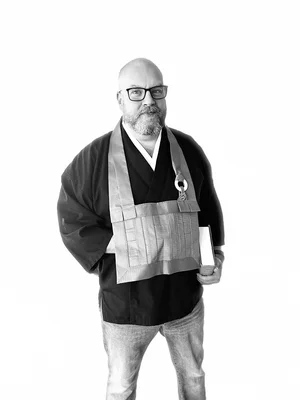
Here we are on the last morning of retreat.
I'm so pleased with all the wonderful practice time we've had together. It's hard to imagine it coming to an end, but it will end soon. Hopefully, you caught a glimpse of a way of being and a way of living that's more intimate with the experiences that you have.
One of the biggest enemies on the spiritual path is knowing. Once we know, things become very, very hard. It's about always cultivating a state of beginnerhood, always looking at things as new and novel.
Why do we do that? Because everything is new and novel. Once you think you have the answers, all of our existence collapses into those answers.
There's a case in the Mumonkan. It's the 40th case. It goes like this:
Riku Taifu, while talking with Nansen, said, "Jō Hōshi said, 'Heaven and earth and I are all of the same root. All things and I are of one substance.' Isn't that absolutely fantastic?"
Nansen pointed to a flower in the garden and called Taifu over to him. He said, "People these days see this flower as though they were in a dream."
It's the entire case.
Riku Taifu is a high government official who actually studied with Nansen. He eventually came to appreciate the Way. Jō Hōshi, the person that Riku is quoting, was a student of Kumārajīva. Kumārajīva was one of the early translators of Sanskrit scriptures into Chinese.
Actually, some of the translations that we use to this day, that we translate from into English, are still being circulated from Kumārajīva's Chinese translations. They've stood the test of time. This is the fifth century that he did this work.
We have this student of Nansen's reflecting on a study he had been doing of a student of Kumārajīva, if that makes sense. He's quoting from a text that he wrote: "Heaven and earth and I are of the same root. All things and I are of one substance."
"Isn't that absolutely fantastic?"
So, Riku's quoting Jō Hōshi to demonstrate his understanding. But understanding can be very rigid, right? It can be indirect. It can be conceptual.
The question comes up: what was the nature of Riku's understanding?
When he says, "Isn't that absolutely fantastic?" the word rendered "fantastic" could also alternately be rendered as strange or weird, almost absurd. So Riku had deeply pondered Jō Hōshi's proposition and found it so profound because it went against ordinary logic.
This is profound.
There's no doubt it's profound.
But is it awake?
There's a lot of different ideologies circulating in the world, a lot of different teachings, a lot of different teachers doing a lot of different gesturing and pointing. No ideology worth its salt stands the test of time unless it can predict what's coming up, or unless it can explain what's coming up with at least a mild degree of precision.
So, in other words, if things as predicted by this ideological model line up, or are incongruent some of the time with the observed state of affairs, then they persist.
So then we should all just find a very good, rigid ideology, right? And that way we'll have a good idea of what's coming up next.
No.
No.
Why? Why? Why not?
So, in response to this, Nansen points to a flower in the garden. He's motioning as if to say, "See this flower."
Be present with it.
Recognize its suchness.
Directly appreciate this nature that's present, this connection that's present.
The beholder and the beheld drop away if we drop away our labels. It's really just a simple matter of looking at things before we judge or apprehend them.
It's not easy to do.
We study the precepts as we study koans. We become more adept at recognizing where we get stuck. But don't turn the precepts and the koans into a new set of ideology to get stuck on.
That's not the point.
What's the point?
It's right here.
You can feel the beauty and the wonder and the curiosity that's present in this room. The ardor and the practice and the courage and the bravery that brought you all here, and the love that we cultivate from one another as we walk down this path.
It's all here.
There's nothing else that's needed.
But if you get lost in the words, if you get lost in the ideas and the concepts, then you understand where Nansen is pointing when he says, "People see this flower nowadays as if they were in a dream."
In other words, I'm no longer present and intimate and playful with what's here.
Instead, I'm playful with my judgments or my mind games or my tautology or my logic, and I've failed to see or express or actually truly sense the intimacy that's right at hand.
If cognition is done vacantly, without actually showing up, then we're in a dream.
This world is now full of all kinds of competing belief systems. And if you take the position of any of these belief systems and look at them through the lens that they produce, the optics that come out of it, then, yeah, we can force our lived experience to fall in congruence with those.
That's why these competing ideological systems, no one ever reigns supreme, right? Because if you step into it from that perspective, then, yeah, things will fall in line with where they're predicted to be, approximately.
And when they don't, that's why you have scholarship.
You can explain it away.
That's no way to live.
If you want to live, you actually have to show up and live. You actually have to experience your life directly. Really appreciate it.
There's a pointer that begins this case that I think is pretty well written and profound:
"When the action of the mind is stopped and swept away, the iron tree will bloom. Can you demonstrate it? Even a crafty fellow will become a cropper here. Even if he excels in every way, he'll have his nostrils pierced. Where are the complications?"
The iron tree will bloom.
So we practice in a state of samadhi.
The activity of our consciousness is stopped, and the source of our thoughts is tapped directly.
So there's no need of an interpreter.
No need of an interpreter.
We can see the beauty for what it is. We can experience life directly. We can feel the pain without needing someone to tell us that we've been shot.
When the activity of our consciousness resumes from within that samadhi, then it's like an iron tree that comes out in full bloom.
Then you can actually experience your cognition as cognition and put it in its rightful place.
In that place, even a single blade of grass is wonderful. The superlative is beyond expression, but it truly is.
It's not an act of some long-ago written sage that we're trying to force on the situation.
But even a crafty fellow will come out a cropper here.
So if you act from a position of understanding, and your understanding is purely conceptual and not based on personal experience, you'll eventually get caught out.
How do you get caught out?
When the gap opens.
When the gap opens between your lived experience and the ideology that you've so thoroughly cherished, there'll be suffering.
That's how you'll know it.
When that happens, just walk directly into that gap.
Rebuild, re-knit, and just experience directly.
The capping verse for this poem was also exceptional:
"Hearing, seeing, touching, and knowing are not one and one. Mountains and rivers shouldn't be viewed in the mirror. The frosty sky, the setting moon at midnight. With whom will the serene waters of the lake reflect the shadows in the cold?"
You can lose that one clinging to ideology. And when you do, you've gained all of your life's experience.
And when that happens, all of the beauty is available to you, but also all of the wisdom.
I said it many times before: wisdom in English is translated from the Sanskrit word prajna. Prajna is a compound word. Pra means before and jna is to know.
So before knowing, there's wisdom.
If you show up on the spot, you'll know just what to do to manifest this compassion in any given situation.
If you can see precisely what's at hand, that's what I want for all of you.
So we come out of this retreat.
Like I said, all your backpacks are on the porch, right?
Full of all of your cares, all of your concerns, all of that story and narrative that we've assembled.
Don't go strap it on mindlessly, yeah?
Just go ahead, go out on the porch, rummage through it, and just throw all the things that don't serve you out on the porch.
You can leave them here.
I'll sweep them up later.
But you walk away with your hands open.
Ready to serve, ready to be available, ready to truly appreciate your lives!