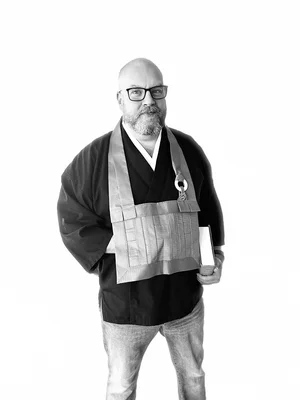
I’m going to talk to you this morning about a koan. It's called “Roaming the Mountains.” It's Case 36 in the Blue Cliff Record:
Chōsha went roaming in the mountains one day. On returning, when he came to the gate, the congregation leader said, “Where have you been, Master?”
Chōsha said, “Roaming the mountains.”
The congregation leader said, “Where did you go?”
Chōsha said, “First, I followed the fragrant grasses on the way out. Then I came back, pursuing the falling flowers.”
The congregation leader said, “Very much like the sense of spring.”
Chōsha said, “It even surpasses the autumn dew dripping on the lotuses.”
Everyone was speechless. But Setchō was present. He spoke up. He said, “Thank you for your answer.”
We all get so caught up, so caught up in our idea about what our life is or should be, that we find it hard to come back.
Chōsha follows the fragrant grasses on the way out, comes back to his senses, back to what's present, driven by enthusiasm, maybe even some ardor.
He's drawn by these grasses, and he goes, and he forgets himself.
He forgets himself.
This is the very marrow of life.
This is it.
This is it.
It can't be labeled.
We call it dropping away or staying in the present. But it's all right. It's beyond any idea of presence or future.
You can't convey it by words.
He sees himself following the fragrant grasses, and as the scent trails off, he comes back. He comes back to the falling flowers.
So when he returns, he forgets himself there too. He's dropping away, continuing to forget the self, and he's just present with what's at hand.
What a beautiful life, yeah? To appreciate being in this way, to forget the notion of our small self, of our worries, and to find it, to return to it, each returning more beautiful than the last.
It's a way of awakening and really being present.
It's like the old maxim that we chant every day during a retreat: “Take heed. Do not squander your life.”
So he presents this miracle, and the congregation leader, you can only imagine, has been practicing for a long time. He has a notion of what order things are supposed to be in and how things are supposed to look and play out.
He responds with, “How very much like the sense of spring.”
But it's not the same.
The congregation leader is trying to bottle the ocean.
He continues on, “How peaceful and present it must be.”
Yeah, he hasn't got a taste of it, though.
It's not to any avail.
Is this the closest you've come to the wonder of your actual being?
It's like referencing a picture postcard, yeah? All dog-eared.
But the question is, have you ever made the journey?
Have you?
Chōsha replies, I can imagine very flatly, “It even surpasses the autumn dew.”
It even surpasses this desolate scenery of a tattered travel brochure, reeking from the incense of a past ritual that was over a long time ago.
The dew clings to this hazy form of the Lotus of Awakening, but it never actually quite penetrates it.
That isn't a pretty picture.
It can't be embraced, right?
It's just very flat.
This is your life.
You have to penetrate it directly.
You have to experience it.
You have to move beyond the pretty bows and the colorful wrapping and open fully to the experiences that present themselves.
I love the last section. Setchō adds, when the assembly leader can't say anything to Chōsha's response, how splendid this realm of Chōsha is. Beyond any description as the present moment, or the beyond.
It's beyond Buddhism, beyond world reality, inexpressible, even in song.
So you can imagine Setchō tearfully responding, “Thank you for your answer.”
Thank you for pointing so clearly.
But you don't have to go roaming very far, right?
This realm that Chōsha is pointing to is right here, now.
It's splendid, beyond description, completely sublime.
So as you roam these mountains, you'll find with every step, you're always home.
You can live in this way.
Come home to your life.
All of the signs are there, all of the beckoning: the wind gently blowing at your face, trying to wake you up; the warm sun on your face, trying to gently warm the icy karmic shell that you're ensconced in and melt it away.
And when you melt it away, it exposes your life.
This is it.
This is it.