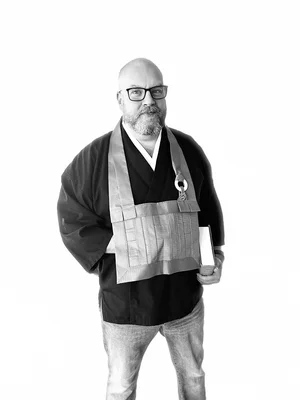
I've talked about what I'm going to talk about tonight before.
Some of you have referenced it today during your check-in, some of the texts that I'm going to cover. But it was on my heart. I'm not sure why, but it's been something that's been coming up regularly for me over the past few days.
It's so wonderful to have you all here today, and again, I want to thank you for your devotion to this ongoing practice. And I'm very grateful and overwhelmed because of the extraordinary ardor that you're all exhibiting and your enthusiasm.
I want you all to know that this road is just beginning for all of you.
Your practice road is just beginning.
There's so much more to see. So continue to cultivate that beginner mindset and recognize that there's so much more joy and wonder to come.
We have to really penetrate to the marrow of our karmic tendencies and really release ourselves from them, kind of rewire the way we approach our lives.
Each one of you is a miracle.
This is a very wonderful Sangha.
There's something very special happening here, to have a group of folks who are so early in practice but so devoted, so much ardor.
I want to remind you: to whom much is given.
Remember, there's a world out there of suffering that your practice is going to move to address.
So continue to cultivate your practice, deepen it, include everything in it.
Some of you sitting in this room, or in the extended room if we include Zoom, will be sitting in my chair one day.
Some of you will remember the words I'm telling you about training now, when it just goes too fast.
No matter how much you prepare, you're never quite ready for the responsibility that comes from teaching and expounding this wonderful Dharma.
But each and every one of you will be called upon, in the days, weeks, months ahead, to be a beacon of light and sanity in this suffering world.
So please train.
Before you think that the path is onerous or too time-consuming, just look at all the opportunities for practice that we miss, all the deeply entrenched karmic habits that we have in our lives that we know we should have put out at the curb last week, but we held on to them for just a little bit longer.
Those things can go.
Those things can go.
This practice is not something discrete from your life.
This practice is your life.
And when you open up to your practice in that way, then you can integrate it in a way that's very meaningful and makes a big difference.
But if we continue to consider it a bucket, or something that we have to do, or something that's on the side, you'll just drag on that labor much longer than it needs to be.
Just give in.
Just give in.
And train.
Your practice is a much greater source of entertainment than Netflix, I promise.
And joy, for that matter.
It's been said, I've heard said before, you need to have three trusts in this practice.
You have to trust in the Dharma. You have to trust in this practice path.
I have every confidence that you all have that trust. Just with the ardor you throw yourself into your practice, I know that you can see the power that's present there.
The other trust, as they say, is to have trust in your teacher.
Not me personally.
But in what I represent, in terms of encouragement for your practice.
Each of you sees me as a projection of your very own self anyway. When I speak, you all hear me a little bit differently based on your own karmic proclivities.
And so, it's more trusting the relationship than anything else, and the nurturing that goes on.
And the fact that over time, we begin to see more and more through the same set of eyes.
We see life the same way.
That's what training does.
Me personally, if we're training well, you'll see me make mistakes.
If we're not training well, you won't see them. You should be too distant from the practice.
But if we're training very well, you'll see me make some blunders, I promise you.
And you should all see each other.
You should take some comfort in that.
When you see someone do something disturbing, you should say, "That's me," if we're practicing correctly.
That means we're together.
There's a reason that we say, "Don't speak of the faults of others," as a precept, right?
Because we recognize ownership as a group in that.
That's not a one-way ownership. That works across the entire Sangha.
We're all supported, one and another, in this practice.
I get to speak to folks all the time on their practice journey.
I get to see a lot of people who are entering their practice journey.
Maybe they start by taking an Entering the Way class. Maybe they're starting by studying a sutra, right?
Some brave souls walk in.
I know some people have walked in doing very difficult and challenging studies and lived to tell the tale, right, and continue on with their practice.
So I'm always curious to know what brings folks into the center, right?
But it's pretty common. There's a smattering of reasons, but there always seems to be one general idea that floats to the top, right?
It's the idea of suffering.
Some of these pivots you know.
Sometimes it's because the children have left the nest, or because they're having marital problems, or because they're having a divorce.
Maybe they have some deep regret.
But suffering's what brings them here.
But the other thing that they're looking for when they come is they want to know.
That part changes, right?
Our relationship to that changes when we get here.
They want to discover a truth greater than themselves, but they think that they can articulate it from a position of intellect.
And of course, we have sutras and teachings that go a long way toward addressing the causes, even prescribing remedies for some suffering.
They point to a place beyond knowing.
They point beyond the words and meaning of the text.
But even with all that, sometimes it's hard for us to see past the end of our nose.
So there's nothing like a good koan.
It's got to shake up our perspective, right?
There's a little kick in the pants, yeah?
So I want to talk to you about a specific koan.
It's Case 36 in the Book of Equanimity.
It also appears as Case 3 in the Blue Cliff Record.
Some of these repeat.
I know you can take comfort in that, right?
People are like, "Oh, thank goodness. I've seen this one before. You're not going to trick me with this."
I've seen this one.
And the name of the case is "Master Ma Is Unwell."
Some of you have heard this case too.
Every case in the Shōyōroku starts with the same word:
"Attention!"
Great Master Baso was ill.
A temple priest asked, "Oshō, how is your health these days?"
Baso replied, "Sun-faced Buddha, moon-faced Buddha."
It's a profound case.
When we look at it initially, we say, "I don't even know where the door is on this one," right?
There's got to be a button or a latch or something.
How do we walk into this case?
There's a couple of things that can help put the koan in context.
The first thing we know is that this great Master Baso, or Master Ma, Mazu Daoyi, who lived in the eighth century, his family name was Ma.
And there's a text that we study, the Denkōroku, what's called the Record of the Transmission of the Light.
It was compiled in 1004.
It's the last collection of cases that we go through.
We move on to the Five Ranks.
But there's a description of Master Ma in the text.
It says:
"His appearance was remarkable. He strode along like a bull and glared about him like a tiger. If he stretched out his tongue, it reached up over his nose. And on the soles of his feet were imprinted two circular marks."
He was an imposing man.
What was even more imposing about him was the way he worked with students.
So in order to pry his students away from conditioned consciousness and break up their karmic contrivances, he used pretty unconventional means.
You've heard of some of these, right?
For instance, sudden shouts.
Just at the appropriate time.
Sometimes when someone's getting ready to present a comment and they look up and to the left, you go, "It's not there."
Trust me, you can look there all day long.
It's not there.
I know where you're going with this.
He unexpectedly hit students with sticks.
Another teaching method he used particularly well was when a student was walking away, he called them.
And when they turned around, he just looked at them.
Call it out.
Let's bring them back, yeah?
And he was also known to occasionally grab a nose and twist it.
It was one of those other little tricks he used to pull.
But utilizing this variety of unexpected shocks, right, these methods were meant to kind of get past not just habits, but vanity, right?
And just some hope that he could nudge them into a sudden kenshō.
So he had four Dharma heirs, one of whom would go on to found what we call the Rinzai School of Zen.
So it continued on, and some of these training methods are still espoused in their ranks to this day, although probably a little bit less thoroughly than they were back then, because it would be illegal.
But his tactics overall helped shape the trajectory of the Zen school.
As a matter of fact, the first use of the word Chan school, or Zen school, was in his writings.
So he's a legendary Zen teacher.
He's known overall not just for his vigorous training methods, but for his ardor for the Dharma.
That's not how we find him here.
He's sick.
He's not a little sick, either.
The distinct impression that we get is that he's very sick.
Most of the commentaries written about this text that are contemporary say he's actually on his deathbed.
So you can imagine here, you had this larger-than-life teacher, and he's exuded so much energy, and he's facing decline now.
It's a sharp contrast to the figure that he cut just a little while before.
All of his life's energy is winding down.
So the other thing to keep in mind, aside from the majesty of this monk, is the sun-faced Buddha, moon-faced Buddha.
His expressions weren't chosen out of a hat.
So the Buddha Names Sutra was a text of the countless names of the Buddha, or of many Buddhas, and had a short bio about each of them.
So the sutra was the names of 11,093, to be exact, Buddhas.
And it describes each of them in a way where it talks about their particular blessings.
If you want to meet these 11,093 Buddhas, all you have to do is call to them throughout the day.
You'll see them all.
They're all there.
But they were used in a ceremony that gained popularity in China in the fifth or sixth century in which the names of the Buddhas of the past, present, and future were recited, and the idea was that it could expiate past offenses.
And among the many Buddhas' names, there are two listed that sound familiar: the sun-faced Buddha and the moon-faced Buddha.
The sun-faced Buddha is a Buddha that lives for a really long time.
Could be hundreds of years, could be kalpas.
Nearly eternal would be a way of referencing the sun-faced Buddha.
And the moon-faced Buddha is a Buddha who lives for one day and one night.
So where does this lead us?
The first temptation when doing koan study is that you start to re-systematize.
I try to shake out the karma.
You try to re-establish the karma.
You say, "Well, this is relative and absolute. This is seeing the monolithic oneness and seeing the small dependent things that make up interdependence."
So Master Ma's answer certainly encompasses both of those.
And I feel that there's some merit to that viewpoint, but it's not going to help you penetrate this koan.
So let's just set that aside.
This is all just another set of new ideas that we've come up with.
So we have a larger-than-life, hale and hearty Zen master who's now dying.
The head monk of the monastery visits.
He already knows what's afoot, but he somehow feels compelled to ask, "And how is your health?"
Man, it's almost as if he went to tee up a response from Master Ma.
That's so, right?
It's just such a mindless question, showing a lack of presence, just some conventional response rather than actually looking through at what was presenting itself directly.
Imagine walking into somebody who's dying in hospice and saying, "How is your health?"
It doesn't make any sense.
It's not the most present, certainly.
But in reply, Baso says something pretty magical.
"Sun-faced Buddha, moon-faced Buddha."
Now, Buddha just means awakened one.
Question is, awake to what?
Sometimes awake to health, to vigor, to years of life ahead, to endless possibilities.
Sometimes awake to weakness, to pain, to what we might call death.
It's as much a lesson to ourselves, our very own self sitting right here, as it is to that monk.
Stay open.
Stay with it.
This is it, folks.
This is it.
This is your life.
Appreciate it.
Appreciate it directly.
The place Master Ma is pointing to is a place of equanimity.
One of the most difficult practices on the path and the foundation of the precepts.
It's a fertile field for wisdom and compassion and love.
Equanimity is not aloofness.
There's a way that we might think, well, we're just distancing ourselves from our emotions.
That's not this.
It's a gateway for warmth, a gateway for being that's only possible when we actually show up completely, so completely that we drop off our very own selves.
The Buddha described a mind filled with equanimity as abundant, exalted, immeasurable, without hostility and without ill will.
The word that we translate as equanimity, when it comes in from the Sanskrit, is known as upeksha.
Upeksha means "to look over."
Equanimity arises from the power of unobstructed observation, the ability to see directly without being trapped in a story, without being trapped in our expectations, or without being stuck in one of the abodes of our consciousness.
One of the abodes of our consciousness, for sure, that we dwell on often is a discursive mind, a place of anxiety, depression, doubt, fear, pain.
But it can even be the abode of our sensations as well, and being able to take a step back and look over and to be present with all of it.
When developed, such a power gives rise to peace.
I once had a pastor who trained me when I was in Bible college.
He said that peace was about the presence of adequate resources.
And at the time, I remember thinking that was compelling.
But now, years later, even more compelling.
When we have peace, we're able to see the presence of infinite resources.
So we're not talking about peace of mind.
We're talking about an embodied peace.
So what gets in the way here?
Well, I think the answer could be reckoned with a couple of questions.
The first being:
Who am I?
We come to practice all bright-eyed and bushy-tailed, ready for a deep experience of the great beyond.
Anuttara-samyak-sambodhi, yeah?
Unexcelled perfect enlightenment.
We're sitting proud on our cushions, waiting for that great bliss.
So happy that we showed up.
And so we swiftly mount those cushions, and we come face-to-face with ourself.
Ourself, the one we call "I."
And oh my, in what sharp detail we come into perspective of ourselves, right?
It's like when someone zooms in directly on your face with an HD camera.
Humanity, yeah?
The frightening detail.
We meet the monkey mind, the one who can't sit still, ever.
It sees any one thought for a second before it's on to the next shiny object.
And then we meet the grasping mind.
It can't let go of any past hurts or grievances.
All of them are still present.
None of them are let go.
We're playing them over and over and over.
And that gives yield to us meeting our inner saintly one, whose practice is impressive.
Whose practice is impressive.
And then we meet our inner complete jerk.
And I won't say in what proportions we have those, right?
It's hard not to dislike what we see and what we hold on to as ourselves.
That won't do.
That won't do.
Because rejecting yourself is rejecting what Aitken Roshi would call the agent of our realization.
You have to make friends with yourself.
You have to even enjoy yourself a little.
Have some fun.
Recognize that inner jerk.
You're going to be a curmudgeon?
Be a curmudgeon.
Do it, yeah?
Be playful with it.
We're all going to mess up.
When you mess up, mess up.
And then get up, brush yourself off, and move on.
There is no cancellation in this practice.
I expect to see some blunders.
As I said before, if I'm not seeing blunders, then our practice isn't very good.
So smile at yourself.
Maybe even laugh a little.
This is where you find the ability to take responsibility and respond skillfully.
And skillfully means with compassion.
Again, continuing with Aitken Roshi, he put it this way:
"When you make a mistake, do you punish yourself? Or can you shake your head with a smile and learn something in the process? If you curse yourself, you're just postponing your practice."
But if you simply tick it off and learn to do better the next time, now you're engaged in your practice.
Now you're engaged in your practice.
So get to know yourself.
Really know yourself.
Be brutally honest.
Approach it like you don't know it, because you don't.
And in that gap between who we think we are, the observer who is meta-aware of the self, and that gap between who we think we are and that meta-awareness, that gap, are all the Buddhas and all the Bodhisattvas of all time.
You can summon their strength and virtue.
We don't bow to statues.
We bow toward the recognition that Avalokiteshvara, the goddess of mercy, lives within us.
We have an altar in this building to Jesus Christ because that same spirit lives within us.
So does the spirit of your inner complete jerk.
You can bow to that too.
Just continue to ask:
Who am I?
Who am I?
This place will lead you to a practice of not knowing.
But it's a not knowing of abundance and compassion and newness.
It's an intimacy beyond understanding.
Understanding is just a weak way of knowing.
This way of being is very close.
Taizan Maezumi wrote:
"Please have deep conviction and trust in yourself. To be truly yourself. There's no other way."
By doing so, you'll have a very deep confidence and respect for yourself.
Going one step further:
"Since the life of each of us contains everything, taking care of yourself is taking care of everything else."
Do you see?
Do you see?
This is the second question.
I'm glad this one's taken root.
It hasn't been adopted so well by the Sangha.
Is that so?
We have a natural state of mind that emphasizes the negative.
And this is for good reason.
We wouldn't be here to discuss Master Ma's wisdom this evening had the human race not been gifted the ability to prioritize threats over pleasure.
Picking wildflowers while a tiger is sizing us up for lunch isn't a very good survival skill.
Things aren't going to go well for you.
But it's a horrible filter for our lived experience.
We all have so many worries.
So many worries.
Even in the awakened way, we have worries.
What's going to happen?
How's this going to pan out?
It's amazing that none of these worries ever add up to much except suffering.
But then, if you know yourself, you'll know that.
Have a little bit of fun with that too.
Master Ma said in another place:
"If you want to know the Way directly, then ordinary mind is the Way."
And what is an ordinary mind?
It means no intentional creation and action.
No right or wrong.
No grasping or rejecting.
No terminable or permanent.
No profane or holy.
The sutra says, "Neither the practice of ordinary men nor the practice of sages, that is the practice of the Bodhisattva."
Now, all of these things are the Way.
Walking, abiding, sitting, lying, responding to situations and dealing with things.
Do you want to know the Way directly?
Just look in.
There's another story about Zen Master Hakuin that sums this up nicely.
Hakuin was praised by his neighbors as living a pure life.
One day, a beautiful Japanese girl whose parents owned a food store lived near him.
Suddenly, without any warning, her parents discovered she was with child.
This made her parents angry.
She would not confess who the man was, but after much harassment, at last named Hakuin.
In great anger, the parents went to the master.
"Is that so?"
That's all he would say.
After the child was born, it was brought to Hakuin.
By this time, he'd lost his reputation, which he didn't much care about.
But he did take very good care of the child.
He obtained milk from his neighbors and everything else the little one needed.
A year later, the girl and mother could stand it no longer.
And she told her parents the truth, that the father of her child was a young man who worked in the fish market.
The mother and father of the girl at once went to Hakuin to ask for forgiveness, to apologize at great length, and to get the child back again.
Hakuin was willing.
In yielding the child, all he said was:
"Is that so?"
Hakuin dropped the narrative.
He had no concern for the story.
"What about my reputation?"
"I'm innocent."
"This is unfair."
"I'll sue them for slander."
"The kid is not my son."
What was left in its place?
Pure compassion.
Compassion for mom.
Compassion for the parents.
Compassion for the baby.
Compassion for Hakuin.
He savored every last drop of that lived experience, right?
He drained it to its dregs.
Every one of you, in seeing that, sees it for what it is.
It's pure awakening.
Pure compassion.
Sun-faced Buddha, moon-faced Buddha.
Both rise together, yeah?
Both the awakened way.
No distinction.
Stay open to both.
Continue to ask yourself:
Who am I?
Is that so?
In time, both questions will fade.
But your life, your life will burst forth anew.
The question is, how will you use it?
If you walk away from here tonight and you reclaim your habits as you walk out onto the porch before you leave, what use is this?
But if you can, and if you find that you can walk away from your practice, I wholeheartedly recommend that you do it.
But seeing as though you've listened to me prattle on after many Dharma talks, it doesn't seem like you have that option.
So why not?
Just put your whole self in.
Put your whole self in.
Foster a creative practice.
Dig deeper on your koans.
Set up gathas to remind yourself to be kind.
And show love and affection to those close to you in your life.
Train.
Then train.
After you're done with that, train.
The time passes very swiftly, I promise.
It's never enough.
It's never enough to appreciate this life you have.
How are you going to spend it?
How are you spending it?