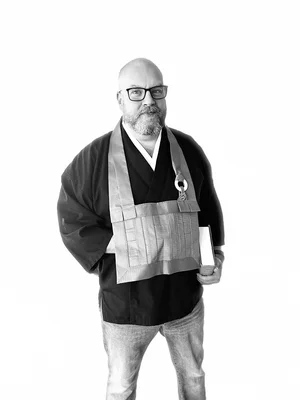
So the Shōyōroku, or the Book of Serenity, is a collection of a hundred cases. It's when you're about two-thirds of the way through your training, you’ll encounter this text.
This is the 63rd case, and it's called “Jōshū Asks About Death.”
Jōshū asked Tōsu, “When one who has experienced the great death returns to life, then what?”
Tōsu said, “It's not permitted to go at night. One must get there in the daylight.”
So here we have Jōshū, the famous pretender of lips and tongues, and we enter the gate with Jōshū, and we encounter him many, many times in our common studies.
He's asking a question.
When a person who dies the great death revives, then what?
We may know conceptually, if we've studied or practiced for any amount of time, that this great death is meant to be nothing other than the dropping off of body and mind.
This dropping off is seeing through all the constructs and concepts that we use to define ourselves, or what we call the small self.
To do this, we have to become vulnerable.
We have to look closely at ourselves.
Many years ago, I remember I was working as a director at a small but growing firm in Chicago when I finally received word I was being promoted to vice president.
And I was in my early 30s.
So I received word I was being promoted to vice president.
And it was in my early 30s, and this was everything I'd set out to accomplish.
Everything up until that time in my life had been about more.
But more never seemed to help.
I really had nowhere to turn.
I couldn't figure out why more wasn't working.
But I was confident in the story that I had written about myself.
The story that knew everything there was to know.
Some of it, maybe, I would admit that I didn't know precisely, but I knew what was in that.
I knew what I didn't know, right?
And I was having a lot of trouble at the time.
So I decided that if I went to a Zen center, maybe I could figure out what it was that I hadn't yet acquired.
I had that one last piece of the story, and the puzzle would be complete.
And I think it would make sense.
So I embarked on the journey that many of you have begun, right?
But it didn't take long for me to see that there was something very different about this practice.
I was asked to look within, but I didn't feel I needed to do that, right?
I already had the title.
I was in my 30s.
I was at the height of my working powers.
I had money.
There was nothing inside that was missing.
I just needed the last piece of the story.
Maybe it was enlightenment.
Maybe it was just this understanding of what it was all about.
But I was forced to look within, and I met some things there that I wasn't very comfortable with, right?
I met a young, scared boy of a man who didn't want anybody to figure out I was swimming in water that was way over my head.
But I was using people, and using substances, and anything else I could to fill gaps in my story, to fill gaps in my narrative, to create more solidity, to create more confidence.
When I looked at it closely, I discovered the story was a lie.
And as I began to continue to open up to it, I saw it wasn't just a small lie.
It was actually many nested layers of lies.
There was a story I told others about who I was to hide who I really was.
Then there was the story I told myself about why I needed more and why I deserved more.
But even that didn't make sense.
So when I finally looked closely at all of these disjointed things, or facets of my life, I began to see past the story.
I realized that the story had its genesis in the expression of “I.”
And in that moment, in that flash, you become aware that there is nothing needed.
And it's all right here.
There's no one to want and nothing to have.
They're all just idols of the discursive mind.
And there's a taste of freedom.
There's a taste of things opening up in this death of the self.
But that's not the whole story, right?
I began to become aloof to the story.
Well, if it was all just a story, then I would just stop telling the story.
So work didn't matter so much.
Neither did money.
Neither did my spouse at the time.
Or, for that matter, my children.
I just needed to sit.
If I sat, I would see.
And I paid.
There were some consequences here for this withdrawal.
But I thought, if I just sat more, dropped off more, then my nature would show through and I'd be rescued.
This is a place they call Zen sickness.
Colloquially, it's also known as spiritual bypass, right?
And this causes a grasping of its own.
When we think, “I'm beyond this. None of this matters,” we create a new headspace, this new realm of I-ness.
Or non-I-ness, yeah?
We run so fast from our lived experience, right?
Collapsing in, but we find nowhere to hide.
You can't hide yourself here in this idea or concept of oneness.
You have to come back to life.
To look at the circumstances of your life.
To see clearly.
And that includes all the karmic vestiges of this self that we have, yeah?
The self that we've created.
And the inheritance of our actions that we own.
Then, when we become aware of this, with our eyes open, we can begin to work skillfully with our life and transform it in a way that's nourishing.
Nourishing to everybody that we come in contact with.
That is kind.
That's compassionate.
That heals.
We say those are just ideas, in a sense.
But when we see them for what they are, and we lose ourselves in our activity, then this constructed self can point clearly as a way to manifest our intentions.
Yeah?
Then we live.
We die so we can live.
It's about being playful, being creative, being joyful, being a medicine.
Be what the karmic circumstances need to transform the suffering that we come in contact with into compassion.
Actually begin to enjoy your life.
Yes?
Have fun with it.
Even all the things right now that we consider to be a bore or drudgery.
Really appreciate them.
Appreciate that argument with your spouse.
Yeah?
Appreciate those undone chores.
Really look for those vestiges of self-importance.
Those are always fun.
Have a really good time looking at that.
Standing and looking in the mirror.
Don't even get me started with this, right?
Treat your life with care and live skillfully.
Use your time well.
There's some new ideologies that we can build here.
We could say that it's about embodiment.
But that's not entirely it either.
It's not about doing precisely what our body says or what feels right all the time.
It's just another way of getting stuck.
We were trapped in our discursive mind.
We can be trapped in our somatic mind as well, our somatic self as well.
Instead, be what is needed.
Rise to the circumstances.
Be right here.
Do it now.
This is it.
This is no dress rehearsal, right?
And you're the one.
So if it's going to happen, it's going to be through your activity and your dedication.
Manifesting your intentions, not your goals.
You can get rid of the goal-seeking mind.
But we can be present with our intentions.
And so it's important, in a very root sense, that we get to the bottom of those intentions.
But it starts with accepting suffering where we find it and steering into the skid.
We feel ourselves going off the track.
We don't run away from suffering.
We dive right into it.