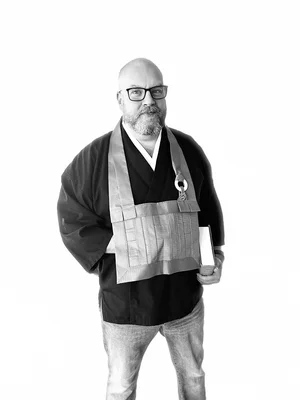
Delivered by Sensei Michael Brunner of Ottawa, Illinois at One River Zen. This talk represents the center’s commitment to a "blooming, eternal spring" of practice. By synthesizing the radical empiricism of David Hume with the 13th-century wisdom of the Mumonkan, Sensei Brunner dismantles the "stale narratives" of the discursive mind to reveal a field of direct, boundless experience. Explore more from our community at One River Zen—where ancient tradition meets the modern mind.
Good morning. It’s truly a gift to be together with everybody, doing this practice, sitting together. We’ve had a beautiful morning of practice, a wonderful service, and that sense of newness, that sense of wonder, that sense of beauty is something we need to protect. We need to protect the sense of newness that we cultivate. We call it this blooming, eternal spring. We think of things as they present themselves, always coming up anew, unburdened by what we think we know—some notion of how we think things should be.
I often reflect on the fact that for a tradition that espouses a state of wonder, we have a ton of text, a ton of things to study! We’re right in the middle of a study of several fascicles of Dōgen, and I can make that statement—you know, six months ago it would have been true, and six months from now it will be true as well. Or, you know, we have a study plan of the Laṅkāvatāra Sūtra, we’ve done the Platform Sūtra, we’ve done the Diamond Sūtra—we’re doing these on a regular basis.
It’s important that occasionally we recalibrate our compass. In the Mahāyāna school of Zen, when we talk about textual criticism, we are often asked to refer back to the Four Reliances. We don’t have a ton of systematic—for lack of a better term, we could say cosmology, we could say theology—but this is the cornerstone of how we approach teachings:
1) Rely on the Dharma, not the person—not the teacher. The authority ultimately of a teaching depends on its truth. Not charisma or status or the color of that person’s rakusu. If what’s being taught doesn’t actually coincide with our experience as we’re living it, then it’s not truth.
2) Rely on the meaning rather than the words. Language ultimately is just a finger that’s pointing to the moon, motioning at what’s there. We don’t spend our lives studying the texture of the fingernail. We have to actually look, or approach where it’s pointing. It’s a specific terminology we use to get there, but it’s secondary when compared to the actual spiritual essence of what’s being motioned to.
3) Rely on the definitive meaning rather than the provisional. Provisional teachings are fraught with skillful means. We use those as a scaffold to lead us toward some deeper essence of truth. But you can’t live on the scaffold. We move through the provisional to reach the direct reality of emptiness and Buddha-nature, and it’s found moment by moment, not in some dusty old tome. Not to say that they’re not important—they’re wonderful ways to point us to what’s here—but ultimately we have to jump in.
4) Rely on wisdom rather than the discursive mind. It’s the heart of our practice. Real understanding comes from non-conceptual, direct wisdom rather than the dualistic, intellectual chatter of the thinking brain.
So when we set these up, we set them up with an eye toward our correct use of the teachings, our correct use of the sūtras and the things we chant. They’re gateways, but don’t get stuck in the gate. That being said, it opens up some amazing possibilities. We begin to recognize that the teachings are everywhere. They’re not limited to some Buddhistic notion of cosmological truth. Other faith traditions point very well, too. They’re using different words, different language, but if you don’t get stuck on the words and the language, they’re pointing to the same place. Even Western philosophy, which to a large extent we say Zen and philosophy don’t get along very well, but if you look closely you’ll see that Dōgen himself has been named as an exponent of Zen philosophy by Western thinkers.
I was thinking about David Hume this morning, an 18th-century philosopher, and he has a lot to say about why we struggle in our lives and why we struggle on the cushion. He lived from 1711 to 1776. He was a giant of what we would know today as the Enlightenment, famous for his radical empiricism and skepticism. He noticed a glitch—a way we all get hung up in our human operating system, our karmic construct—and he used it to explain exactly why we get stuck in our heads.
He divided the mental world into two categories: impressions and ideas. An impression is vivid and forceful. When you walk out into the cold, it’s there. If your knee is in pain, that sharp ache is very real. When a bell peals, the piercing sound is immediate. These are the experiential essence of life as it presents itself right now.
An idea, on the other hand, is a faint copy of that impression. It’s the memory of the ache or the bell. It’s the shorthand we use to talk about our lives, but we often cling to the shorthand. That creates a practice problem. We come to the cushion with ambition and treat enlightenment like a destination we can reach if we just think about it hard enough. We turn practice into a laboratory of faint copies, compressing raw experience into stale narratives: good sit, bad sit, good practitioner, bad practitioner.
Hume warns us that these are just shadows. This is the shadowboxing of the discursive mind, where we think we’re interacting with reality but we’re really just flailing, like a dog running in its sleep. It doesn’t actually get anywhere, and sometimes it knocks things over. We listen to the inner critic and miss the vivid, forceful reality that is always present right here and right now.
And this points to a case, the 19th case of the Mumonkan, called Ordinary Mind Is the Way:
Joshu asked Nansen, “What is the Way?”
Nansen said, “Ordinary mind is the Way.”
Joshu asked, “Should I turn toward it?”
Nansen said, “If you turn toward it, you go against it.”
Joshu asked, “If I do not try to turn toward it, how can I know it is the Way?”
Nansen said, “The Way does not belong to knowing or not knowing. Knowing is delusion. Not knowing is blank consciousness. When you truly meet the Way, it is vast and boundless like the open sky.”
Nansen is pointing directly to this problem. The moment we try to grasp the Way as an idea, we lose it. We trade direct experience for a conceptual map. Hume showed that even our most basic beliefs arise from habit, and in Zen we call that karmic momentum. These patterns feel convincing, but they are just patterns.
So when we hear “not knowing,” we have to be careful not to turn it into dullness or blankness. True not knowing is profound wonder. When we drop the shorthand of the intellect, we don’t fall into a void—we open into a vast, boundless field of direct experience. In that openness, we are able to respond, to act, to meet what is here.
So the invitation is to drop the story and open to the wonder. When we do that, the boundaries we rely on begin to dissolve. We are no longer avoiding suffering—we step directly into it. And in that movement, we realize we are not standing apart from life trying to understand it. We are already participating in it completely.
And when that happens, it becomes clear that we are not looking at the moon. We are already dancing with it.