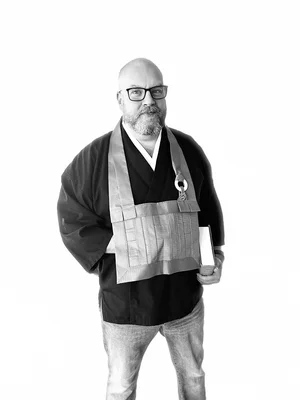
Good morning, everyone. So happy to have you here. And to those joining online as well.
I'm Sensei Michael Brunner, the abbot of One River Zen. We had a beautiful service this morning, with Chief Priest Shūhō Sensei (Robert Steele) officiating. All the service positions were filled by people new at it. A lot of wonder being experienced. That’s when the real beauty comes out in this practice!
Everything is always new—always walking into a blooming, eternal spring.
I have to laugh sometimes, because is that how we always practice? Sometimes we approach our practice—and by that I mean our lives—with a fixed idea before we start of where it should finish. We wake up in the morning and think we know what we're going to see that day.
And miracle of miracles—we see what we expect to see.
But we still don't stop to reflect on that. The universe is vast and wide and as beautiful as this. How could it be that we only see what we expect to see? And yet that conundrum sometimes goes unnoticed.
There's a case in the Shōyōroku—the Book of Equanimity. It's the sixteenth case. It's called “Mayoku Thumps His Staff.” And it speaks to this conundrum a little bit.
The case says:
Mayoku arrived at Shokei’s place holding his staff. He walked three times around the meditation seat of Shokei and thumped his staff once.
Shokei said, “Right! Right!”
Mayoku afterward went to Nansen’s place. Again he walked three times around the meditation seat and thumped his staff once.
Nansen said, “Wrong! Wrong!”
Mayoku said, “Shokei said ‘Right.’ Why do you say ‘Wrong’?”
Nansen replied, “For Shokei it is right. For you it is wrong. What comes from the power of the wind in the end becomes broken and crumbled.”
Beautiful case. Beautiful case.
But again, we practice with these koans not because we want to unravel them as some great cosmic riddle. Using the mind road is what got us into this trap in the first place. Koans resist that type of inquiry. We have to sit with them and allow them to unfold within us.
And then we notice that there’s nothing outside.
The truth is that the circumstances of our life present themselves directly and unabatedly. When we encounter suffering, it can be a challenge. We’re so often inclined to enter the laboratory of our thoughts when this happens.
“Oh, I’m experiencing something a little rough. Better think this through.”
And we play out different scenarios of engagement—little chess games—and we weigh all the different potential outcomes.
The only problem here, of course, is that all we have in our mind are representative symbols. We can’t compress the richness of this being, this life, into a narrative. So we take shorthand:
Respect and disrespect.
Good and bad.
Sword and plowshare.
Each stands in for an unfathomable amount of rich, lived experience.
But over time, if we continue playing these mind games, we can be seduced into thinking that this shorthand is the equivalent of our lived experience.
Even worse—we begin to project our understanding of that shorthand into our lives as they are. And we no longer experience what is actually at hand.
When we practice in that way—when we're out of balance in that way—our actions become incongruent with the practice imperative that wisdom demands in any given moment.
Our life becomes a stale, syndicated rerun of past accomplishments, past defeats, past highs and lows.
I've often referred to it as shadow boxing.
We keep raging against something. We keep protesting. But we're just swinging. We never actually land a punch.
We keep ordering around a compact narrative of our limited understanding, and we reject the actual wisdom that is always presenting itself.
And this is precisely what this koan is pointing to.
Mayoku performs what appears to be the exact same action in two different rooms: the same three circles, the same strike of the staff.
One master says “Right.”
The other says “Wrong.”
Now the action itself is lost. It's out of focus.
What winds up happening is that we can’t see whether the action arises freshly from the living moment, or whether it is some repetition of something that once worked—some gaining idea, some grasping for rightness or wrongness.
Nansen is not necessarily grasping or rejecting the gesture. He’s trying to help Mayoku see the insubstantiality not only of our judgments, but of our clinging to those judgments—and of ourselves acting out of those judgments.
Just to see this play as it is, in and of itself, is a powerful kenshō.
Often people will come to me and say, “My practice is out of balance. I'm doing this wrong.”
But if you're seeing that your practice is out of balance, there’s strength in that.
Suzuki Roshi once said that when you have a stomach ache, you should actually be happy you have a stomach ache. Because the stomach ache forces you to address some underlying issue. It's when your stomach is diseased and you stop feeling the ache that you really have a problem.
The ability to see how illusion sets in—and the power of its seduction—that’s the important part of our practice.
Through these eyes we become capable of shifting our gaze and actually bearing witness directly to the full council of our lives just as they are—just as they are always presenting themselves.
The weight of our judgments and labels becomes much lighter when we begin to see their insubstantiality.
We see that the whimsical notions we erect in our mental sandbox must all meet their end. And how very tenuous they were in the first place.
What’s actually left when we open to this truth?
What’s left when we recognize that the sandcastle we build in the mind must eventually collapse?
The Preface to the Assembly points to this very place. It says:
Pointing to a deer, it becomes a horse.
Grubbing the soil, it becomes gold.
On the tongue, winter thunder is raised.
Between the eyebrows, a bloody blade is stored.
While sitting, success and failure are perceived.
While standing, life and death are examined.
Tell me—what kind of samadhi is this?
Notice that last line.
What kind of samadhi is this?
When the experience overrides the narrative—when we are engaged by what is present and step into our lives wholeheartedly—what kind of samadhi is this?
A student approached me recently. Sometimes students are the best teachers.
He confided: “I struggle sometimes. I look at my son or my wife—and I worry. What if something happens to them?”
That's a good question.
How do we sit with that?
What does that moment demand?
When you look at your son, a feeling of boundless love opens. A desire arises to make that moment very special—to recognize that everything we love, everything we cherish, will eventually be separated from us.
We sometimes imagine we can escape that truth through some logical progression of steps—chanting the name of the Buddha, performing a perfect bow.
But when we do that, we avoid the responsibility of the moment.
When that truth is present, we actually know exactly how to act.
Wisdom takes over.
That’s what our practice is about.
What he was experiencing was not a problem. In fact, it was a very profound moment of awakening.
Nansen’s warning echoes through this moment:
“What comes from the power of the wind in the end becomes broken and crumbled.”
When we think we have it figured out—when we think we can construct a mental trap and somehow escape the imperative of our life—that borrowed understanding, borrowed gestures, borrowed certainty—that is full delusion.
They cannot endure.
They may captivate us for a little while, but they can never actually meet this living moment.
There is also an appreciatory verse for this case:
Right and wrong—watch out for the trap.
It seems to be putting down; it seems to be approving.
Who is the elder? Difficult to tell.
Who is the younger? Difficult to tell.
He knows how to release when it is time.
What is so special about my snatching away?
Thumping the golden staff, standing all alone,
Circling the rope seat three times, he plays at leisure.
Being agitated, Asanga spawns.
Right and wrong—
I reflect that the demon’s seed
Is born in a withered skull.
I like that line:
He plays at leisure.
“But Sensei, I’m very busy. I have a long list of things to do.”
There is only one thing to do at any given moment!
What the practice imperative of that moment demands.
What wisdom demands when we are fully immersed in the circumstances of our life.
You will never experience that as long as you don’t know when to release—when to let go of our ideas and judgments about it—and step directly into it.
The bow is drawn, and we see the suffering of the world everywhere we look.
It resonates right here—even in this very moment.
What is being asked of us is that we verify our aim is congruent with our intention.
We all know our intentions.
Are we present with them?
Have we set our intention to transform suffering and bring release?
Step into it.
Release yourself right into this beautiful wonder of our life.
He knows to release when it’s time.
It’s time.