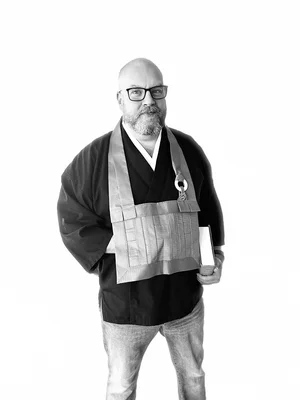
Stop Trying to Fix Yourself | A Zen Teaching on Not Knowing | Shoyoroku Case 45
Good morning, everyone. It’s nice. I think we’re just getting the first hints of autumn out there!
It’s a wonderful time of year, a time of change. There’s plenty of change going around, yeah? A lot of wonderful change. It’s not always easy because there’s this anxiety about not knowing.
“I don’t know how this is all going to happen. I don’t know how this is all going to turn out.” There’s a great temptation in our practice to believe that knowing is the same thing as seeing clearly.
We want to know what’s happening. We want to know why it’s happening. We want to know whether we’re making progress, right? Is this relationship going to work out? Is this job going to last? Is this decision the right one? Yeah.
We want to know where we stand. We think if we can stand in the firmament of our certainty, we’ll find some degree of peace. But we spend such an enormous part of our lives trying to turn the uncertainty of actual experience into something certain that we miss what’s right before us.
We make judgments. We form opinions. And we tell ourselves these stories, and we diagnose ourselves and everybody who’s around us.
Once we’ve done all the work, we sit in the little world we’ve created, and we have a name for it. We say, “This is reality. That person is detached from reality because I know reality.”
This is my reality. The problem is that reality refuses to cooperate. Something changes.
Somebody surprises us. Our body gets sick. The relationship changes.
Something we thought we understood suddenly looks very different. Our rich tenant doesn’t pay their rent. Instead of noticing what this might tell us about the limitations of certainty or the boundaries of ourselves, we usually respond by trying to know harder.
I want to figure this out. So we create another explanation. Eventually, our explanations stand between us and our life.
And that brings us to Case 45 of the Book of Equanimity. The name of the case is “The Sutra of Complete Awakening.”
Attention!
The Sutra of Complete Awakening says:
“Be at all times without deluded thoughts arising. Moreover, with regard to all deluded states of mind, do not try to extinguish them. Dwelling in the realm of delusion, do not add discriminating knowledge. When knowledge is absent, don’t distinguish reality.”
We may think that the monk is asking a clever question, but in this case, there’s no monk to ask it. It’s just a declarative statement.
There isn’t a master slamming a door. There’s no one raising a finger. No one gets hit with a stick.
The koan is actually four lines lifted from a Buddhist scripture. And the scripture involved is usually called the Sutra of Complete Awakening in English, the Engaku-kyō in Japanese. Tradition held that it was an Indian text translated into Chinese, but modern scholarship generally regards it as a Chinese Buddhist composition from around the beginning of the eighth century.
And it became enormously influential in Chinese Buddhism through the work of Keihō Shūmitsu. But interestingly enough, Dōgen himself appears to have been skeptical of the scripture, and he didn’t accept it the same way many of the other Chinese masters did. Yet, here it is right in the middle of a koan compendium.
And what I love about this case is it actually begins by giving us what sounds like a perfectly reasonable instruction: “Be at all times without deluded thoughts arising.”
Well, sure. That sounds like Buddhism, right? Get rid of delusion.
Become wise. Stop thinking stupid things. Straighten yourself out.
Have some discipline, man!
Many of us begin our practice with exactly this idea. We sit down on our cushion, and we discover that our mind is full of thoughts.
So we assume that the assignment must be to get rid of them, to banish them. We notice things like anger and jealousy, anxiety or fear or lust or ambition. And we think these are all the things that enlightened people shouldn’t have.
And so we begin cleaning house.
But the Sutra takes a turn, right, and it pulls the rug out from under us: “With regard to all deluded states of mind, do not try to extinguish them.”
Huh? What?
First, you tell me not to have deluded thoughts. Then you tell me that when deluded thoughts appear, I shouldn’t get rid of them.
This is where we do the work. Do the work.
Because the first instruction is not really telling us to construct some purified mental condition in which nothing troublesome ever appears. It’s pointing toward not manufacturing something extra.
Just accepting what’s present, working with what’s there. A thought appears. Okay.
An emotion appears. Yeah, that’s an emotion.
Fear appears.
Ah, is that so?
But notice how quickly we take whatever appears and we start building. Fear appears, and I want to know why I’m afraid. Should I be afraid? What does this say about me? What happens next? How do I make this stop? You know, you should even start talking faster, right? Your thoughts start racing.
And pretty soon the original experience of fear is almost nowhere to be found. We surround it with a whole architecture of interpretation, which I’ve talked about before in this notion of exhausting the mind road. We continue trying to reason our way into intimacy with our own experience and eventually have to discover that the mind road simply doesn’t get there.
Reason has tremendous usefulness, but it can’t substitute for actually being moved by what’s here.
So the Sutra says, don’t give rise to delusion. But when delusion appears, well, don’t try to extinguish it.
That second part’s really important because the moment we decide that some state of mind has no place in our practice, we’ve created yet another division. Now there is the mind I have and the mind that I’m supposed to have. There’s the angry me, and there’s the spiritual me.
There’s the fearful one, and there’s the fearless one. And now we’re chasing enlightenment around the room trying to get away from ourselves.
So don’t extinguish it.
Sit with it. Let anger be anger. Let sadness be sadness.
Then the case takes us to the third movement: “Dwelling in the realm of delusion, don’t add discriminating knowledge. When knowledge is absent, don’t distinguish reality.”
This is where things get a little trickier and a lot more interesting, right? So we’ve stopped trying to suppress experience.
Now the Sutra tells us not to stand over it and do an autopsy. Don’t try explaining it. Even that state of mind isn’t something.
Don’t add discriminating knowledge. When that discriminating knowledge finally falls away, don’t make the mistake of saying, “Ah, now. Now we’ve reached reality,” because now we just constructed something new.
The act of Zen isn’t so much about adding things as it is letting things be present and letting them drop away of their own accord.
We think practice has to move in the other direction. We imagine that when we begin practice, we’re uncertain, but eventually, after enough years on the cushion, we’ll become very certain people.
That’s not what happens at all. This practice is about becoming increasingly comfortable with uncertainty. Becoming less desperate to know.
Great Doubt is sometimes how it’s expressed when we’re pointing to Zen teachings: “Great doubt, great awakening. No doubt, no awakening.”
Boshan, the master of old, said that.
But Great Doubt doesn’t mean walking around suspicious of everything. It doesn’t mean cynicism or paralysis.
Small doubt says, “I don’t know what to do, and I’m afraid I’ll get it wrong.”
Great Doubt says, “What if the ground I think I’m standing on isn’t there? What if the person I think I am isn’t as fixed as I imagine? What if my understanding of this life is very tenuous, and it’s no more than a handful of conceptual ideas that have accumulated, attached together, and been mistaken for this thing itself? What happens if I move beyond knowing?”
We talk about the Three Transformative Touchstones. The first is Maintain Wonder.
Not wonder in some sentimental sense. We’re not walking around pretending every flower is just as beautiful as the next and every sunrise is magical, although they are.
Wonder is actually the willingness to encounter something before we decide what it is.
Wonder means allowing this moment to remain larger than our explanation of it. That’s why we maintain wonder. Because the moment I’m absolutely certain what you are, I stop seeing you.
The moment I’m absolutely certain what my life is, I stop living it.
Wonder keeps the door open.
There’s a preface to this case, and it goes straight at it.
It says:
“A manifest koan depends solely on right now. The absolute manner distinguishes only itself. If you try to set up gradations or intentionally strive, all this is painting eyebrows on chaos or attaching a handle to a bowl.”
So how is tranquility achieved?
A manifest koan depends solely on right now.
Not yesterday. Not after you fix yourself. Not after you become enlightened.
Right now, this is the koan.
Your knee hurts. Somebody’s coughing. David once again is displeased about something.
You’re worried about something happening on Monday. You’re ruminating about that argument that you had with your wife or the one you think you’re about to have.
That’s it.
The manifest koan is right there.
If we start creating gradations, if we start saying that this state of mind is higher and that state is lower, this experience is spiritual or that one’s mundane, then we start painting eyebrows on chaos.
So this is actually a reference to an old Chinese story about Chaos, in Chinese, Hun Dun.
Hun Dun was born with no openings in his face. Now that’s sad, right? So all of his friends decided to help him by giving him the openings that everybody else had.
So day after day, they bored another opening into him.
And when they finished, as predicted, Chaos died.
They improved him to death.
That’s sometimes our practice, right? We look at this perfectly complete life and say, “You know what this needs? Eyebrows.”
So we paint them on.
We take the bowl that’s perfectly capable of being a bowl and say it needs a handle. We keep adding something.
So the introduction says, well, how is tranquility achieved?
The moment you try to attain tranquility, you’ve already disturbed it. Because now there’s you over here and tranquility over there.
Or you think, “Well, maybe tomorrow. Maybe after another retreat. Maybe when we finish building the zendo. Maybe after another ten years of zazen.”
But this isn’t the manifest koan.
The manifest koan is right there.
The poem at the end is beautiful, too:
“Sublime, magnificent, courageous, magnanimous,
piercing your head in bustling places,
walking along in tranquil places.
Underfoot, string cut away, perfectly free.
Stop cutting.
The mud’s gone from the nose.
Don’t be disturbed.
A prescription on thousand-year-old paper.”
Now you read that and you think there’s a lot of beauty here, but what’s this nonsense about the mud being gone from the nose?
The liberated person doesn’t require quiet.
We sometimes imagine Zen freedom as somebody sitting beside a mountain stream where nothing difficult ever happens. But in our practice, we’re sent straight into the marketplace.
You know, the place where there are buses and kids and deadlines and bills, divorce, traffic, and grief.
It’s saying: walk right into that.
Yeah.
Walk right into that.
None of those circumstances own you.
You’re free.
The cords around your feet are gone. You can walk.
But then that peculiar line sticks in you:
“Stop cutting. The mud’s gone from the nose.”
There’s another old Chinese story about an extraordinarily skilled axman who could slice a tiny speck of mud from another man’s nose without actually touching the skin.
The verse is saying, the mud’s already gone.
Put the ax down.
Stop goofing around here, right? You’re going to cut right into your practice with that.
Someone’s going to get hurt.
But how much of our practice is walking around with an ax looking for something to remove?
A bad habit.
A bad self.
A bad thought.
Cutting and cutting and cutting versus: stop cutting.
The mud’s already gone.
It’s almost comical, the ending line:
“Don’t be disturbed. A prescription on thousand-year-old paper.”
It’s a thousand years old in the twelfth century already. How much older is it now?
Take the medicine when you need it. But don’t worship the prescription.
Buddhism itself can become one more thing when we try to use it to avoid our direct experience or our lives. We collect teachings, go through our rituals. But don’t stop being astonished about this one life.
Swallow the medicine.
Throw the paper away.
There’s an old poem called the Shinjinmei, Faith in Mind.
What does it mean to have faith in mind? What is mind?
It doesn’t mean certainty.
That’s backwards.
Faith is what’s possible when certainty is no longer expected or required.
But we like to know the why of things.
The Perfect Way appears when our gaining idea dissolves, when we stop making distinctions and simply return home.
Faith that this life can be met directly.
Faith that when suffering appears, my hands will be moved by the experience if I just drop some idea of what the experience is or should be. And maintain wonder and allow ourselves to be moved.
Who knows?
When you’ve already decided what kind of day you’re having or what some difficulty means, right there, before you paint another eyebrow on Chaos, just stop.
Let yourself not know.
Maintain wonder.
See what’s actually presenting itself.
And then join the dance and actually be moved.
So before we finish, I just want to remind everybody that in October, some of you may not have heard about this, we’re also going to have our eight-week Artist-in-Residence Program again.
So this is a way of exploring the intersection of contemplative practice and creativity, and I’m really excited about it.
It actually dovetails well into this talk because creativity requires exactly that kind of wonder.
So we’re putting this on in cooperation with the Ottawa Center for the Arts.
So it’ll be held at the Abbey, which is on the other side of town. On Wednesdays, we’ll be lecturing from 6:00 to 7:30.
So I hope you’ll all mark your calendars. Go to OneRiverZen.org/artists, or you can click on the link in the middle of the page.
So we’ll be doing the lecture series there, but then we’ll do the final presentations at the New Hall on Jefferson Street. So it’ll be in cooperation with those two organizations.
And I’ll be giving you more information as it comes, but this year it’s not just for the people in residence.
We’re actually doing this lecture series and having everybody kind of participate. The two people will be called out specifically to go take a deeper dive into this intersection, and they’ll do a separate presentation at the end.
So everyone can sign up, be a part of it.
So the idea as you’re going out into this week is: don’t be so quick to know, right?
The mud’s gone.
You put down your ax and just maintain wonder.
See you all for meditation first thing Monday morning.