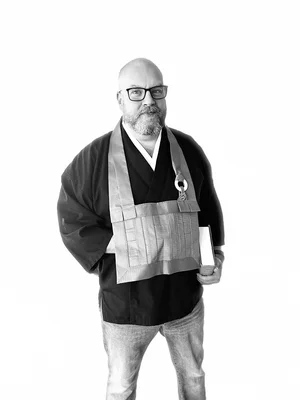
Transcript of the first lecture in a four-part series on the Dhammapada delivered by Sensei Michael Brunner at One River Zen in Ottawa, IL
So I want to begin tonight with the first two verses of the Dhammapada. But I don’t want to explain them. I want to just let them sit there for a while.
Because I think if we start by asking what they mean, it kind of loses the luster of the wonder involved in them. I think it’s worth considering how remarkable it is that we have these verses at all. Here they are:
Mind precedes all mental states. Mind is their chief. They are all mind-wrought.
If with an impure mind a person speaks or acts, suffering follows them like the wheel that follows the foot of the ox.
Mind precedes all mental states. Mind is their chief. They are all mind-wrought.
If with a pure mind a person speaks or acts, happiness follows them like their never-departing shadow.
So somewhere around 2,500 years ago in northern India, a wandering teacher spoke in this way to people.
He didn’t write a book. He didn’t leave behind a manuscript. He didn’t set out to establish a religion in the way that people tend to imagine religions being founded.
He just taught. And people listened. They remembered what they heard.
And then they went on to repeat those teachings to others. Over time, communities began to form around these teachings. And those communities continued long after the teacher himself was gone.
And then, over time, those teachings traveled enormous distances. They crossed languages. They crossed cultures.
They traveled south to Sri Lanka and Southeast Asia, made their way through Gandhāra and Central Asia. They eventually moved into China, Korea, Japan, Tibet, and then throughout the world.
And now here we are, sitting in a small town in Illinois, opening a collection of verses that emerged from that stream of teaching, that stream of practice.
So before we begin to ask what the Dhammapada says, I think it’s worth backing up a couple of steps and asking a few more basic questions.
Who was this person we call the Buddha? What was the world in which he lived? How did what he taught become what we now call Buddhist scripture? And where does this small collection of sayings that we call the Dhammapada fit into that much larger body of teachings?
We tend to tell the life of the Buddha as though Buddhism somehow appeared fully formed beneath the Bodhi tree, right? He stood up, and here was the canon. It was all set.
Before that moment there was no Buddhism, and then Siddhārtha Gautama awakened and suddenly Buddhism existed.
But, as history often plays out, it’s always a little more complicated than that, and actually a little bit more interesting.
We’re somewhere in northern India in the middle of the first millennium before the Common Era, and we’re not talking about these texts yet.
We can’t place the Buddha’s life without some form of conjecture. We don’t have precision in this. Traditional chronologies vary all over the place. Modern scholarship has moved the dates around over the last several decades. But the safest thing to say is that Gautama probably lived sometime around the sixth or fifth century before the Common Era, with many scholars placing most of his life in the fifth century.
And the world around him was changing, and it was changing fast.
Towns were growing, trade was expanding, and new political states were beginning to emerge. Wealth was being distributed, and it was moving.
People were traveling, and there was the hint of social structures becoming a little bit more malleable. There was a degree of social mobility and even some instability that hadn’t existed in quite the same way before.
Religiously, this was also a very active world, right? The Brahmanical traditions of sacrifice and ritual were still deeply established, still held sway, but they weren’t the only game in town.
There were groups of wandering renunciants known broadly as śramaṇas. People had stepped outside the ordinary structures of household life because they believed the central questions of human existence couldn’t be answered just through standard familial structures or property or status or political power.
And these people were out there experimenting in this lab we call life.
They fasted. They meditated. A lot of them practiced extreme austerities.
And they met and debated with one another. They developed ideas about things like karma, rebirth, liberation, consciousness, and this thing we call self. Some believed freedom came through purifying oneself by enduring suffering.
Others pursued deep meditative absorption. Some were determinists. Some questioned whether moral action even mattered.
So when Gautama leaves home, he’s not inventing the idea of spiritual renunciation. He’s already entering into an existing conversation that has been playing out.
The Buddha didn’t begin with the question, “How can I create a new ideological system? How can I create Buddhism?”
It actually started off with a much more immediate question.
Why is there suffering?
Why is there suffering?
And is there a way through it?
That question is the real beginning of the Buddhist story.
The man we generally call Siddhārtha Gautama belonged to the Śākya people, which is why one of the names we use for him is Śākyamuni, the Sage of the Śākyas. In the Pāli texts he is usually called Gotama.
Siddhārtha is a Sanskrit name that becomes more prominent in later biographies.
And then there’s the name by which we all know him best: Buddha.
Buddha is not a personal name. It’s a title. It means “Awakened One.”
What becomes central is not who Gautama was, but what happened to him.
He woke up.
Tradition tells us that he was born at Lumbinī, near the modern border of Nepal and India. And the familiar story says that he was born into privilege, often described as a prince.
His father attempted to protect him from the unpleasant realities of life. He lived surrounded by comfort until he encountered, somewhat by chance, an old person, a sick person, a corpse, and finally a wandering religious seeker.
And the first three sights revealed something that he couldn’t get out of his mind, something profound.
We grow old. We become sick. And we die.
And this inconvenient truth that his father had so ardently tried to protect him from was suddenly brought to the fore.
The fourth sight revealed something different. He saw the wandering mendicant. That is: perhaps there’s another way to live in the face of all those realities.
I’m not suggesting that we should look at this as historical fact. The complete and beautifully polished version of the Buddha’s life develops over generations. It’s not something we were handed from the get-go.
The earliest texts don’t give us a modern biography. They give us pieces, memories, teachings, stories.
Later Buddhists take those pieces and shape them into a kind of sacred life story.
But that doesn’t make the story unimportant. In a lot of ways, I would argue that it makes it more important, because the story becomes a way of expressing what generations of Buddhists understood awakening to mean.
But underneath all those later details is something we do find very early.
Gautama recognizes that he himself is subject to aging, sickness, death, and sorrow. And yet he keeps seeking security among things that are themselves subject to aging, sickness, death, and sorrow.
And something about that doesn’t make any sense to him.
I think that’s one of the most powerful moments for all of us, because it’s not exotic. It’s what we all do.
It’s a familiar pattern that all of us who are born in this human form follow.
We know everything changes, and yet we spend an enormous amount of our lives trying to arrange changing things in such a way that we hope they’ll stop changing.
If we could just get enough money, then we’d be secure.
Or if we could find the right relationship, then we’d be secure.
If my body would just cooperate. If I could have that magic surgery that fixes everything, then maybe I could trust it.
Gautama sees the problem.
Everything we’re using to construct that security is itself unstable.
So he leaves.
Tradition calls this the Great Renunciation. But I’m not sure we should understand renunciation here as him simply rejecting something.
He’s not running away from life. He’s actually looking for a more honest way to meet life.
And so he studies with teachers.
He enters profound states of meditation. Those don’t settle the matter.
He turns toward severe asceticism. He deprives the body. He pushes himself until he nearly dies.
That doesn’t settle the matter either.
And this becomes one of the major turning points in what we now call Buddhism.
Gautama discovers that awakening will not be found through indulgence, but neither will it be found by declaring war upon his own existence.
Later, our tradition will call this the Middle Way.
And so he begins to eat.
And when he’s eating, he’s just eating.
He recovers his strength. Slowly, he walks. He’s just walking.
And then he sits.
The tradition places him beneath the Bodhi tree at Bodh Gaya. There he resolves to remain until his matter is settled, and something happens.
Different Buddhist traditions describe the experience in different ways.
The early texts speak of insight into past lives, the arising and passing of beings according to karma, and finally direct understanding of suffering and its cessation.
Later traditions will use other language, but ultimately we’re all gesturing toward the same place.
Underneath all those descriptions is something very simple.
He sees clearly.
He sees how suffering arises.
He sees what sustains it.
He sees that it can cease.
And he sees a way of practice through which that cessation can be realized.
And that insight becomes the framework for what we now call the Four Noble Truths.
But what I find important here is what he does not discover as well.
He doesn’t discover that somewhere beyond this painful world there is another perfect world that we need to escape into.
He discovers something about this experience, about craving, grasping, ignorance, about the way we construct our own suffering.
And because we construct our own suffering, freedom becomes possible.
So after awakening, tradition tells us that the Buddha hesitates to teach. What he sees, he considers very subtle.
Human beings are deeply attached to exactly the habits that prevent them from seeing it.
Eventually, though, he goes to Sarnath and teaches the five ascetics who had practiced with him before.
And now we have another pivot point.
Before this, we have the Buddha, the Awakened One.
Now we have Buddha, Dharma, and Sangha.
A teacher, a teaching, and people practicing this teaching together.
Then the Buddha spends the remainder of his life moving throughout northern India. He teaches monks and nuns, kings and merchants.
Communities begin to form. Rules develop. Teachings are given in response to particular people, in particular circumstances.
And eventually the Buddha dies, as we all do.
The tradition uses the word parinirvāṇa, or in Pāli, parinibbāna, for the final nirvana of one who is awakened.
But now the Buddhist community faces a problem that every tradition eventually faces.
Their teacher is gone.
What do we do?
What happens to the teaching?
And this is where we have to remove our modern assumptions from the equation.
The Buddha did not write the Buddhist scriptures.
Nobody was walking around behind him writing down every single word he said.
There was no first edition of the Dhammapada signed by the Buddha. You’re not going to find it.
There’s no original copy of the Majjhima Nikāya sitting on some shelf somewhere.
For a very long time, Buddhist teaching was preserved orally.
The traditional Buddhist accounts say that a particular disciple preserved the Buddha’s discourses: Ānanda. But it’s important to note that they don’t say Ānanda wrote them all down.
The original story is one of memorization and recitation, followed by centuries of oral transmission.
According to the traditional accounts, shortly after the Buddha’s parinibbāna, Mahākassapa convened what came to be called the First Buddhist Council at Rājagaha.
Ānanda had been the Buddha’s attendant for many years and was renowned for his memory.
Mahākassapa questioned him about the teachings, and Ānanda recited the discourses from memory.
Upāli, another senior disciple, was questioned about and recited the monastic discipline, the Vinaya.
This is also the traditional explanation for the famous opening of so many suttas:
Evaṃ me sutaṃ.
“Thus have I heard.”
“Thus have I heard.”
Communities memorized teachings and recited them together.
That helps explain something that anybody who reads the early Buddhist texts quickly notices.
They repeat themselves.
They meander.
And they repeat themselves constantly.
As modern readers, we look at it and say, “This is a little excessive,” right?
We think like people holding printed books. If a paragraph has already said something once, why would you repeat it again?
But these teachings grew in a world of hearing and remembering.
And in that world repetition wasn’t a flaw.
Repetition was a kind of technology, yeah?
Numbered lists: another kind of technology.
Communal chanting: another way of embodying it, another form of technology.
The teaching was preserved inside human beings.
Isn’t that beautiful?
Precisely where it belongs.
Before the Dharma was stored on paper, it was written in people.
The whole community became the manuscript.
Over time, these teachings began to form collections. Different early Buddhist communities preserved overlapping bodies of material.
And those communities eventually became, or fragmented into, different schools.
Some teachings were preserved in Pāli. Others survived in Sanskrit, Gāndhārī, Chinese, Tibetan, and other forms.
And sometimes you can place texts from different traditions beside one another and recognize that we’re looking at versions of the very same ancient teaching.
So rather than imagining that there was one perfect book of Buddhism that was later copied into several different languages, it’s probably more accurate to imagine a living stream of teachings being remembered, organized, transmitted, rearranged, translated, and preserved by different communities over long stretches of time.
So when we talk about Pāli, this is another place where people often oversimplify things.
We sometimes hear people say that the Buddha spoke Pāli.
But that’s likely not the case.
Pāli is the language in which the Theravāda canon was preserved.
It’s a Middle Indo-Aryan literary language shaped through a long history of oral transmission. Exactly what dialect, or dialects, the historical Buddha spoke is difficult to know.
So when we speak about the Pāli canon, of which the Dhammapada is a part, we mean the Buddhist scriptures that were preserved in Pāli.
We don’t mean that we possess transcripts of the Buddha’s exact words.
And I want to stress that I’m not suggesting this makes the text any less important.
I think it makes what happened more remarkable.
People cared enough about these teachings to memorize them and to go on repeating them, to correct one another, to carry them across generations, to move them across countries and translate them, and to build their lives around them.
Eventually, according to the Theravāda tradition, the teachings were committed to writing in Sri Lanka sometime around the first century before the Common Era.
But by that point, centuries had passed since the Buddha’s lifetime.
And now we can get a sense of where the Dhammapada fits.
The great canonical collection preserved in Pāli is called the Tipiṭaka, the Three Baskets.
One basket is the Vinaya Piṭaka, which contains monastic rules and material concerning the life of the community.
One is the Sutta Piṭaka, the collection of discourses and teachings.
And one is the Abhidhamma Piṭaka, which offers a much more systematic analysis of Buddhist teaching and experience.
The Dhammapada belongs to the second, the Sutta Piṭaka.
Within the Sutta Piṭaka are five large collections of texts known as nikāyas.
One is a collection of long discourses. One is a collection of middle-length discourses. Then we have teachings grouped around connected themes in another collection, and teachings arranged numerically in another.
So these are different ways of organizing the teachings.
And finally, there’s a collection of shorter texts.
It’s called the Khuddaka Nikāya, and the Dhammapada lives in that collection.
So if we want to give it an address, we’d say the Dhammapada belongs to the Khuddaka Nikāya, which belongs to the Sutta Piṭaka, which belongs to the Tipiṭaka.
We’re just moving up through these different levels of text.
The Pāli Dhammapada contains 423 verses arranged in 26 chapters.
But when we use the word “chapter,” that’s just a convention of our own, right? It’s kind of a misnomer when we apply it here.
They’re not chapters in the way we think about chapters in a modern book.
Chapter One doesn’t establish an argument that Chapter Two then continues to develop. There’s no continuous narrative in that sense, moving from the first verse to the last.
Instead, the chapters gather sayings around themes.
So you have chapter headings like Pairs, Heedfulness, Mind, Flowers, the Fool, the Wise, the Arahant, Thousands, Evil, Violence, Old Age, Self, and so on and so on, until we get to the Brahmin at the end.
Even hearing those titles gives you a little flavor of the kind of text we’re dealing with here.
It’s not systematic theology.
It’s more of a treasury.
It’s more of a storehouse.
It’s a collection of teachings that people remembered because they were memorable.
Some are beautiful.
Many are very severe.
Some appear to be incredibly simple. Some look almost obvious, until you actually sit with them for a while and recognize they’re not all that obvious at all.
But all of these verses open into an entire world of practice.
It’s one of the reasons why, even though we don’t do a lot of studies directly in the Pāli canon, I think the Dhammapada is a natural text for us to study as a community.
Because we do this all the time.
I can evoke a whole set of teachings with just a few words.
What if I say, “Ordinary mind is the Way”?
Or, “Not knowing is most intimate”?
For those of you who have practiced with the community for a while, you’ve heard these things.
“Wash your bowls.”
“Every day is a good day.”
“Mu.”
Yeah.
Someone says something in a particular place to a particular person hundreds of years ago.
We lift that sentence out and carry it because somehow that sentence can become a door.
And that’s how the Dhammapada works.
The verse becomes a door, a Dharma gate.
The Dhammapada is preserved in the Pāli canon, which means we usually encounter it as a Theravāda text, a First Turning text.
And I guess, in one sense, you could say that’s true. The Pāli canon is the canonical collection preserved by the Theravāda tradition.
Most of you know that our address is in the Mahāyāna tradition.
But we should be careful not to misunderstand this.
It would be easy for us, sitting in a zendo, to imagine that we’re spending four weeks visiting some other branch of Buddhism.
But that’s not it at all.
All of these teachings, all those First Turning teachings, are still core to our practice.
They’re a different way of pointing, and they’re foundational to our own practice. They’re embedded in all of the teachings as they are expressed here.
We just don’t generally go down to this level of granularity with them.
But I think it’s helpful.
There are other ancient Dhammapada-like collections. Verses overlap. Verses appear in different locations. Some sayings show up across different traditions.
So again, it’s not important for us to sit here and say, “Well, are these the exact words that were spoken?”
It’s not something we can cling to.
We’re not treating this as some sort of verbally and plenarily inspired scripture where each individual word becomes critical.
We’re looking at where the teachings are pointing and not mistaking the words for the teachings themselves.
And we’re not stepping outside of Zen.
We’re walking backward through the family tree.
Before Dōgen.
Before Hongzhi.
Before Bodhidharma.
Before Nāgārjuna.
Before anyone was talking about Zen or Chan or Mahāyāna in the ways we now understand all of those words.
We come back to people trying to answer the same very basic question:
What is it to be awake?
What is it to be awake?
Is it possible?
And how does that inform our actions, our life?
So here’s how we’re going to read the text over the next three weeks.
We’re going to separate it into sections, and we’re all going to read the assigned sections.
Each week, we’re going to slow down around particular verses that open up into something larger.
I’m going to send you five segments of the text each week. They’re going to cover different numbers of verses depending on what portion of the text we’re in.
But you can divide the text broadly into three sections.
Next week, we’re going to work with Chapters One through Eight: Pairs, Heedfulness, Mind, Flowers, the Fool, the Wise, the Arahant, and Thousands.
And the question that lives underneath this section is pretty simple:
What makes a human life go in one direction rather than another?
We’re looking at the seeds of karma.
We’re going to look at mind, attention, heedlessness, wisdom, foolishness, knowing the teaching, and actually living the teaching.
The week after that, we’re going to go through Chapters Nine through Seventeen.
The question then is going to shift.
If practice begins right here, then how does that change the way we live right here?
How do I meet another person?
How do I meet anger?
How do I meet injury?
So now we’re trying to talk a little bit about the ethical underpinning, the ethical framework that opens when we open to what is here, in a relational and embodied sense.
And then in the final week, we’re going to take Chapters Eighteen through Twenty-Six.
The question here becomes even sharper still:
What has to be relinquished?
What will we have to loosen our grasp on if we’re going to be free?
It’s going to bring us directly into craving, discipline, renunciation, liberation, and finally the strange last chapter on the Brahmin.
The word Brahmin carried enormous social and religious weight in ancient India.
It referred to the hereditary priestly class.
But the Dhammapada takes that word and repeatedly changes what it means.
The true Brahmin is not someone who is simply born into the right family.
The true Brahmin is the one who is free.
The one who cuts through bondage.
The one who no longer clings.
The one who has crossed over.
So the book begins with mind and ends with liberation.
That’s the movement we’re going to follow:
Mind.
Life.
Freedom.
So we began today’s class with those two verses.
After all this history, after all the names and languages and canons and centuries of transmission, the Dhammapada begins in a surprisingly intimate place.
It comes right here.
Right here with mind.
With experience.