SUZUKI ROSHI TRANSLATION
While human faculties are sharp or dull, the Way has no northern or southern ancestors.
MAEZUMI ROSHI TRANSLATION
Among human beings there are wise ones and fools, but in the Way, there is no Northern or Southern Ancestor.
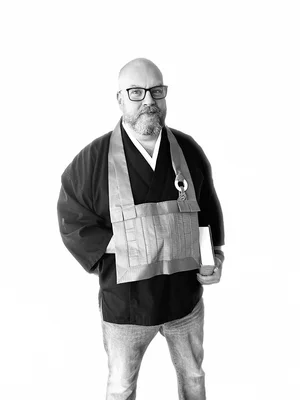
SENSEI SŌEN MICHAEL BRUNNER COMMENTARY
If we continue our practice and witness our lived experience with Big Mind, with non-grasping mind, we see no contradiction in what presents itself. The moment we label and categorize, we inevitably create a dichotomy, imposing conceptual frameworks onto the fluidity of reality. However, if we approach each moment without preconceived notions,without grasping onto fixed ideas, what manifests simply reveals itself as it is. This must be experienced—it cannot be described without cleaving its essence.
Consider the act of visiting the ocean and attempting to capture a sample within a small jar to take home. In this process,the ocean loses its true essence as it becomes confined and restricted by the limitations of the container. Similarly, in the realm of human thought and logic, when we ascribe judgments and labels to things as they are and cling to them, we inadvertently disrupt the harmonious interplay within the interconnected whole. By refusing to label and categorize, we can perceive and appreciate the inherent diversity within the unity without losing sight of the underlying interconnectedness. However, when we succumb to judgment, our attention narrows, and the once harmonious interplay transforms into dissonance.
We have a Sangha that is vibrant and young. Some established Sanghas may turn their noses up at this and consider themselves to have already arrived. This limited perspective inhibits their ability to remain open and receptive to further growth through practice. But for us, each teaching is new, and we are beginners at everything. This is right practice.Lacking the knowing required to make a judgment keeps us in the right seat. Paradoxically, it is through embracing our inherent foolishness that we can attain true wisdom. In the Way, wisdom and folly are not two. Both are included, both expressions of the same jewel. To set them against one another is to miss their source. Rather than becoming entangled in our judgments, we must steadfastly bear witness to the direct and conscious observation of Big Mind as it perpetually presents itself.
The reference to the Northern and Southern ancestors points to a dust-up recorded in the Platform Sūtra of Daikan Enō,the Sixth Zen Ancestor. Enō, having overheard an excerpt from the Diamond Sūtra and experienced an awakening,traveled hundreds of miles on foot to enter a monastery in the North. Upon his arrival, he was roughly treated and sent to work outside the practice gates. But even in this lowly (or perhaps particularly in this lowly) place, he was able to demonstrate his insight to the Fifth Ancestor, Hongren. Hongren recognized him as his successor and insisted he flee to avoid the wrath of the other monks. He fled South, setting up an exciting chase scene to reclaim the outward vestments of Enō's empowerment. It ended with the Sixth Ancestor retaining his place in the lineage, and no small enmity between the Northern and Southern lineages, compounded by subtle doctrinal fissures between them.
The same dust continues to settle in our own time. We see it in sectarian rivalries, in our comparisons between Sōtō and Rinzai, monastic and lay, ancient and modern. All of it is a narrowing of view. Sekitō points us past these divisions into the single field where all opposites dissolve, mending the fabric of interconnectedness by using the thread of difference to weave the One.
Each and every one of you reflects as a unique facet of the whole precious jewel of Buddha Nature. This shining is not an “idea.” It becomes evident the moment we take our seat, upright and unmoving, letting the jewel reveal itself, facet by facet. Shine on!