SUZUKI ROSHI TRANSLATION
All the objects of the senses Interact and yet do not. Interacting brings involvement. Otherwise, each keeps its place.
MAEZUMI ROSHI TRANSLATION
Each and all, the subjective and objective spheres are related, and at the same time independent. Related, yet working differently, though each keeps its own place.
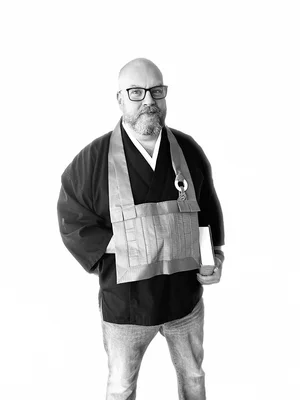
SENSEI SŌEN MICHAEL BRUNNER COMMENTARY
Now we are confronted with the basic nature of the interplay between the absolute and the relative. We gaze on the interconnectedness that permeates existence, while also recognizing the sense of individuality that brings proper balance.
All the sense-objects, the myriad phenomena that make up our lived experience, interact with one another in a dance of constant shifting and transformation. They are intricately connected, intertwined in a vast web of relationships. The sound of a bell, the scent of incense, the taste of tea—each arises distinctly, yet together they form the whole texture of practice.They lean into one another, yet each remains itself. Within this tapestry, each sense-object maintains its unique place and identity. As Suzuki Roshi said, “Things must be different to be truly equal.”
When we engage with what appears before us, and allow our notion of self to dissolve into the actualization of our intentions, we recognize our true self as the whole fabric of existence. If, however, we assert judgments—cultivating desires, attachments, and conflicts—we lose sight of our True Nature.
There is a profound teaching in recognizing that despite the interactions and interdependencies, each sense-object maintains its own place. This points to the importance of honoring the unique expression of each phenomenon as the mark of its interconnectedness. Nothing arises independently; all require each other. One and many are two sides of the same coin.
By embodying this teaching, we can navigate the world with clarity and wisdom. We can engage with sense-objects without becoming ensnared by them, without asserting ourselves through picking and choosing. We can appreciate the interconnectedness of all things while also honoring the qualities and talents that define our own being.
Remember: when you create or subscribe to an ideology—or any conceptual framework that asserts notions of oppressor and oppressed, have and have-not, winner and loser—you necessarily create the opposing ideology. Bow to the one whose ideas you abhor. They make the dwelling of your preferred concepts possible. They are your truest reflection when you take the road of any manifesto. Or better yet, simply approach each moment in wonder and actualize your intentions. No labels are required. This is the activity of a Bodhisattva.
Ultimately, the Sandōkai calls us to embrace a delicate dance between interaction and individuation. Your actions play the chords of existence; your intentions are the Cosmic Symphony. All dance together.
When we step out of the conductor’s box of the small self and simply play our part, dualistic distinctions fall away. In this living orchestra, nothing is drowned out and nothing stands apart—there is only the profound joy of pure harmony.