CHAPTER 3
THE MIND
3:1. Just as a fletcher straightens an arrow shaft, even so the discerning man straightens his mind, so fickle and unsteady, so difficult to guard.
3:2. As a fish when pulled out of water and cast on land throbs and quivers, even so is this mind agitated. Hence should one abandon the realm of Mara.
3:3. Wonderful, indeed, it is to subdue the mind, so difficult to subdue, ever swift, and seizing whatever it desires. A tamed mind brings happiness.
3:4. Let the discerning man guard the mind, so difficult to detect and extremely subtle, seizing whatever it desires. A guarded mind brings happiness.
3:5. Dwelling in the cave of the heart, the mind, without form, wanders far and alone. Those who subdue this mind are liberated from the bonds of Mara.
3:6. Wisdom never becomes perfect in one whose mind is not steadfast, who knows not the Good Teaching and whose faith wavers.
3:7. There is no fear for an awakened one, whose mind is not sodden by lust nor afflicted by hate, and who has gone beyond both merit and demerit.
3:8. Realizing that this body is as fragile as a clay pot, and fortifying this mind like a well-fortified city, fight out Mara with the sword of wisdom. Then, guarding the conquest, remain unattached.
3:9. Ere long, alas! this body will lie upon the earth, unheeded and lifeless, like a useless log.
3:10. Whatever harm an enemy may do to an enemy, or a hater to a hater, an ill-directed mind inflicts on oneself a greater harm.
3:11. Neither mother, father, nor any other relative can do one greater good than one’s own well-directed mind.
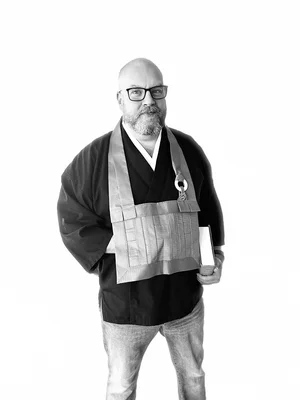
SENSEI MICHAEL COMMENTARY
CHAPTER III
Chapter three opens with the image of a fletcher straightening an arrow shaft, comparing this careful work to the cultivation of mind. The mind is fickle, unsteady, difficult to guard. Left unattended, it bends around whatever karmic causes and conditions press against it. We begin with an experience, make something of it, repeat what we have made, and eventually our conjecture crystallizes into certainty. We no longer wonder what is here because we have decided that we already know. To straighten the mind is to interrupt this crystallization and return again and again to the clarity of what is actually present. This is the work of Maintain Wonder.
The mind caught in this activity is like a fish pulled from the water and thrown onto dry land, throbbing and quivering. We know this mind. It is the mind consumed by what happened yesterday, what someone might do tomorrow, what we should have said, what we need to happen next. We abandon the vital veritas of lived experience and begin living in karmic conjecture. This is the realm of Mara. In a sense, Mara is the mechanism that keeps the small self afloat through longing, aversion, and conjecture.
That makes Mara no less personified, just a lot closer at hand! The fish does not need to learn how to become calm on dry land. It needs to return to the water of playful samadhi, creatively working with what is at hand and allowing compassion to flow.
The Dhammapada tells us that this mind is swift and continually seizes whatever it desires. Something arises and we immediately make something of it. We name it, judge it, possess it, reject it, and incorporate it into the story of who “I” am. The tamed mind is not a mind in which thoughts, desires, or feelings cease to arise. It is a mind that does not immediately crystallize around what arises. Everything is allowed, but nothing needs to become another structure for the karmic self to inhabit.
We are told that this mind, dwelling in the cave of the heart, can wander far and alone. But where exactly can it go? All of space and time is right here! If some pain from thirty years ago is being felt, isn’t that pain present now? If we remember something from childhood, isn’t that childhood appearing here? Even if we speak of past lives, there is nowhere else those lives can be encountered except in this boundless present moment. We spend enormous energy searching elsewhere for the causes of what is happening here when what needs to be transformed has already arrived. There is nowhere else to look.
This is where faith becomes necessary. Faith is not the certainty that we know what all of this means. On the contrary, faith is the courage to work with what is present in a state of wonder rather than running toward some created certainty. Wisdom cannot mature in a mind that is always looking for somewhere else to stand. We have to be willing to remain with what is here long enough for our knowing to loosen its grip.
Then the text points us to the awakened one the awakened one who has gone beyond both merit and demerit. This does not eliminate moral responsibility: it deepens it. We no longer need to preserve a karmic self who is “good” by constructing another self who is “bad”. We no longer need a ledger that tells us who deserves what. We take responsibility for all that occurs because nothing has to be pushed outside the gate. When the energy that was spent defending the small self is released, compassion has room to arise. This is the movement embodied in our third Transformative Touchstone: Allow Compassion to Arise.
The Dhammapada gives us the image of a fragile clay pot and a fortified city, and then tells us to confront Mara with the sword of wisdom. Prajñā is usually translated as wisdom, but I like to hear its function as something like before knowing. Before we construct the explanation, or decide who is responsible. The sword cuts directly through karmic conjecture and returns us to the vital veritas of this boundless present moment. And then the text adds something essential: having made the conquest, remain unattached. Do not turn liberation itself into another possession of the karmic self.
The body will soon lie upon the ground like a useless log. We hear this imperative at the end of every day in sesshin: do not squander your life. But here it points even beyond that. The body changes and dies. The karmic self we continually construct is born and dies with every changing condition. Yet the true essence of mind is not contained by what we have created. When mind is no longer completely identified with the structures it constructs, birth and death no longer define the whole field of our existence.
No enemy can do greater harm to us than an ill-directed mind, and no mother, father, teacher, or friend can do greater good than a well-directed one. We have reclaimed the throne of the mind-kingdom. No one else can be made responsible for our bondage, and no one else can be made responsible for our liberation. When we Maintain Wonder, Include Everything, and refuse to let the small self crystallize around what appears, we are no longer occupied with defending the world we have created. We are free to meet what is actually here. This is the space from which compassion arises.