CHAPTER 5
THE FOOL
5:1. Long is the night to the sleepless; long is the league to the weary. Long is worldly existence to fools who know not the Sublime Truth.
5:2. Should a seeker not find a companion who is better or equal, let him resolutely pursue a solitary course; there is no fellowship with the fool.
5:3. The fool worries, thinking, “I have sons, I have wealth.” Indeed, when he himself is not his own, whence are sons, whence is wealth?
5:4. A fool who knows his foolishness is wise at least to that extent, but a fool who thinks himself wise is a fool indeed.
5:5. Though all his life a fool associates with a wise man, he no more comprehends the Truth than a spoon tastes the flavor of the soup.
5:6. Though only for a moment a discerning person associates with a wise man, quickly he comprehends the Truth, just as the tongue tastes the flavor of the soup.
5:7. Fools of little wit are enemies unto themselves as they move about doing evil deeds, the fruits of which are bitter.
5:8. Ill done is that action of doing which one repents later, and the fruit of which one, weeping, reaps with tears.
5:9. Well done is that action of doing which one repents not later, and the fruit of which one reaps with delight and happiness.
5:10. So long as an evil deed has not ripened, the fool thinks it as sweet as honey. But when the evil deed ripens, the fool comes to grief.
5:11. Month after month a fool may eat his food with the tip of a blade of grass, but he still is not worth a sixteenth part of those who have comprehended the Truth.
5:12. Truly, an evil deed committed does not immediately bear fruit, like milk that does not turn sour all at once. But smoldering, it follows the fool like fire covered by ashes.
5:13. To his own ruin the fool gains knowledge, for it cleaves his head and destroys his innate goodness.
5:14. The fool seeks undeserved reputation, precedence among monks, authority over monasteries, and honor among householders.
5:15. “Let both laymen and monks think that it was done by me. In every work, great and small, let them follow me” — such is the ambition of the fool; thus his desire and pride increase.
5:16. One is the quest for worldly gain, and quite another is the path to Nibbana. Clearly understanding this, let not the monk, the disciple of the Buddha, be carried away by worldly acclaim, but develop detachment instead.
CHAPTER 6
THE WISE MAN
6:1. Should one find a man who points out faults and who reproves, let him follow such a wise and sagacious person as one would a guide to hidden treasure. It is always better, and never worse, to cultivate such an association.
6:2. Let him admonish, instruct and shield one from wrong; he, indeed, is dear to the good and detestable to the evil.
6:3. Do not associate with evil companions; do not seek the fellowship of the vile. Associate with good friends; seek the fellowship of noble men.
6:4. He who drinks deep the Dhamma lives happily with a tranquil mind. The wise man ever delights in the Dhamma made known by the Noble One, the Buddha.
6:5. Irrigators regulate the rivers; fletchers straighten the arrow shaft; carpenters shape the wood; the wise control themselves.
6:6. Just as a solid rock is not shaken by the storm, even so the wise are not affected by praise or blame.
6:7. On hearing the Teachings, the wise become perfectly purified, like a lake deep, clear and still.
6:8. The good renounce attachment for everything. The virtuous do not prattle with a yearning for pleasures. The wise show no elation or depression when touched by happiness or sorrow.
6:9. He is indeed virtuous, wise, and righteous who neither for his own sake nor for the sake of another does any wrong, who does not crave for sons, wealth, or kingdom, and does not desire success by unjust means.
6:10. Few among men are those who cross to the farther shore. The rest, the bulk of men, only run up and down the hither bank.
6:11. But those who act according to the perfectly taught Dhamma will cross the realm of Death, so difficult to cross.
6:12–13. Abandoning the dark way, let the wise man cultivate the bright path. Having gone from home to homelessness, let him yearn for that delight in detachment, so difficult to enjoy. Giving up sensual pleasures, with no attachment, let the wise man cleanse himself of defilements of the mind.
6:14. Those whose minds have reached full excellence in the factors of enlightenment, who, having renounced acquisitiveness, rejoice in not clinging to things, rid of cankers, glowing with wisdom, they have attained Nibbana in this very life.
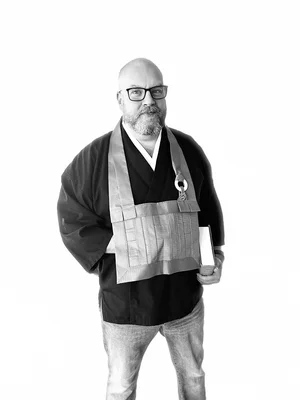
SENSEI MICHAEL COMMENTARY
CHAPTERS V-VI
The fool is not someone who lacks intelligence. The most dangerous fool is the one who is absolutely certain that he understands what is happening. Karmic conjecture has crystallized into reality, and there is no longer any room for wonder. This is why the text says that the fool who knows his foolishness is wise at least to that extent, while the fool who thinks himself wise is a fool indeed! If we are not awake to our own delusion, then we are asleep. Wisdom does not require that delusion disappear; it requires that we can see it when it arises.
The fool says, “I have sons, I have wealth.” We spend so much of our lives building the karmic self through what we have: my family, my work, my reputation; each possession seems to make the self a little more substantial. Yet everything we call ours is moving through causes and conditions, including the person doing the claiming! When we recognize our True Nature and abide there, nothing needs to be possessed because nothing is outside of us. In that sense, we already have it all.
This is also why merely being near the Dharma does not mean we have tasted it. It is like a spoon sitting in soup its entire life without ever knowing the flavor. We have already seen the same thing with the flower that has color but no fragrance. We can sit in the zendo for decades, memorize teachings, wear robes, collect titles, and still never allow the Dharma to enter the vital activity of our lives. The tongue tastes the soup because there is intimacy. The teaching has to move through us.
Then the text turns toward karma and consequence. Every single act affects the entire universe. That is already profound, but the implication becomes almost impossible to comprehend when we remember that this activity extends throughout space and time. Nothing we do simply disappears. Every word, every action, every movement of mind enters the whole field of causes and conditions and changes what can arise next. The fruit may not appear immediately. Milk does not sour all at once, and fire can continue smoldering beneath the ashes. But the universe has already been changed by what we have done.
This gives moral responsibility an extraordinary depth. We cannot retreat into the idea that what I do privately, or what I think privately, somehow belongs only to me. There is no sealed-off place where karma happens. If mind creates the world we experience, then every act of creation participates in the whole.
The fool can even turn spiritual practice into another form of bondage. The text describes someone practicing severe austerity, eating almost nothing, and tells us that such a person does not come close to one who has actually understood the Truth. The act of starving the self can itself become a surrender to the self. We can spend enormous energy attacking, purifying, disciplining, and denying the karmic self while never noticing that it remains at the center of the whole project. The self that must become holy is still the self.
Knowledge can become just as dangerous. Knowledge gained by the fool leads to his own ruin. Knowing gives the karmic self something especially powerful to inhabit: now I know how things are. I know what Buddhism teaches. I know why I am right. Knowledge that should open the world instead closes it. Prajñā cuts in the other direction. It interrupts certainty and returns us to the clarity before knowing has hardened into conjecture.
Finally, the fool wants to be known. He wants the monks and householders to recognize what he has done. He wants authority, reputation, and people who will follow him. Even good activity is pulled back into the orbit of the small self: I did this. Look at me! The gift stops flowing because someone has decided to possess it. If reputation, authority, knowledge, austerity, or accomplishment become places where the karmic self settles, then even our practice becomes another way of staying asleep.
Conversely, the wise person is someone who can be corrected. When someone points out their faults, they follow that person as though they were showing them hidden treasure. This is difficult precisely because correction threatens the structure we have built around self. The karmic self does not experience being corrected as treasure, it experiences it as danger.
This is one reason the teacher-student relationship matters. A teacher is not simply someone who gives us more Buddhist information. If that were all we needed, we could read books. A teacher enters into relationship with us deeply enough to see the places where our own certainty prevents us from seeing ourselves. That requires trust on both sides. The student has to become willing to be shown something that the self would rather defend. The teacher has to be willing to point directly without needing the student’s approval. When that relationship is alive, correction becomes an act of compassion.
The Dhammapada returns to images we have already encountered: rivers being directed, arrow shafts being straightened, wood being shaped. Wisdom is not passive. We are continuously cultivating the conditions through which we meet the world. But the result is not rigidity. The wise person is compared to a rock unmoved by praise or blame and then to a lake that is deep, clear, and still. Stillness here is spaciousness. Praise can enter. Blame can enter. Joy can enter. Sorrow can enter. None of them needs to dictate the condition of mind.
Renunciation begins when we renounce the renouncer. As long as there is a self proudly giving up possessions, pleasures, reputation, and attachment, the karmic trap remains set. True renunciation is discovering that we are already at home in everything, everywhere. There is no fixed place for the self to settle and therefore nothing that has to be acquired in order to complete it.
The wise can be touched by happiness and sorrow without being swept into elation or despair. Renunciation is not indifference. It is intimacy without possession. We can love completely without needing what we love to remain unchanged. We can grieve without turning grief into an identity. We can receive happiness without demanding that the universe preserve it for us.
The text says that most people simply run up and down the near bank while only a few cross to the farther shore. But perhaps the running itself is what keeps the farther shore distant. We move toward what we want, away from what we fear, back toward what we miss, forward toward what we hope will save us. Longing and aversion keep us running along the same bank. The farther shore becomes available when we stop imagining that liberation is waiting somewhere else.
The language of homelessness at the end of the chapter is traditionally monastic, but there is also an existential homelessness here. No fixed place for the karmic self to settle. Nothing to acquire and defend. No identity sturdy enough to hide inside forever. When there is no home for the small self to protect, the whole universe becomes home.
That is why the chapter ends with people who rejoice in not clinging. They have not withdrawn from life. They have become available to it. Nothing needs to be grasped, nothing needs to be made into proof of who they are, and nothing needs to be pushed away in order for them to remain whole. Wisdom is not finally about knowing more than the fool. It is about no longer needing our knowing, our possessions, our reputation, or even our practice to hold the self together.
Then the life before us becomes remarkably free. We can be corrected. We can be moved. We can love. We can act. We can respond to what is here without first asking what it will do for “me.” This is what allows wisdom to become compassionate activity rather than another possession of the self.