Dhammapada Reflections | Part Twelve | Chapters Twenty & Twenty-one
CHAPTER 20
THE PATH
20:1. Of all the paths, the Eightfold Path is the best; of all the truths, the Four Noble Truths are the best; of all things, passionlessness is the best; of men, the Seeing One, the Buddha, is the best.
20:2. This is the only path; there is none other for the purification of insight. Tread this path, and you will bewilder Mara.
20:3. Walking upon this path, you will make an end of suffering. Having discovered how to pull out the thorn of lust, I make known the path.
20:4. You yourselves must strive; the Buddhas only point the way. Those meditative ones who tread the path are released from the bonds of Mara.
20:5. “All conditioned things are impermanent”—when one sees this with wisdom, one turns away from suffering. This is the path to purification.
20:6. “All conditioned things are unsatisfactory”—when one sees this with wisdom, one turns away from suffering. This is the path to purification.
20:7. “All things are not-self”—when one sees this with wisdom, one turns away from suffering. This is the path to purification.
20:8. The idler who does not exert himself when he should, who though young and strong is full of sloth, with a mind full of vain thoughts—such an indolent man does not find the path to wisdom.
20:9. Let a man be watchful of speech, well controlled in mind, and not commit evil in bodily action. Let him purify these three courses of action and win the path made known by the Great Sage.
20:10. Wisdom springs from meditation; without meditation wisdom wanes. Having known these two paths of progress and decline, let a man so conduct himself that his wisdom may increase.
20:11. Cut down the forest of lust, but not the tree; from the forest springs fear. Having cut down the forest and the underbrush of desire, be passionless, O monks!
20:12. For so long as the underbrush of desire, even the most subtle, of a man toward a woman is not cut down, his mind is in bondage, like the sucking calf to its mother.
20:13. Cut off your affection in the manner of a man who plucks with his hand an autumn lotus. Cultivate only the path to peace, Nibbana, as made known by the Exalted One.
20:14. “Here shall I live during the rains, here in winter and summer”—thus thinks the fool. He does not realize the danger that death might intervene.
20:15. As a great flood carries away a sleeping village, so death seizes and carries away the man with a clinging mind, doting on his children and cattle.
20:16. For him who is assailed by death, there is no protection by kinsmen. None there are to save him—no sons, nor father, nor relatives.
20:17. Realizing this fact, let the wise man, restrained by morality, hasten to clear the path leading to Nibbana.
CHAPTER 21
MISCELLANEOUS
21:1. If by renouncing a lesser happiness one may realize a greater happiness, let the wise man renounce the lesser, having regard for the greater.
21:2. Entangled by the bonds of hate, he who seeks his own happiness by inflicting pain on others is never delivered from hatred.
21:3. The cankers only increase for those who are arrogant and heedless, who leave undone what should be done and do what should not be done.
21:4. The cankers cease for those mindful and clearly comprehending ones who always earnestly practice mindfulness of the body, who do not resort to what should not be done, and steadfastly pursue what should be done.
21:5. Having slain mother, craving; father, self-conceit; two warrior-kings, eternalism and nihilism; and destroyed a country, the sense organs and sense objects, together with its treasurer, attachment and lust, ungrieving goes the holy man.
21:6. Having slain mother, father, two brahmin kings, the two extreme views, and a tiger as the fifth, the five mental hindrances, ungrieving goes the holy man.
21:7. Those disciples of Gotama ever awaken happily who day and night constantly practice the recollection of the qualities of the Buddha.
21:8. Those disciples of Gotama ever awaken happily who day and night constantly practice the recollection of the qualities of the Dhamma.
21:9. Those disciples of Gotama ever awaken happily who day and night constantly practice the recollection of the qualities of the Sangha.
21:10. Those disciples of Gotama ever awaken happily who day and night constantly practice mindfulness of the body.
21:11. Those disciples of Gotama ever awaken happily whose minds by day and night delight in the practice of non-violence.
21:12. Those disciples of Gotama ever awaken happily whose minds by day and night delight in the practice of meditation.
21:13. Difficult is life as a monk; difficult is it to delight therein. Also difficult and sorrowful is the household life. Suffering comes from association with unequals; suffering comes from wandering in samsara. Therefore, be not an aimless wanderer, be not a pursuer of suffering.
21:14. He who is full of faith and virtue, and possesses good repute and wealth—he is respected everywhere, in whatever land he travels.
21:15. The good shine from afar, like the Himalaya mountains. But the wicked are unseen, like arrows shot in the night.
21:16. He who sits alone, sleeps alone, and walks alone, who is strenuous and subdues himself alone, will find delight in the solitude of the forest.
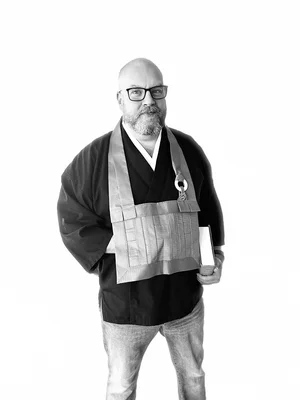
SENSEI MICHAEL BRUNNER COMMENTARY
CHAPTER XX-XXI | THE PATH & MISCELLANEOUS
Chapter twenty opens by naming the Eightfold Path, the Four Noble Truths, passionlessness, and the Buddha as the Seeing One. These can easily become just another set of teachings we know about, but the text immediately removes that refuge: “You yourselves must strive; the Buddhas only point the way.” The path has to be practiced. We have to work with the creations that are already present, engaging what has arisen skillfully enough to transform suffering into joy. A teacher can point, Sangha can support, and Dharma can illuminate, but no one can practice in our place. If we do not practice, no one practices.
This is why there is only one path. It is not an argument that one religious ideology has somehow defeated all the others. Suffering has to be met where it is being created. We can understand its causes, talk beautifully about them, and surround ourselves with every form of Buddhist practice, but to practice we have to work directly with what is plainly here. The path is engaging body, speech, and mind without continually allowing our karmic constructions of them to determine what happens next.
Then the Dhammapada gives us three declarations: “All conditioned things are impermanent.” “All conditioned things are unsatisfactory.” “All things are not-self.”These are not propositions we are just being asked to believe. They are what becomes visible when we stop substituting manufactured knowledge for lived experience. Nothing conditioned can be held still. Nothing conditioned can finally satisfy the grasping self. No conditioned construction can serve as our True Nature. We suffer because we keep asking conditioned things to do what they cannot do.
Impermanence is visible when we encounter the moving essence of forms. Unsatisfactoriness appears when we insist that what is moving needs to stop long enough for us to apprehend it intellectually and weave it into the fiber of the constructed self. Not-self cuts through the assumption that the one demanding security is something other than a story. The self we defend is created, assembled from causes and conditions, and continually revised as life unfolds. The problem is not that this self appears. The problem is mistaking it for our essential nature.
Thus: wisdom springs from meditation. Meditation gives us the opportunity to watch creation happening so we can skillfully engage it. Something arises, and almost immediately we begin trying to make something of it. If we remain present, we can see the difference between what is here and what we have constructed around it. Wisdom grows from that intimacy because creation is seen as creation rather than mistaken for reality.
The forest image makes the point wonderfully: “Cut down the forest, but not the tree.” The tree was never the problem. What has arisen and is present is not the problem. Feelings can arise, desires can arise, difficult circumstances can arise; none of these are enemies. The forest is what chokes their vitality when the karmic self begins assigning judgment, possession, and certainty until the original tree is impossible to see.
Mentation-practice can easily become another form of violence. We decide that anger should not appear, grief should not appear, desire should not appear, and then begin attacking the circumstances of our own life in the name of awakening. Amputation is never an option, so instead, work with the tree that is here. Clear what has grown around it by releasing it. The path is not the destruction of experience; it is learning to participate in what is present without continually imprisoning it inside the constructed reality of our judgments.
The verses on affection return us to the same place. Love is not the problem, nor are relationships. The bondage begins when affection hardens into ownership and we ask another person to stabilize the self we have constructed. Then love becomes fear because what we have made “mine” can be lost. The path does not require less intimacy. It asks for an intimacy spacious enough that what we love does not have to become our possession.
The text brings all of our hopes and dreams into the awakened field: “Here shall I live during the rains, here in winter and summer,” thinks the fool. Planning is not the problem. We have to make plans. The trouble begins when planning quietly becomes certainty and we start behaving as though tomorrow has promised to arrive according to our expectations. Death is compared to a flood sweeping away a sleeping village because the danger is not simply that death will come. The danger is that we will sleep through the life that is already passing.
No relationship can protect us from this, and no one we love can practice in our place. This does not diminish relationship. It allows us to stop burdening one another with impossible demands. We can meet what is here while it is here, without asking it to guarantee what cannot be guaranteed.
In Chapter twenty-one the movement continues by encouraging a willingness to relinquish a lesser happiness for a greater one. This is not rejecting ordinary joy for some spiritual prize waiting elsewhere. The lesser happiness is the brief satisfaction that comes when the karmic self gets what it wants. The greater happiness appears when we no longer have to keep arranging the world in order to sustain that self.
This is why happiness gained through another person’s suffering can never free us from hatred. If my well-being depends upon your defeat, I remain bound to you through the very division I imagine will make me free. I have created another border and placed happiness on my side of it. The Dhammapada keeps asking us to see how often the thing we call freedom is simply another country the karmic self has built for itself.
Then come the peculiar verses about slaying mother, father, kings, and even a country. This is not violence against people; it is destruction of the architecture through which suffering perpetuates itself: craving, self-conceit, extreme views, and attachment. The country to be destroyed is the one we created by looking at the undivided Dharmakāya through karmic lenses and drawing borders across it. We do not destroy beings. We destroy the mechanism through which beings become objects for our grasping and opposition. We do not destroy the world. We destroy our insistence that the world conform to the borders we have drawn across it.
From there the text turns toward recollection of Buddha, Dharma, and Sangha, along with mindfulness of the body, nonviolence, and meditation. These are not escapes into some safer spiritual reality. They keep reorienting us toward what is living. Buddha points toward awakening, Dharma toward the truth of what is here, and Sangha toward the relational field in which practice is challenged and embodied. Mindfulness, nonviolence, and meditation keep that orientation from becoming merely an idea.
The chapter also refuses the fantasy that another form of life will finally make practice easy. Monastic life is difficult. Household life is difficult. The karmic self is always convinced that freedom exists under a different set of circumstances: another place, another teacher, another life. But suffering does not arise because we chose the wrong scenery. It arises through the way we participate in what is already here. Our Buddha-hall has but one English encouragement in it, adapted from John F. Kennedy: “We do these things not because they are easy, but because they are hard.”
The path does not lead away from our creations. It steers us into them and teaches us how to work with them. We do not wait for a better life to begin practicing, and we do not destroy the life that has appeared because it fails to match our idea of awakening. We meet what is here, see what we have added, and work skillfully with the whole of it.
The Buddhas and Ancestors can point the way, but we have to walk…