
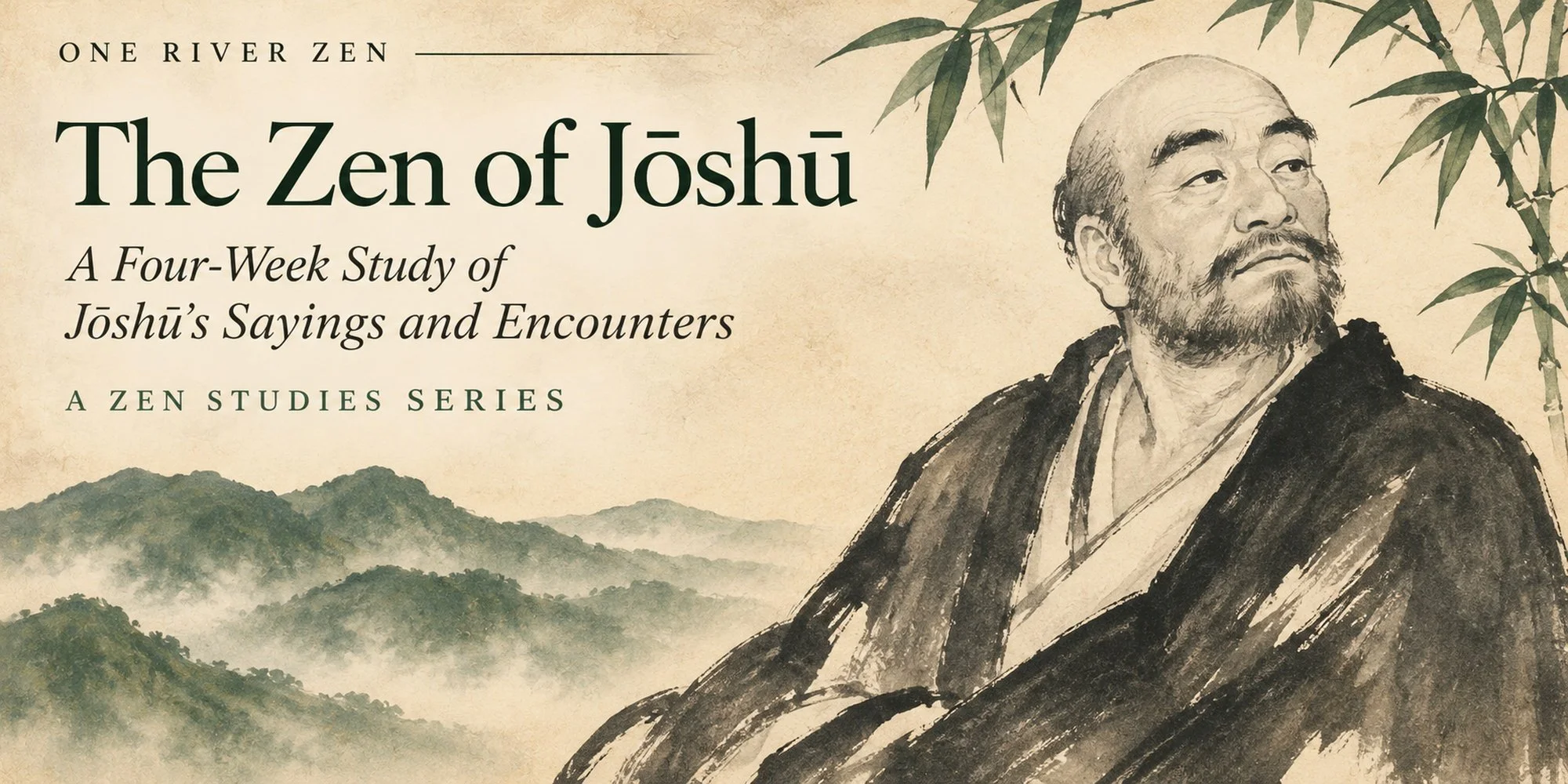
The Zen of Jōshū
A Four-Week Study of Jōshū’s Sayings and Encounters
Zhaozhou Congshen · 趙州從諗
What happens when we stop demanding that life conform to our understanding of it? Through the remarkable encounters of one of Zen's most beloved teachers, discover the freedom, intimacy, and wonder that become possible when we meet our lives directly.
Beyond the answers we think we need.
We spend much of our lives trying to find the right answers. We want to understand who we are, what our lives mean, what we ought to become, and how we might finally arrive at a place of certainty. Yet our efforts to resolve these questions can sometimes prevent us from encountering the very lives we are trying to understand.
Jōshū, known in Chinese as Zhaozhou Congshen, stands among the most celebrated teachers of the Tang dynasty Chan tradition. The encounters attributed to him are remarkable for their simplicity, humor, and ability to expose the limitations of our habitual thinking.
When asked about Buddha-nature, Jōshū responds with Mu. When a student seeks instruction, he directs him toward his unwashed bowl. When asked about the fundamental meaning of Buddhism, he points toward a tree in the courtyard.
These encounters are not simply clever responses to difficult questions. They invite us to discover a way of living that is no longer confined to our ideas about ourselves, others, and the world.
In this four-week series, we will explore Jōshū's recorded sayings and the encounters preserved in the classical Zen koan collections, bringing their extraordinary wisdom into conversation with our everyday lives.
Begin exploring Jōshū's teachings.
Read Sensei Sōen Michael Brunner's commentary on Jōshū's most famous encounter, The Gateway of Mu , or explore our Zen Koan Library for further teachings from the classical collections.
Discovering the freedom of Zen.
Move beyond habitual thinking
Recognize how our insistence on certainty and our attachment to fixed ideas can obscure the richness and possibilities of our lives.
Awaken within ordinary life
Discover how the seemingly insignificant activities of our everyday lives can become expressions of awakening, intimacy, and profound understanding.
Respond with freedom and compassion
Explore what becomes possible when we encounter people and circumstances without continually filtering them through our expectations, judgments, and demands.
Who was Zen Master Jōshū?
Jōshū Jūshin (Zhaozhou Congshen, traditionally 778–897) was a Chinese Chan master whose teachings have profoundly influenced the development of Zen Buddhism. A student of Nansen, he became renowned within the Zen tradition for the directness and subtlety of his encounters with students and fellow practitioners.
His teachings have been transmitted through collections of recorded sayings and later anthologies, including the Gateless Gate (Mumonkan), the Blue Cliff Record (Hekiganroku), and the Book of Equanimity (Shōyōroku).
Although these literary accounts were transmitted and compiled over generations, they remain living resources for Zen practice. Our study will approach them with an appreciation of their historical context and, above all, an openness to what they reveal about our lives today.
Our Four Weeks Together
Each week will bring us into conversation with a different dimension of Jōshū's teachings. We will examine selected encounters, their significance within the Zen tradition, and their implications for our own lives and practice. Select a week to read its complete description.
Week One · April 7 Beyond Yes and No Jōshū's Dog, Mu, and the Limits of Conceptual Thought
We begin with an introduction to Jōshū and his place within the Chan tradition, followed by an exploration of his most celebrated encounter: a monk's question concerning whether a dog possesses Buddha-nature.
Through the different versions of this encounter preserved in Zen literature, we will examine our tendency to divide reality into opposing categories and to seek security in the conclusions we reach.
What happens when neither affirmation nor denial can adequately express what is before us? What becomes possible when we allow the question to transform us rather than merely demanding an answer from it?
Suggested reading: The Gateway of Mu by Sensei Sōen Michael Brunner.
Week Two · April 14 The End of Seeking Ordinary Mind Is the Way and The Great Way Is Not Difficult
As a student of Nansen, Jōshū asks his teacher about the nature of the Way. Their encounter, preserved as Case 19 of the Gateless Gate, challenges the assumption that awakening is something we must acquire or a destination toward which we must travel.
We will bring this encounter into conversation with Jōshū's treatment of the opening lines of the Shin Jin Mei, which examine the relationship between the Great Way and our habits of picking and choosing.
Together, these teachings invite us to investigate the distance we continually create between the lives we are living and the lives we imagine we ought to be living. How might our aspirations find expression through engagement with this very life rather than through its rejection?
Related reading: Shin Jin Mei — Faith in Mind .
Week Three · April 21 The Sacred Within the Ordinary Wash Your Bowl, Drink Your Tea, and Everyday Practice
Much of our spiritual life can become an effort to seek extraordinary experiences while overlooking the significance of the ordinary. Jōshū repeatedly interrupts this tendency.
Through his encounters concerning washing bowls and drinking tea, we will explore the relationship between awakening and the seemingly mundane activities that constitute our days.
We will consider what it means to give ourselves fully to an activity without treating it simply as a means toward something else. How might our work, relationships, and responsibilities become opportunities for the expression of wisdom and compassion?
These teachings invite us to recognize the extraordinary possibilities present within the ordinary circumstances of our lives.
Week Four · April 28 Meeting Reality Directly The Cypress Tree, the Stone Bridge, and the Living Dharma
In our final week, we will explore two of Jōshū's most evocative encounters: the cypress tree in the courtyard and the stone bridge of Zhaozhou.
These encounters challenge our tendency to substitute our ideas about reality for our actual participation in it. They invite us beyond the distinction between the sacred and the ordinary, between ourselves and the circumstances we encounter.
We will conclude our study by bringing Jōshū's teachings into conversation with One River Zen's Three Touchstones: Maintain Wonder, Include Everything, and Allow Compassion to Flow.
What might it mean to live with the openness, responsiveness, and freedom that Jōshū's encounters continue to illuminate?
Study, conversation, and living practice.
Each class will combine teaching, close readings of selected encounters, and opportunities for discussion. Rather than attempting to solve koans intellectually, we will allow these teachings to illuminate the living questions of our own experience.
No previous experience with Zen, koan study, or Buddhist philosophy is necessary. Experienced practitioners and those encountering Zen for the first time are equally welcome.
- Four weekly sessions, in person or online
- Accessible teaching rooted in the Zen tradition
- Class recordings included
- A supportive community of practice
Learn more about Sensei Sōen Michael Brunner , explore our Zen readings, join us for meditation, or deepen your practice through one of our Zen retreats.

Abbot and Founding Teacher of One River Zen
Series Instructor
Discover the extraordinary within your ordinary life.
Join One River Zen for four Wednesdays of study, conversation, and inquiry into the remarkable teachings of Zen Master Jōshū.
Everyone is welcome, whether you are new to Zen or have practiced for years.
-
Dates:
April 7, 14, 21 & 28, 2027 -
Time:
Wednesdays, 7:00–8:15 p.m. Central -
Location:
One River Zen Community Center
Ottawa, Illinois -
Online participation:
Available from wherever you are. -
Includes:
All four sessions and class recordings.
One River Zen is open to everyone, regardless of background or ability to pay. If you need financial assistance to participate, please contact us at outreach@oneriverzen.org .