SEEING OURSELVES IN THE MIRROR OF REALITY
A STUDY OF THE PRECIOUS MIRROR SAMADHI | HŌKYŌ ZANMAI | 寶鏡三昧
We ordinarily experience the world in terms of separation. There is ourselves and everything else, the things we like and the things we would rather avoid, the person we are and the person we imagine we ought to become. Even in our spiritual practice, we can find ourselves caught in the same divisions, searching for awakening as though it were something apart from the life we are already living.
The Precious Mirror Samadhi (Hōkyō Zanmai), traditionally attributed to Dongshan Liangjie (Tōzan Ryōkai), is one of the foundational teaching poems of the Sōtō Zen tradition. Its verses explore the intimate relationship between sameness and difference, the absolute and the relative, and the ways in which our ordinary experience both reveals and conceals the nature of reality.
In this four-week series, we will undertake a close reading of the Precious Mirror Samadhi, exploring its language, historical setting, and place within the development of the Sōtō Zen tradition. More importantly, we will consider the questions the poem raises for our own practice. What does it mean to recognize ourselves without making an object of who we are? How do we understand difference without losing sight of our fundamental intimacy with all things? And what does it mean to bring this understanding into the ordinary circumstances of our lives?
What to Expect:
Four weekly sessions — offered both in-person at One River Zen and online
Accessible teaching rooted in tradition, grounded in lived life
Recordings provided for those who cannot attend live
A supportive, sincere community of practice
Our Four Weeks Together
Week One: The Dharma of Thusness
Receiving What Has Always Been Here
We begin by exploring the origins of the Precious Mirror Samadhi, its traditional association with Dongshan, and its relationship to the teachings of Shitou and the early Caodong tradition. We will consider the poem's opening invitation to receive and preserve the Dharma of thusness, not as a teaching to be possessed, but as something to be realized in our own experience.
What does it mean to encounter reality before we divide it into what we accept and what we reject? And how might our effort to understand the Dharma become an obstacle to recognizing what is already present?
Week Two: Snow in a Silver Bowl
Sameness, Difference, and the Nature of Reality
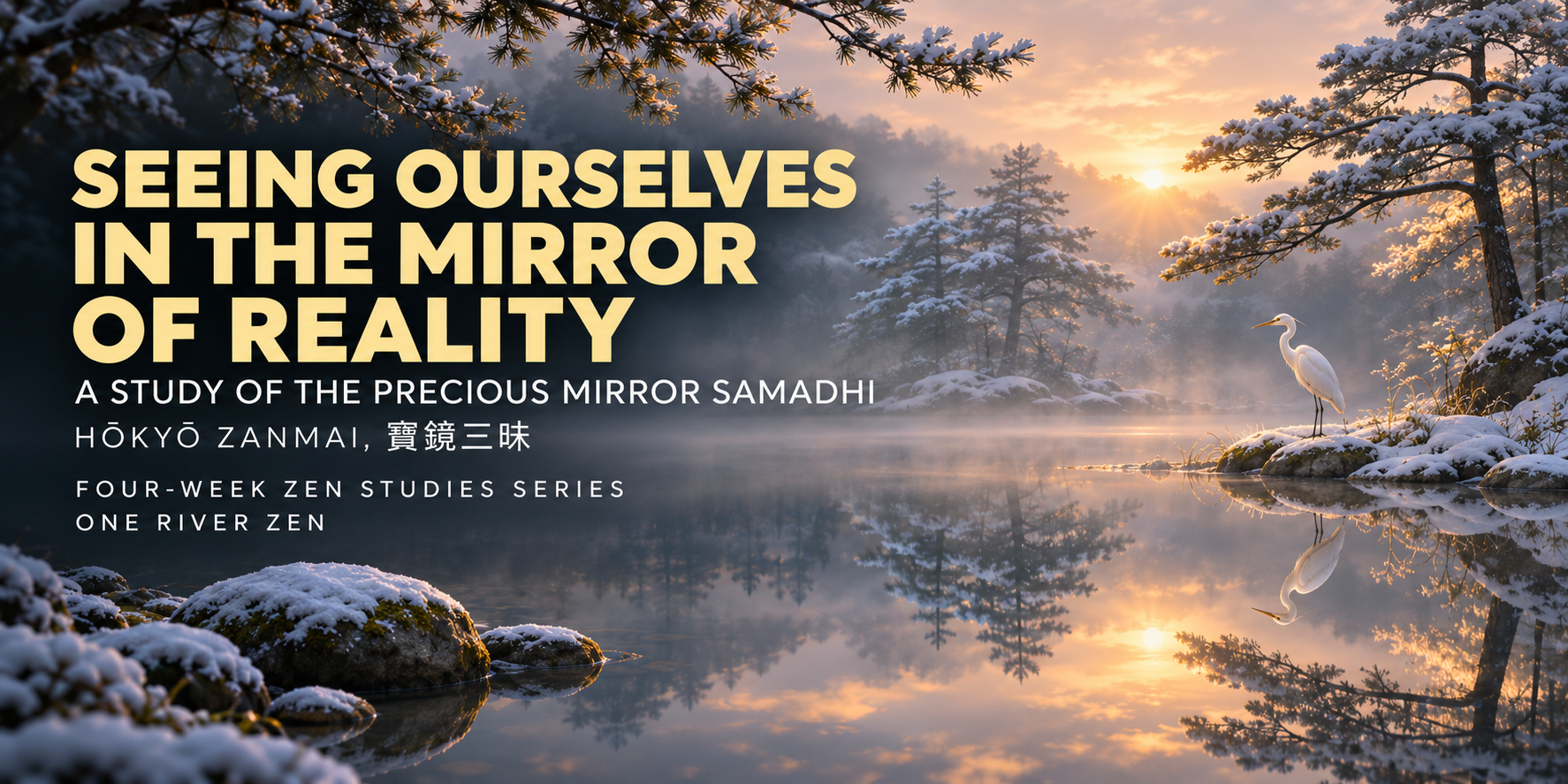
The poem offers us two remarkable images: snow gathered in a silver bowl and a white heron concealed in moonlight. In each, we encounter things that are alike but not identical, distinct but never truly separate. These images invite us to examine the way we ordinarily understand the relationship between ourselves and the world.
We will explore the interplay of sameness and difference, and the difficulty of recognizing unity without erasing the particularity of things. What happens when we stop treating difference as separation? And how does this understanding change the way we encounter the people, situations, and difficulties of our everyday lives?
Week Three: The Mirror and Its Reflection
Identity, Awakening, and the One Who Sees
At the heart of the poem lies the image of a person looking into a precious mirror. The reflection is not separate from the person standing before it, yet neither can the two be said to be exactly the same. Here, the poem brings us into one of the central questions of Zen: Who is it that we take ourselves to be?
We will examine the relationship between self and experience, the limitations of conceptual understanding, and the meaning of awakening when there is no separate self standing outside reality to attain it. Rather than seeking a more satisfying idea of who we are, the poem asks us to question the very ground upon which our familiar sense of identity rests.
Week Four: Just This Is It
Bringing the Teaching into the Life We Live
The Precious Mirror Samadhi does not end by asking us to withdraw from the world or remain absorbed in some special state of understanding. Its teaching must be realized through the changing conditions of our lives, in our relationships, our responsibilities, and the countless moments in which we meet things as they are.
In our final week, we will explore the poem's closing instructions and their implications for the work of practice. If the Dharma is not separate from our everyday lives, what does it mean to practice with sincerity and care? How do we respond to the circumstances before us without becoming caught in attachment or rejection?
We will conclude by returning to the image of the mirror, considering what it means to recognize our lives not as obstacles to awakening, but as the very place where awakening is expressed.
About This Series
Each class will combine teaching, a close reading of selected passages, and opportunities for discussion. Participants will receive the text of the Precious Mirror Samadhi along with supporting materials to help explore its imagery and teachings between sessions.
No previous study of the poem is necessary. Whether you are new to Zen or have been practicing for many years, this series offers an opportunity to examine some of the deepest questions of our tradition, not simply as matters of philosophy, but as questions that bear directly upon the lives we are living.
FOUR-WEEK SERIES BEGINS WEDNESDAY, JANUARY 6th, 2027 @ 7P CST
Classes are online and in-person.
If you need help financially to participate, please email outreach@oneriverzen.org
One donation is good for all classes: