
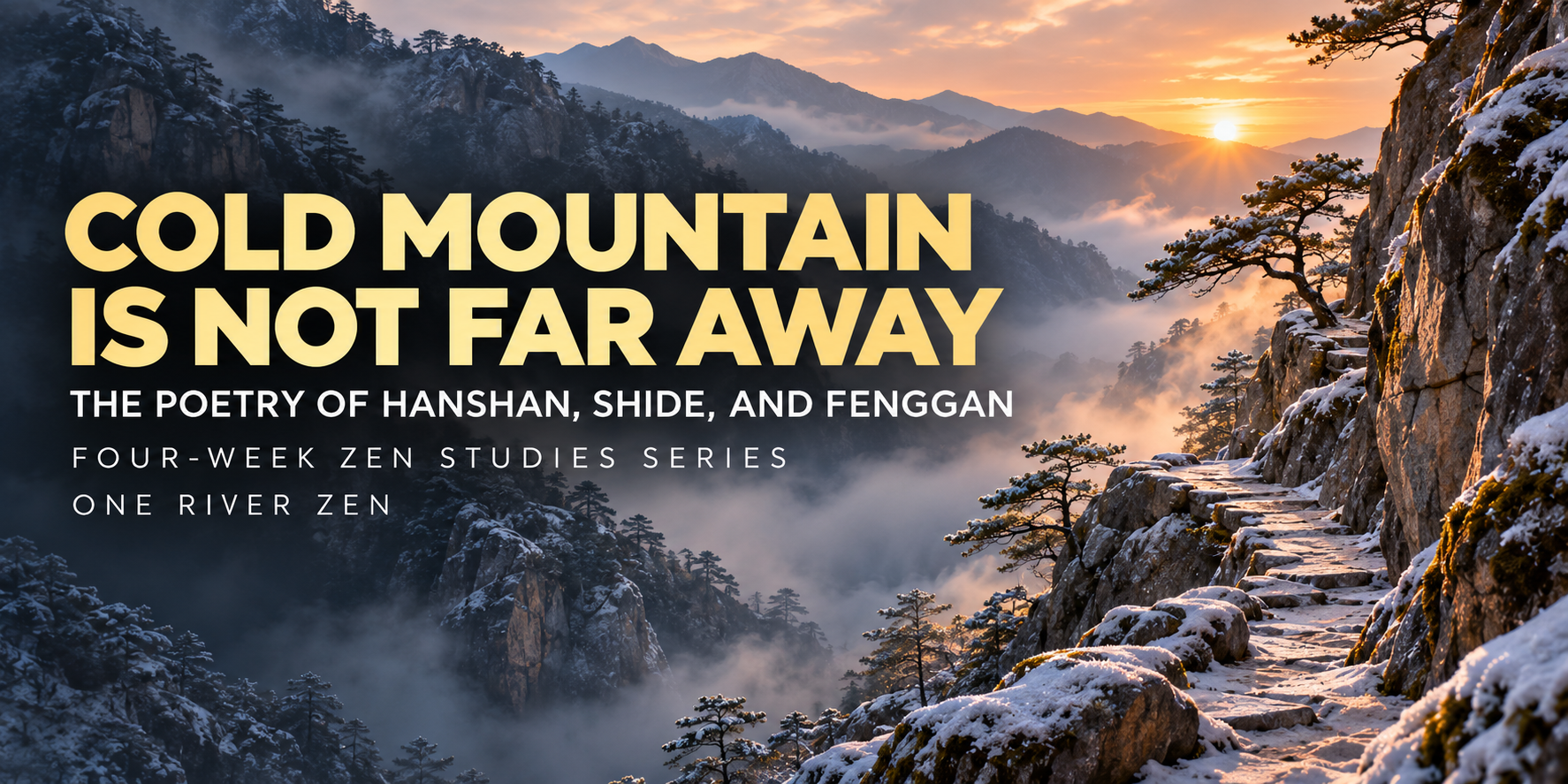
COLD MOUNTAIN IS NOT FAR AWAY
The Poetry of Hanshan, Shide, and Fenggan
More than a thousand years ago, three unconventional figures in the mountains of China left behind a collection of poems that continues to challenge our understanding of practice, awakening, and the lives we lead. Sometimes humorous, sometimes confrontational, and often remarkably direct, their verses invite us to question what we are searching for and what we may have overlooked along the way.
Join us for a four-week Zen Studies series exploring the poetry of Hanshan, Shide, and Fenggan, and what their teachings reveal about impermanence, Buddha-nature, and the freedom found in this very life.
No previous experience with Zen or Chinese poetry is necessary. Join us in person or online at One River Zen.
Their poems are not always gentle. Sometimes they are funny, sometimes confrontational, and sometimes so simple that we might miss what they are pointing toward. They speak of our fear of death, our attachment to things that cannot last, and our tendency to mistake the ideas we hold about ourselves for the reality of who we are. And running throughout them is the possibility of a freedom that does not depend upon escaping the circumstances of our lives.
In this four-week series, we will spend time with the poetry of these three figures, considering both the historical world in which the poems emerged and the questions they continue to raise for those of us practicing today. We will read the poems closely, explore their relationship to the teachings of Zen, and consider what they reveal about the ordinary, sometimes difficult, and always changing life that is our practice.
What to Expect:
Four weekly sessions — offered both in-person at One River Zen and online
Accessible teaching rooted in tradition, grounded in lived life
Recordings provided for those who cannot attend live
A supportive, sincere community of practice
Our Four Weeks Together
Week One: Entering Cold Mountain
The Poets, Their World, and the Dharma of Poetry
We begin with the world of Tang dynasty China, the legends surrounding Hanshan, Shide, and Fenggan, and the place their poetry came to occupy within the Chan and Zen traditions. We will consider how Buddhism, Daoism, and the Chinese tradition of the mountain recluse shaped these poems, and why figures who seemed so far removed from conventional religious life came to be regarded as expressions of awakening itself.
We will also explore something of the relationship between poetry and Zen. A poem does not necessarily tell us what to think. At its best, it interrupts our familiar ways of thinking and asks us to see something for ourselves. How might we approach these verses in the same spirit with which we approach a koan, not looking for an answer to possess, but allowing a question to open?
Week Two: Hanshan — The Road That Cannot Be Traveled
Impermanence, Solitude, and the Search for Freedom
Hanshan, or Cold Mountain, is the best known of the three poets. His verses describe a life among remote cliffs, mountain paths, and drifting clouds, far from the ambitions and preoccupations of ordinary society. Yet Hanshan is not simply celebrating a life of withdrawal. His poems continually turn our attention toward the attachments, fears, and assumptions that shape our experience, whether we live on a mountainside or in the middle of a busy town.
We will explore his teachings on impermanence, the futility of chasing after recognition, and the freedom that comes from seeing through our ideas of what life ought to be. And we will consider the meaning of Cold Mountain itself. Is it a place apart from the world, or does the difficulty of finding the road tell us something about the nature of the search?
Week Three: Shide — The Dharma Right Before Us
Buddha-Nature, Compassion, and Ordinary Life
Shide, whose name means "Foundling," is remembered as a temple worker and close companion of Hanshan. The traditional stories place him in the kitchen at Guoqing Temple, attending to the most ordinary tasks while displaying a wisdom that others frequently failed to recognize. His poetry is direct, often humorous, and particularly concerned with the difference between appearing to practice the Dharma and actually bringing it to life.
Through his verses, we will examine generosity, compassion, Buddha-nature, and the ways we overlook what is immediately before us. Shide challenges the assumption that wisdom must announce itself through extraordinary experiences or religious accomplishments. What does it mean to practice without separating the sacred from the ordinary? And how might our relationships, responsibilities, and daily activities become the very place where the Dharma is realized?
Week Four: Fenggan — Originally, Not a Single Thing
Original Nature and the Freedom of Nonattachment
Fenggan is perhaps the most mysterious of the three. Remembered as an eccentric monk who lived at Guoqing Temple, he appears in the legends as the one who recognized the extraordinary nature of Hanshan and Shide. Only two poems are attributed to him in the collection, yet they bring us directly to one of the central questions of Zen practice: What is it that we are trying to attain?
Fenggan's verses speak of the boundless nature of reality and of a mind that has never been separate from it. They challenge our tendency to approach practice as an effort to become something other than what we are. We will explore the relationship between original nature, awakening, and the work of practice itself. If there is originally nothing lacking, why do we practice? And what becomes possible when we stop treating awakening as something waiting for us somewhere in the future?
As we conclude, we will return to the three poets together and to the question that has accompanied us throughout these four weeks: Where, exactly, is Cold Mountain?
About This Series
Each class will combine teaching, close readings of selected poems, and group discussion. Our primary text will be The Poetry of Hanshan (Cold Mountain), Shide, and Fenggan, translated by Paul Rouzer. Selected readings will be provided to participants.
No background in Chinese poetry or previous study of these figures is necessary. The invitation is simply to come with an open mind and a willingness to question what we think we know.

Your guide on this journey will be Sensei Michael, Abbot and Founder of One River Zen
FOUR-WEEK SERIES BEGINS WEDNESDAY, NOVEMBER 25th @ 7P CST
Classes are online and in-person.
If you need help financially to participate, please email outreach@oneriverzen.org
One donation is good for all classes: