
The Extraordinary Ordinary
A Vimalakīrti Sūtra Journey — 12 complete readings and commentaries on nonduality, compassion, the bodhisattva path, and the awakening of everyday life.
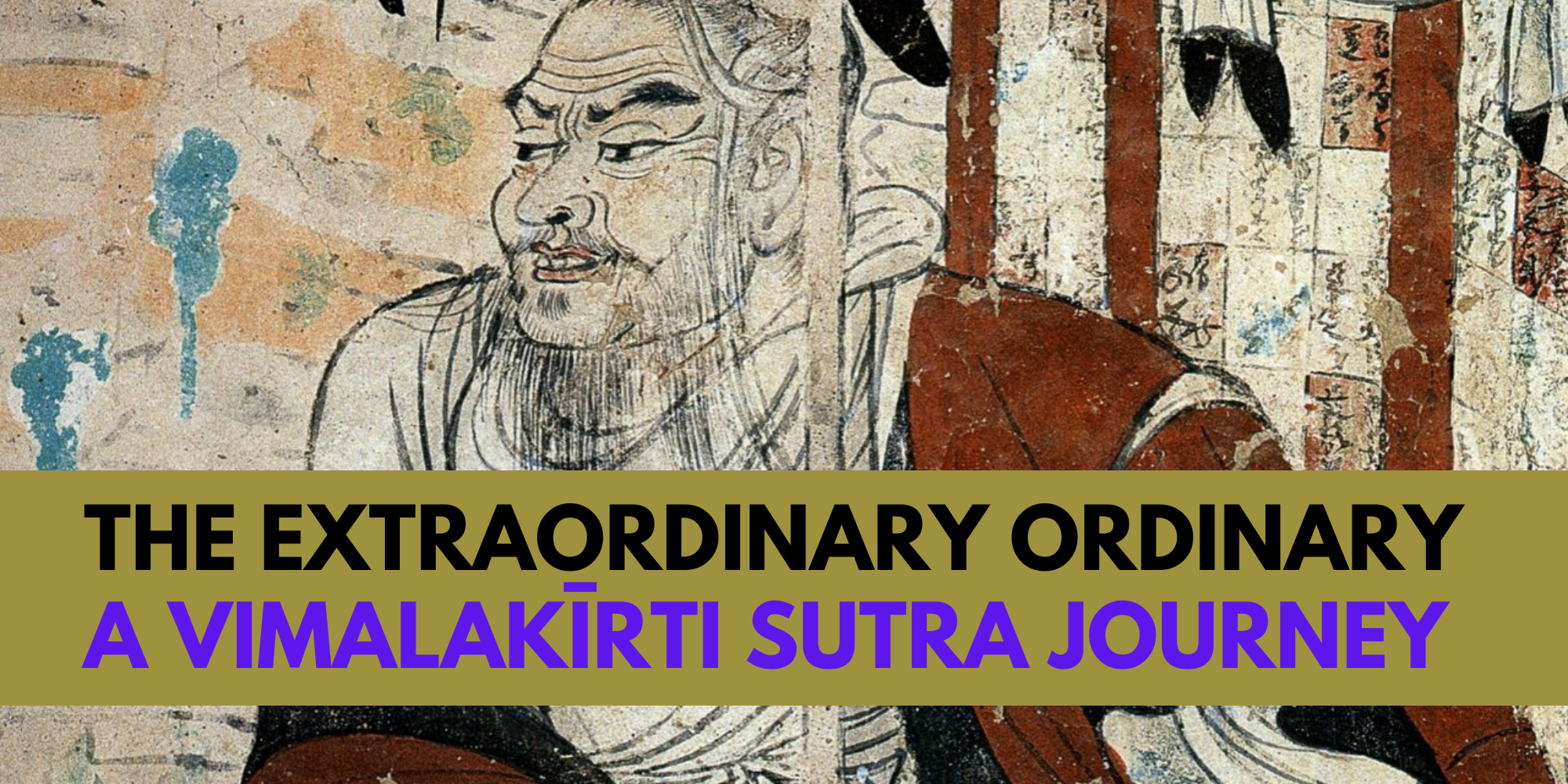
We often imagine that spiritual awakening requires us to leave ordinary life behind: its uncertainties, its responsibilities, its difficult relationships, and its unexpected demands. In the Vimalakīrti Sūtra, we meet a householder whose life becomes the living expression of the Dharma. The world is not a barrier to practice; it is where awakening is brought into being through wisdom, courage, and compassion.
This collection preserves the original twelve-part study by Sensei Sōen Michael Brunner, Abbot of One River Zen. Each installment includes the sūtra passage selected for that lesson and the author's complete commentary. All teaching text is directly on this page, in the original course sequence, so you can read it from beginning to end or move among the chapters.
Buddha Land & Skillful Means
Discovering that the Buddha Land is not somewhere removed from ordinary experience, and meeting Vimalakīrti as the householder who embodies the teaching.
Part 1: Chapter I · Buddha Land
The Sūtra · Passage under discussion
“When the elder’s son Jewel Accumulation finished speaking this verse, he addressed the Buddha, “World-honored One, these five hundred elders’ sons have all generated the intention to achieve anuttarā samyaksaṃbodhi (complete, perfect enlightenment). We wish to hear of the purity of the countries of the Buddha. Would the World-honored One please explain for the bodhisattvas the practices by which a land is purified?”
The Buddha said, “Excellent, Jewel Accumulation! You are able to inquire on behalf of the bodhisattvas regarding the practices by which the Tathāgata purified his land. Listen clearly, listen clearly, and consider this well. I will explain it for you.” At this Jewel Accumulation and the five hundred elders’ sons listened as instructed.
The Buddha said, “Jewel Accumulation, the categories of sentient beings are the bodhisattvas’ buddha lands. Why is this? Bodhisattvas acquire the buddha lands according to the sentient beings they convert. They acquire the buddha lands according to the sentient beings they discipline. They acquire the buddha lands according to what country sentient beings need to enter into buddha wisdom. They acquire the buddha lands according to what country sentient beings need to generate the roots [for becoming] bodhisattvas.
Why is this? Because bodhisattvas’ acquisition of the pure countries is entirely for the benefit of sentient beings. It is like a man who wants to build a palace on empty land who is [able to build it] according to his wish without hindrance. He would never be able to build it in space. Bodhisattvas are like this. In order to accomplish the [salvation of] sentient beings, they vow to acquire the buddha countries. The vow to acquire a buddha land is not done in empty space!”
Part 2: Chapter I · Buddha Land
The Sūtra · Passage under discussion
“Therefore, Jewel Accumulation, if a bodhisattva wishes to attain a pure land he should purify his mind. According to the purity of his mind is his buddha land pure!”
At that time Śāriputra was influenced by the Buddha’s numinous charisma to have this thought: “If the bodhisattva’s buddha land is pure according to the purity of the bodhisattva’s mind, then when our World-honored One was a bodhisattva his mind must have been pure. Nevertheless, this buddha land is so impure!”
The Buddha knew what he was thinking and asked him, “What do you think? Although the blind do not see them, can the sun and moon be anything but pure?” Śāriputra answered, “No, World-honored One! This is the fault of the blind, not that of the sun and moon.” The Buddha said, “Śāriputra, it is through the transgressions of sentient beings that they do not see the purity of the Tathāgata’s buddha land. This is not the Tathāgata’s fault! Śāriputra, this land of mine is pure, but you do not see it.”
At that time Conch Crest Brahmā King said to Śāriputra, “Do not think thus, saying that this buddha land is not pure. Why? I have witnessed the purity of Śākyamuni’s buddha land. It is like the heavenly palace of Īśvara.”
Śāriputra said, “As I observe this land, it is hills and hollows, brambles and gravel, and rocks and mountains—all filled with defilements.”
Conch Crest Brahmā King said, “Sir, your mind has high and low because you are not relying on buddha wisdom. Hence you perceive this land as impure. Śāriputra, the bodhisattva is universally same in attitude regarding all sentient beings. The purity of his profound mind relies on buddha wisdom and therefore is able to perceive the purity of this buddha land.”
At this the Buddha pointed to the earth with his toe, and instantly the trimegachiliocosm was as if ornamented with a hundred thousand jewels. It was like the Jewel Ornamentation land, with all its immeasurable merits, of Jewel Ornament Buddha.
The entire great assembly exclaimed at this unprecedented event, and they all saw themselves sitting on many-jeweled lotus flowers.
The Buddha told Śāriputra, “You should now observe the purity of this buddha land.” Śāriputra said, “So it is, World-honored One. Originally I did not see it; originally I did not hear it. Now the purity of the Buddha’s country is entirely apparent.” The Buddha said to Śāriputra, “My buddha country is always pure, like this. It is only so as to save inferior persons here that I manifest it as a defiled and impure land. It is like the many-jeweled eating utensils used in common by the gods, the food in which is of different colors depending on their merits. Just so, Śāriputra, if a person’s mind is pure he sees the merits and ornaments of this land.”
When the Buddha manifested the purity of this country, the five hundred elders’ sons led by Jewel Accumulation all achieved forbearance of the nonarising of dharmas. Eighty-four thousand people all generated the intention to achieve anuttarā samyaksaṃbodhi.
The Buddha then withdrew his numinous powers, and the world returned to its former appearance.
The thirty-two thousand gods and humans who sought the śrāvaka vehicle understood that conditioned dharmas were all entirely impermanent and, distantly transcending sensory defilement, they attained purity of the Dharma eye.
Eight thousand bhikṣus achieved nonexperiencing of the dharmas, their minds liberated by the elimination of the flaws.
Sensei Sōen Michael Brunner’s commentary
After the Buddha tells Jewel Accumulation that sentient beings are the bodhisattvas’ Buddha Lands, he turns to the question of purity. This is important, because if we are not careful we will take the first teaching and immediately turn it into another abstraction. We may agree that sentient beings are Buddha Lands, but still secretly imagine that the land is purified by removing everything difficult, painful, inconvenient, or impure from it. In other words, we still want a purified world made by exile. We want to keep what we like, remove what we don’t, and call the result “awakening”. But this is not the Buddha’s teaching. The Buddha does not say the land is purified by getting rid of sentient beings, or by separating the clean from the unclean, or by finding a place where the brambles and gravel of ordinary life no longer appear. He says that if a bodhisattva wishes to attain a pure land, he should purify his mind.
This can be easily misunderstood. To purify the mind does not mean to perfect our opinions, polish our spiritual identity, or develop a private interior sanctuary where nothing disturbs us. It is not the creation of a more refined self. Purifying the mind is the loosening of the self-centered frame of reference that constantly divides the world into what serves me and what threatens me, what pleases me and what offends me, what belongs and what should be cast out. When this grasping mind softens, the world is no longer reduced to the narrow terms of our preference. We begin to see more clearly. We begin to see context. We begin to see the totality of things instead of only the small portion of reality that confirms our karmic story.
Śāriputra gives voice to the question most of us would ask. If the purity of the Buddha Land depends upon the purity of the bodhisattva’s mind, then surely Śākyamuni’s mind must have been pure. So why does this world look the way it does? Why is there suffering? Why are there hills and hollows, brambles and gravel, rocks and mountains, all filled with defilements? This is not a foolish question. This is the question of our actual lives. We hear that this very world is the field of awakening, and then we look around and see cruelty, illness, loss, greed, division, loneliness, and confusion. We hear that sentient beings are Buddha Lands, and then we meet sentient beings who are difficult, angry, frightened, manipulative, grieving, and lost. We hear that the Way is right here, and then right here looks nothing like the sacred world we imagined.
The Buddha does not answer by denying what Śāriputra sees. This is crucial. He does not say there are no brambles. He does not say there is no gravel. He does not say suffering is imaginary or that the world’s wounds are insignificant. Instead, he compares Śāriputra’s perception to blindness before the sun and moon. The blind do not see the sun and moon, but this does not make the sun and moon impure. The failure of perception does not exhaust reality. This is a subtle but necessary point. The problem is not that the world must be rejected. The problem is that we have not yet learned to see the world fully.
Conch Crest Brahmā King makes the matter even more direct: Śāriputra sees high and low because he is not relying on Buddha wisdom. Here again, the teaching is not asking us to pretend that distinctions have no practical function. This touches on the vital teaching of the Two Truths. In the relative world, high and low appear. Pain and joy appear. The brambles will still scratch your skin, and the gravel will still hurt your feet. We must honor this relative reality. But Buddha wisdom relies on the absolute truth: that beneath these passing conditions, no single thing is permanently fixed, inherently impure, or fundamentally separate from anything else. When we absolutize our relative distinctions—when we build our lives from them and mistake our karmic perception for the dharmakaya—we live in a broken world of our own creation. We see fragments and call them truth. We see beings as separate problems and fail to recognize their place in the continuous field of awakening.
This is where practice becomes essential. We cannot reason our way into Buddha wisdom while still clinging to the same small self that obscures it. We cannot simply agree with the teaching and expect to see differently. We have to practice. We have to sit, breathe, bow, listen, serve, forgive, begin again, and let our mind be softened by the life we are actually living. We have to let go of the idea that our preferences are the measure of reality. We have to release the constant inner argument that says this belongs and that does not. When we loosen this grasp, the world does not become pure because we have decorated it with spiritual imagination. It is revealed as pure because our deluded way of seeing no longer conceals it.
Then the Buddha points to the earth with his toe, and the whole world appears ornamented with jewels. This is a wonderful image, but it should not be read as an escape from the ordinary. The Buddha is not replacing this world with another world. He is revealing this world. The same earth that Śāriputra sees as hills and hollows, brambles and gravel, is shown as jeweled and immeasurable. Nothing has to be transported elsewhere. Nothing has to be traded in. The Buddha simply touches the earth, and what was always present becomes visible.
This is the extraordinary ordinary. The land is not purified by leaving it. The land is purified when we no longer see it through the narrowness of delusion. The person before us does not become Buddha Land only after they are improved, corrected, or made acceptable to us. They are Buddha Land when seen through Buddha wisdom. This does not erase their suffering or ours. It does not make harm harmless. It does not remove the need for compassionate action. Rather, it shows us how to act without exile. It shows us how to meet beings from the ground of wholeness instead of from the habits of separation.
Śāriputra finally says, “Originally I did not see it; originally I did not hear it. Now the purity of the Buddha’s country is entirely apparent.” This is the turn of practice. The purity was not newly manufactured. It was not created by argument. It was not achieved by removing the world’s roughness. It was apparent when his seeing changed. This is not a call to passive optimism. It is not a denial of suffering. It is a call to the most intimate responsibility. If the land is pure according to the purity of mind, then our work is to meet this world with a mind that does not divide endlessly, does not cling to superiority, does not exile beings from the field of care, and does not confuse its own wounded perception for final truth.
In Part One, we saw that sentient beings are the bodhisattva’s Buddha Lands. In Part Two, we see that the impurity we perceive is not the final truth of the land. This matters because the beings we meet are always more than our first judgment of them. The world is always more than our fear of it. Our lives are always more than the stories we have inherited about what is possible. When we practice, we are not trying to escape into a purified elsewhere. We are learning to see deeply enough that this very life, with its brambles and gravel, its tenderness and grief, its confusion and beauty, is revealed as the place where wisdom and compassion must appear.
The Buddha touches the earth with his toe. This is enough. The earth doesn’t magically become holy in that moment, we just finally see that it was never apart from holiness. This is our practice as well: to touch this life directly. To stop trying to stand somewhere else. To stop waiting for better conditions. We stop mistaking our blindness for the nature of the sun and moon. When we open to the totality of things, the jeweled land appears under our feet. Not somewhere else someday–right here now.
Part 3: Chapter II · Skillful Means
The Sūtra · Passage under discussion
“At that time there was within the great city of Vaiśālī an elder named Vimalakīrti. He had already made offerings to immeasurable buddhas, deeply planting the foundation of goodness. He had attained forbearance of the nonarising of dharmas, and his eloquence was unhindered. He disported in the numinous penetrations and had achieved all the dhāraṇīs. He had attained fearlessness and had subjugated the troubling vengeance of the Māras. Entering into all the gates of profound Dharma, he was excellent at the perfection of wisdom. Having penetrated skillful means, his great vows had been accomplished. Understanding the tendencies of the minds of sentient beings, he was also able to discriminate between those of sharp and dull faculties. Long a practitioner of the path of buddhahood, his mind was already pure, and he was definitively dedicated to the Mahayana. He considered well the activities of the realms of existence, and, residing in the deportment of the Buddha, his mind was great as the ocean. The buddhas praised him as their disciple, and the Indras, Brahmās, and world lords revered him.
Wanting to save people, Vimalakīrti used his excellent skillful means to reside in Vaiśālī, where with wealth immeasurable he attracted the poor, with the purity of his morality he attracted the miscreants, with the moderation of his forbearance he attracted the angry, with great exertion he attracted the indolent, with singleminded concentration he attracted the perturbed, and with definitive wisdom he attracted the foolish.
Although he was a white-robed layman, he maintained the pure Vinaya conduct of a śramaṇa; although he resided in the home, he was not attached to the triple world. He manifested the existence of wife and sons, but always cultivated chastity. He revealed the existence of subordinates, but always enjoyed transcendence. Although his clothing was richly decorated, it was with the marks and features of a Tathāgata that he adorned his body. Although he drank and ate, the joy of concentration was his favorite flavor. If he went to gambling houses or theaters it was only to save people. He hosted those of the heretic paths without breaking his correct faith. Although he illuminated the profane classics he always took pleasure in the Buddha-Dharma. He was revered by all as the one most worthy of offerings.
In supporting the correct Dharma he attracted both old and young. In all of his business dealings, although he made worldly profits he never took joy in them. In wandering the crossroads, he dispensed benefit to sentient beings. In entering into government administration, he safeguarded everyone. In entering into the lecture halls, he led people by means of the Mahayana. In entering the schools, he inspired the children. In entering the brothels, he revealed the transgressions that arise from desire. In entering the wine shops, he was able to maintain his good intention.
When he was with the elders, as the most honored of the eminent he explained the excellent Dharma for them. When he was among retired scholars, as the most honored of the retired scholars he eradicated their attachments. When he was among kṣatriyas, as the most honored among kṣatriyas he taught them forbearance. When he was among brahmans, as the most honored among brahmans he eliminated their arrogance. When he was among the ministers, as the most honored among ministers he taught them the correct Dharma. When he was among princes, as the most honored among princes he instructed them with loyalty and filiality. When he was among palace officials, as the most honored among palace officials he converted the palace women.
When he was among the common people, as the most honored among the common people he had them generate the power of blessings. When he was among Brahmā gods, as the most honored of the Brahmā gods he taught with superior wisdom. When he was among Indras, as the most honored among Indras he manifested impermanence. When he was among world-protector gods, as the most honored among world-protectors he protected sentient beings. The Elder Vimalakīrti used immeasurable skillful means such as these to benefit sentient beings.
Using skillful means he manifested becoming ill himself. Because he was ill, the king, ministers, elders, retired scholars, brahmans, the princes and the other palace retainers, and innumerable thousands of people all came to inquire about his illness.
To those who came, Vimalakīrti used the occasion of his illness to make extensive explanations of the Dharma.
“Sirs, the body is impermanent, without strength, without power, without solidity. Given the way it rapidly disintegrates, it cannot be trusted. Alternately suffering and vexatious, it accumulates a host of illnesses. Sirs, the wise do not rely on such a body.
“This body is like a bit of foam that cannot be grasped. This body is like bubbles that do not last very long. This body is like a mirage, generated from thirst. This body is like a banana tree, with nothing solid within. This body is like a phantasm arising from confused views. This body is like a dream, an illusory view. This body is like a shadow, manifested through karmic conditions. This body is like an echo, dependent on causes and conditions. This body is like a cloud, which changes and disappears in an instant. This body is like lightning, unstable from one moment to another.
“This body is without master, like the earth. This body is without self, like fire. This body is without lifespan, like the wind. This body is without person, like water.
“This body is insubstantial, being housed in the four elements. This body is empty, transcending self and the qualities of self. This body is ignorant, like plants and rocks. This body is inactive, being turned by the power of the wind. This body is impure, replete with defilements. This body is untrustworthy, since even though one washes, clothes, and feeds it it will necessarily disintegrate. This body is a disaster, vexed by a hundred and one illnesses. This body is like a well on a hill, pressed by age. This body is unreliable, dying in spite of being needed. This body is like a poisonous snake, a vengeful bandit, an empty aggregation. It is the composite of the skandhas, sensory realms, and sensory capacities.
“Sirs, this body being so calamitous and repugnant, you should wish for the body of the Buddha. Why?
“The body of the Buddha is the body of the Dharma. It is generated through immeasurable wisdom and merit. It is generated through morality, meditation, wisdom, emancipation, and the knowledge and vision of emancipation. It is generated through sympathy, compassion, joy, and equanimity. It is generated through the perfections of charity, morality, forbearance and adaptability, energetic exertion, meditation, emancipation, samādhi, and learned wisdom. It is generated from skillful means; it has been generated from the six penetrations; it is generated from the three illuminations; it is generated from the thirty-seven factors of enlightenment; it has been generated from concentration and contemplation; it is generated from the ten powers, the four fearlessnesses, and the eighteen exclusive attributes; it is generated from the eradication of all the dharmas that are not good and accumulation of all the good dharmas; it is generated from the truth; it is generated from the absence of negligence.
“The Tathāgata’s body is generated from immeasurable pure dharmas such as these. Sirs, if you wish to attain the body of the Buddha and eradicate all the illnesses of sentient beings, you should generate the intention to achieve anuttarā samyaksaṃbodhi!”
Thus did the Elder Vimalakīrti explain the Dharma for those who inquired about his illness, causing innumerable thousands of people to all generate the intention to achieve anuttarā samyaksaṃbodhi.”
Sensei Sōen Michael Brunner’s commentary
In Chapter II, we meet Vimalakīrti himself, and the teaching now moves from the language of Buddha Lands into the activity of a bodhisattva. Chapter I presents the Buddha explaining to us that sentient beings are the bodhisattvas’ Buddha Lands, and that the purity of the land is revealed through the purification of mind. Now we are shown what that looks like when it is embodied. Vimalakīrti is not introduced as someone who has escaped ordinary life. He is not hidden away in a monastery, sealed off from the disorder of the world. He lives in Vaiśālī and is possessed of wealth, relationships, social standing, and access to every part of civic life. None of this, however, ensnares him. He moves freely through the world because he is not clinging to anything to complete the small self.
The sutra does not present Vimalakīrti as a layperson who simply does whatever he wants and calls it practice. That would be a very grave misunderstanding–he is not unintentional or undisciplined. He is not twisting the teachings to justify his preferences or indulge his fancies. Even as a white-robed layman, he maintains the pure conduct of a śramaṇa. Residing in the home, he is not attached to the triple world. He may manifest a wife and sons, but he cultivates chastity. Although he enters gambling houses, theaters, brothels, wine shops, government offices, schools, crossroads, and lecture halls, he does not enter them as a tourist of samsara. He enters them to bring sentient beings to the other shore.
This is the activity of awakening through skillful means. Beyond cleverness or compromise, skillful means is wisdom taking the shape required by compassion to address the suffering at hand. Vimalakīrti does not force his ideas of what practice should be onto the situation–he meets each suffering creation according to its causes and conditions. With his wealth, he mends poverty. With his morality, he attends to those who have fallen into misconduct. With his forbearance, he attends the angry. In each case, the medicine is suited to the illness as it presents itself based on causes and conditions. He does not condemn beings for the form in which their suffering shows itself. He penetrates delusion by discerning what actions will allow suffering beings to find the nourishment needed to generate roots and connection.
This builds on the first chapter by teaching us that if sentient beings are Buddha Lands, then practice cannot be idealized abstraction. Buddha Land can’t be built in the empty space of the discursive mind, thus we cannot save beings by addressing an imagined version of them. The bodhisattva must see clearly and act on what presents itself. Poverty requires generosity. Anger requires forbearance. Confusion requires wisdom. Disturbance requires concentration. Laziness requires energy. This is not a matter of fixing people from the outside–it is the careful cultivation of conditions through which beings cease from clinging to the deluded awareness of separateness and sink deep roots into Oneness.
There is boundless generosity in this vision in that Vimalakīrti does not wait for beings to come to him in a properly sacred form. He goes to them by entering the messy places where life is lived. He enters business dealings, crossroads, government, schools, and places of desire. He meets elders, scholars, warriors, brahmans, ministers, princes, palace officials, common people, Brahmā gods, Indras, and world-protectors. Nothing is outside his field of practice, everything is included. No conditions are beneath the Dharma, and no realm of existence is excluded from the penetrating light of awakening.
This is also where the sutra challenges our tendency to divide sacred and profane. We often imagine that spiritual life is what happens in explicitly spiritual places, while the rest of life is merely something to endure, manage, or escape. Vimalakīrti refuses to create this separation, his activity reveals that the marketplace can be a temple, the crossroads can be a Dharma hall, and the difficult person before us can be the precise field in which our vows become real. This does not make everything wholesome or deny the dangers of desire, greed, arrogance, or ignorance. It shows that the bodhisattva does not abandon beings simply because they appear in difficult places.
There is great freedom here, but it is not the freedom of doing whatever we want. It is the freedom of not being possessed by what we encounter. Vimalakīrti can enter the wine shop because he is not intoxicated by it. He can enter the brothel because he is not governed by desire. He can engage in business because worldly profit does not delight him. He can illuminate profane classics because he still takes joy in the Buddha-Dharma. This is not avoidance, and it is not indulgence. It is the middle way functioning dynamically in the world. He neither rejects the world nor is captured by it.
This is an important corrective for practice. Sometimes we think purity means distance. We imagine that if we can keep far enough away from difficulty, we will remain undefiled. But this often creates a very fragile spirituality. It depends on controlled conditions. It depends on life not pressing too hard. It depends on everyone behaving properly around us. The bodhisattva’s purity is different. Vimalakīrti’s purity is not maintained by staying away from the world, but by entering the world without losing his vow. He does not need to exile beings in order to remain clear. He meets them from the ground of wisdom and compassion.
Then the chapter turns. Vimalakīrti manifests illness. This is one of the most important moments in the sutra because his sickness becomes the doorway into everything that follows. Because he is sick, the king, ministers, elders, scholars, brahmans, princes, palace retainers, and innumerable thousands of people come to inquire about him. His illness gathers the world to his bedside. The sickroom becomes the Dharma hall. The body, vulnerable and unreliable, becomes the occasion for awakening. There is a great temptation to move quickly beyond this, but it requires us to give pause and deeply witness this. Most of us experience illness just as an interruption. We imagine our practice is going well until the body fails, until pain appears, until age sets in on us, or until grief or anxiety or diagnosis enters the room. Then we think practice somehow has been obstructed, and pray for its return. Vimalakīrti uses illness itself as skillful means. He does not wait until the body is strong to teach. He does not wait until conditions are ideal. He takes the very condition most likely to frighten us and opens it as the gate of Dharma.
This body is impermanent, without strength, without power, without solidity. It is foam, bubbles, mirage, banana tree, phantasm, dream, shadow, echo, cloud, and lightning. It is without master, without self, without lifespan, without person. It is insubstantial, empty, impure, unreliable, vexed by illnesses, pressed by age, dying in spite of our feeling of its being needed. This is meant to free us from our delusion about the body: We suffer because we keep asking the body to be what no conditioned thing can be: permanent, reliable, self-owned, and secure.
This teaching can sound harsh to modern ears because we are so accustomed to identifying with the body as self. We want the body to guarantee our continuity and hold our identity together. So it has to remain attractive, useful, obedient, and safe. A casual observation, however, shows the body does not belong to our preferences. It is a composite of the skandhas, sensory realms, and sensory capacities and is dependent on causes and conditions. It appears for a time, changes without asking permission, and passes away. To see this clearly is not morbid, it is liberating. It releases us from the impossible burden of trying to make the impermanent permanent and from placing our trust in dust and ashes.
Instead, Vimalakīrti turns from the unreliable body to the body of the Buddha, which is the body of the Dharma. The point is not to despise this human form, but to stop relying on it as a fixed self and awaken to the Dharma body that is generated through wisdom, merit, morality, meditation, emancipation, compassion, joy, equanimity, skillful means, truth, and the absence of negligence. In other words, he is not asking us to reject embodiment. He is asking us to embrace the whole truth of embodiment, and thus truly embody the Way.
Here we find the Two Truths again. Relatively, the body hurts. The body ages. The body fails. The brambles scratch skin, the gravel hurts feet, and sickness brings suffering. We cannot deny this without falling into fantasy. But absolutely, the body is empty of fixed self. It is not separate from the total field of causes and conditions. When we cling to it as “me” or “mine,” we suffer. When we see it as Dharma, as the temporary activity of reality itself, we can care for it without being imprisoned by it. Vimalakīrti uses the occasion of his own sickness to point beings toward the eradication of all illnesses of sentient beings. His body becomes a teaching because he does not make it private. The suffering of the body opens into the bodhisattva vow. He shows that the way beyond suffering is not to secure this fragile form against all loss, but to generate the intention to achieve complete, perfect enlightenment for the sake of beings. The cure is not escape from the body. The cure is awakening through this very body, this very vulnerability, this very life.
This is the extraordinary ordinary. Vimalakīrti’s life is extraordinary not because it escapes ordinary conditions, but because it reveals what ordinary conditions are when seen clearly. Wealth, family, work, public life, desire, illness, aging, and death are not outside practice. They are the very places where our delusion of separateness is exposed and our vows are tested. The question is not whether these conditions are pure enough for practice. The question is whether we will meet them with a mind large enough to include them.
The Elder Vimalakīrti uses immeasurable skillful means to benefit sentient beings. This is our invitation as well. We do not need to imitate his cosmic powers or imagine ourselves as some grand bodhisattva moving through Vaiśālī. We begin where we are. We meet the person before us. We see the condition clearly. We respond with what is needed. We stop using practice as a dream of elsewhere and allow it to become the activity of this life. Not somewhere else someday—right here now.
Disciples & Bodhisattvas
An encounter with teachers and practitioners who find their settled notions of practice, purity, wisdom, and enlightenment overturned.
Part 4: Chapter IIIa · Disciples
The Sūtra · Passage under discussion
“At that time the Elder Vimalakīrti thought to himself, “I am lying sick in bed. How can the World-honored One, He of Great Sympathy, not take pity on me?”
Knowing what Vimalakīrti was thinking, the Buddha immediately told Śāriputra, “Go visit Vimalakīrti and inquire about his illness.”
Śāriputra addressed the Buddha, “World-honored One, I dare not accept your instruction to go inquire about his illness. Why? I remember once in the past, when I was sitting in repose beneath a tree. At the time Vimalakīrti came and said to me,
“‘O Śāriputra, you need not take this sitting in meditation to be sitting in repose. Sitting in repose is to not manifest body and mind in the triple world—this is sitting in repose. To generate the concentration of extinction while manifesting the deportments—this is sitting in repose. Not to relinquish the Dharma of enlightenment and yet manifest the affairs of ordinary sentient beings—this is sitting in repose. To have the mind neither abide internally nor locate itself externally—this is sitting in repose. To be unmoved by the sixty-two mistaken views yet cultivate the thirty-seven factors of enlightenment—this is sitting in repose. Not to eradicate the afflictions yet enter into nirvana—this is sitting in repose.
“‘Those who are able to sit in this fashion will receive the Buddha’s seal of approval.’
“At the time, World-honored One, I simply listened to this explanation in silence and was unable to respond. Therefore, I cannot accept your instruction to go inquire about his illness.”
The Buddha told Mahāmaudgalyāyana, “You go inquire about Vimalakīrti’s illness.”
Maudgalyāyana addressed the Buddha, “World-honored One, I dare not accept your instruction to go inquire about his illness. Why? I remember once in the past, I had entered the great city of Vaiśālī and was explaining the Dharma to the retired scholars of a certain neighborhood. At the time Vimalakīrti came and said to me,
“‘O Mahāmaudgalyāyana, when you explain the Dharma to white-robed retired scholars, you should not explain it as you are now doing. In explaining the Dharma, you should explain according to the Dharma.
“‘The Dharma is without sentient beings because it transcends the defilements of sentient beings; the Dharma is without self because it transcends the defilements of self; the Dharma is without lifespan because it transcends birth and death; and the Dharma is without person because it eradicates the threshold between previous and subsequent moments.
“‘The Dharma is permanently serene because it extinguishes the characteristics; the Dharma transcends characteristics because it is without conditions; the Dharma is without names because it eradicates words; the Dharma is without explanation because it transcends discursive thought and reasoning; the Dharma is without the characteristics of form because it is like space; the Dharma is without hypotheses because it is ultimately empty; the Dharma is without the sense of personal possession because it transcends personal possession; the Dharma is without discrimination because it transcends the consciousnesses; and the Dharma is incomparable because there is nothing to match it; the Dharma is divorced from causation because it is not located in conditionality.
“‘The Dharma is identical to Dharma-nature because it inheres in the dharmas; the Dharma accords with suchness because it is without anything that accords with it; the Dharma abides in the actual because it is unmoved by the extremes; the Dharma is motionless because it is not dependent on the six types of sensory data; and the Dharma is without past and future because it is constantly nonabiding.
“‘The Dharma concurs with emptiness, accords with the absence of characteristics, and responds to inactivity. The Dharma transcends good and ugly, the Dharma is without gain and loss, the Dharma is without generation and extinction, and the Dharma is without refuge. The Dharma surpasses eye, ear, nose, tongue, body, and mind. The Dharma is without high and low, the Dharma abides constantly without moving, and the Dharma transcends all practices of contemplation.
“‘O Mahāmaudgalyāyana, with characteristics such as these, how can the Dharma be explained? Explaining the Dharma should be without explaining and without indicating. Listening to the Dharma should be without listening and without attaining.
“‘It is like a magician explaining the Dharma to conjured people.
“‘One should have such a mindset in explaining the Dharma; one should comprehend that the faculties of sentient beings include both sharp and dull. You would do well to be without hindrance in your knowledge and vision. Use the mind of great compassion and praise the Mahayana. Remember to recompense the kindness of the Buddha and do not cut off the Three Jewels. Thus should you explain the Dharma.’
“When Vimalakīrti explained this Dharma, eight hundred retired scholars generated the intention to achieve anuttarā samyaksaṃbodhi. I lack this eloquence. Therefore I cannot accept your instruction to go inquire about his illness.”
The Buddha told Mahākāśyapa, “You go inquire about Vimalakīrti’s illness.”
Kāśyapa addressed the Buddha, “World-honored One, I dare not accept your instruction to go inquire about his illness. Why? I remember once in the past, when I was begging in a poor neighborhood, Vimalakīrti came and said to me,
“‘O Mahākāśyapa, you have the mind of sympathy and compassion but are unable to apply it universally. You have abandoned the wealthy to beg from the poor.
“‘Kāśyapa, while abiding in the Dharma of universal sameness, you should proceed in sequence in your begging.
“‘It is because of not eating that you should practice begging.
“‘It is because of the destruction of one’s physical integrity that you should take that lump of food. It is because of not receiving that you should receive that food.
“‘You should enter a village with the idea that it is an empty aggregation.
“‘The forms you see are equivalent to what the blind see; the sounds you hear are equivalent to echoes; the fragrances you smell are equivalent to the wind; the flavors you eat should not be discriminated; your tactile sensations are like the realizations of wisdom; and you should understand that the dharmas are like phantasms. That which is without self-nature and without other-nature originally was not burning and will not become extinguished now.
“‘Kāśyapa, if you are able to enter the eight emancipations without renouncing the eight perversions, using the characteristic of perversion to enter into the correct Dharma, and using a single meal to give to all, making offerings to the buddhas and the assembly of worthies and sages—only then should you eat.
“‘To eat in this fashion is neither to have the afflictions nor to transcend the afflictions, it is neither to enter into concentration nor to arise from concentration, it is neither to abide in the world nor to abide in nirvana.
“‘Where there is charity, there are neither great nor small blessings, neither benefit nor harm. This is the correct entry into the path of buddhahood, without relying on the śrāvaka vehicle.
“‘Kāśyapa, if you can eat according to this understanding then you will not render void the charity of those who feed you.’
“At the time, World-honored One, the explanation I heard was unprecedented to me, and I immediately generated a profound sense of reverence for all bodhisattvas. I also thought, ‘This householder’s eloquence and wisdom being as they are, how could anyone who hears him not generate the intention to achieve anuttarā samyaksaṃbodhi? From now on I will never exhort anyone to undertake the practices of śrāvaka or pratyekabuddha.’ Therefore I cannot accept your instruction to go inquire about his illness.”
The Buddha told Subhūti, “You go inquire about Vimalakīrti’s illness.”
Subhūti addressed the Buddha, “World-honored One, I dare not accept your instruction to go inquire about his illness. Why? I remember once in the past, I entered into his home to beg. At the time Vimalakīrti filled my bowl full of food and said to me,
“‘O Subhūti, if you are able to be universally same about eating, then the dharmas are also universally same; if the dharmas are universally same, you should also be universally same about eating. If you can practice begging like this, you may accept the food.
“‘If, Subhūti, you refrain from eradicating licentiousness, anger, and stupidity, yet are not equipped with them; if you do not destroy the body, yet accord with the single characteristic; if you do not extinguish stupidity and affection, yet generate wisdom and emancipation; if you use the characteristics of the five transgressions to attain emancipation, without either emancipation or bondage; if you do not perceive the four noble truths, yet do not fail to perceive the truths; neither attaining the results of becoming a stream-enterer, and so on, nor not attaining the results; neither being an ordinary unenlightened person nor transcending the state of ordinary person; neither being a sage nor not being a sage; accomplishing all the dharmas yet transcending the characteristics of the dharmas—then you can accept this food.
“‘Subhūti, you should only accept this food if you can neither see the Buddha nor hear the Dharma, nor the six teachers of heterodox paths—Pūraṇa Kāśyapa, Maskarin Gośālīputra, Saṃjayin Vairaṭīputra, Ajita Keśakambala, Kakuda Kātyāyana, and Nirgrantha Jñātiputra, who were your teachers, following whom you left home, so that at the defeat of those teachers you were also defeated—then you can accept this food.
“‘If, Subhūti, you can enter into the heterodox views and not reach the other shore; abide in the eight difficulties and not attain the absence of difficulty; identify with the afflictions and transcend the pure dharmas; attain the samādhi of noncontention; if all sentient beings generate this concentration; if the donors do not name you their field of blessings; if those making offerings to you fall into the three evil destinations; if you join hands with the host of Māras and make them your co-workers; if you do not differentiate yourself from the host of Māras and the sensory troubles; if you bear resentment toward all sentient beings; if you revile the Buddha, denigrate the Dharma, and do not enter the Sangha; and if you never attain extinction—if you are like this then you can accept the food.’
“When I heard these words, World-honored One, I was bewildered and did not understand what he had said. I did not know how to answer, so I put down the bowl and tried to leave his house. Vimalakīrti then said,
“‘O Subhūti, do not be afraid to take your bowl. What is the meaning of this? If a phantasmagorical person whom the Tathāgata has created through the transformation of conjury is criticized for this, should he be afraid?’ I said, ‘No.’ Vimalakīrti said, ‘All the dharmas have the characteristic of being like phantasmagorical transformations. You should not have any fear now. Why? All verbal explanations do not transcend this characteristic. The wise are not attached to letters, and therefore they have no fear. Why? The nature of letters transcends their characteristics; there are no letters. This is emancipation, and the characteristic of emancipation is the dharmas.’”
Sensei Sōen Michael Brunner’s commentary
Chapter III begins with Vimalakīrti lying sick in bed, wondering why the Buddha has not sent someone to inquire after him. We should be careful here to appreciate what is happening. Vimalakīrti is not merely lonely, and he is not just asking why he has been forsaken rhetorically. His sickroom is transforming into the place where the great spiritual identities of the Buddha’s disciples are brought into the light of total awareness and integrated. These are not totally separate beings corrected for their shortcomings. These are historically the Buddha’s great disciples, each reflecting a facet of the Dharma’s Light. When the Buddha asks them to go, they cannot. They can’t because each have met Vimalakīrti before, and each has already felt the sharp edge of his compassion.
This matters because most of us do not hide from the Dharma in obviously foolish places! We hide in the places where the sense of “I” is strongest–in what we already understand. We hide inside what others praise in us, or in forms of practice that have given us some comfort. We hide where we find some identity, some sense that we know where we stand. This is why Vimalakīrti is so unsettling. He doesn’t just expose ignorance, he exposes the arrogance that can attach itself to wisdom, meditation, teaching, austerity, and even emptiness. He shows us that any piece of the Dharma, when grasped as identity, becomes another expression of the small self.
Śāriputra is asked to go first, and he refuses because Vimalakīrti once came upon him sitting beneath a tree in repose. This is a dangerous scene for practitioners, because Śāriputra appears to be doing exactly what we think practice should look like. He is sitting quietly. He is settled. He is withdrawn from the ordinary distractions of the world. Vimalakīrti points out that this is not true sitting. True sitting is not simply taking the posture of serenity while still abiding in separation. We cannot just create a private spiritual enclosure where the world can’t reach us, abandoning the suffering of sentient beings and calling that abandonment peace. Many of us come to practice longing for stillness, and there is nothing wrong with that. Our lives are full of demands, wounds, and unsettled scores. So obviously we long for a tree to sit beneath and hide ourselves. However, we can’t just cling to the version of ourselves that is quiet and composed, and we resent the life that requires us to rise from the cushion. Practice is not what happens when no one needs us, no one irritates us, no one interrupts us, and nothing presses against the borders of our control.
Vimalakīrti is not telling Śāriputra not to sit. He is showing him that sitting must be large enough to include all postural attitudes and all sentient beings. If our zazen does not make us more available to the suffering world, then our zazen is far too small. If our peace depends upon exile, it is not yet peace. If our stillness cannot enter the sickroom, then it is not yet Big Mind. The problem is not sitting. The problem is leaning on sitting as though it were the whole of the Way.
Mahāmaudgalyāyana is asked next, and he also refuses. He remembers teaching Dharma to laypeople in Vaiśālī when Vimalakīrti came and corrected him. The issue here is subtle: teaching Dharma is not the problem, and words are not the problem. The Dharma has been carried through words, protected through words, transmitted through words, and we should appreciate this. Vimalakīrti is telling him that he should explain the Dharma according to the Dharma itself. The Dharma is without sentient beings, without self, without lifespan, without person, without names, without explanation, without gain or loss, without generation or extinction.
This is not a rejection of teaching–it is a warning about the teacher. We can say true things while still standing outside the truth we are saying. We can teach emptiness and still preserve the one who knows. We can speak of compassion and still fail to meet the actual people before us. We can become fluent in Dharma language and mistake that fluency for realization. This is especially treacherous because Dharma words are beautiful. They have the power to move people. But if we are not careful, they also become a mirror in which the small self admires its own spiritual reflection.
Then the Buddha asks Mahākāśyapa to go. He refuses because Vimalakīrti once met him while he was begging in a poor neighborhood. Kāśyapa is a figure of great austerity and renunciation, and it would be easy to admire him without question. Yet Vimalakīrti tells him that although he has sympathy and compassion, he is not applying them appropriately. By abandoning the wealthy and begging only from the poor, Kāśyapa has created a subtle division. He has made poverty spiritually preferable and wealth spiritually suspect. Even in compassion, high and low have entered.
This is another place where Vimalakīrti’s light penetrates our shallow clinging. We love to make categories. We love to decide who is pure and who is impure, who is worthy and who is unworthy, who belongs in the circle of care and who should remain outside. Sometimes these distinctions arise from real wounds and real histories, and we must not pretend the relative world doesn’t touch us. Poverty and wealth are not the same condition. Harm and healing are not the same activity. But when our compassion becomes attached to one side of a duality, it ceases to be universal. It becomes another way the small self arranges the world.
Vimalakīrti is not asking Kāśyapa to abandon renunciation. He is asking him to relinquish the identity of the renunciate. He is asking him to beg without creating a self who begs, a poor person who gives, a wealthy person who is excluded, and merit that can be possessed. He is asking him to see the village as an empty aggregation, to receive food without turning the act into a spiritual hierarchy. This is the vital point: practice must not secretly preserve the very separateness it claims to heal.
Then the Buddha asks Subhūti to go, and Subhūti also refuses. This encounter is especially powerful because Subhūti is associated with the teaching of emptiness, and Vimalakīrti presses emptiness until it can no longer be held as a concept. Subhūti comes to Vimalakīrti’s home to beg, and Vimalakīrti fills his bowl. Then he turns the whole situation inside out. Food, begging, purity, impurity, ordinary person, sage, bondage, emancipation, truth, non-truth, Buddha, Dharma, Sangha: all of it is shown as empty, illusory, with nowhere to grasp.
Subhūti becomes bewildered and doesn’t know what to say. He puts down the bowl and tries to leave. It is one thing to appreciate emptiness when it remains safely doctrinal. It is another thing when emptiness begins dissolving the one who appreciates it. We may love the teaching that all things are empty until it touches the self we are still protecting! We may speak about non-attachment until the bowl is in our own hands. We may praise the absence of fixed self until the self we call “mine” is the one being exposed.
Vimalakīrti tells him not to be afraid. If a conjured person created by the Tathāgata were criticized, should he be afraid? Of course not. All dharmas have the character of phantasmagorical transformation. All words and explanations belong to this same field. The wise are not attached to letters, and therefore they have no fear. This does not mean words are useless. It means they are not ultimate. The finger can point, but we must not mistake it for the moon. The teaching can guide, but we must not make a residence there.
So in this first movement of Chapter III, we see four great disciples unable to enter Vimalakīrti’s sickroom. Śāriputra cannot enter by leaning on sitting. Mahāmaudgalyāyana cannot enter by leaning on teaching. Mahākāśyapa cannot enter by leaning on austerity. Subhūti cannot enter by leaning on emptiness. Each of these is a true and beautiful Dharma gate. None of them should be discarded. But Vimalakīrti has reconciled them into Big Mind and leans on none of them. He can sit, teach, renounce, receive, speak, remain silent, enter the marketplace, and lie sick in bed without making any of these his final dwelling place.
This is why his question at the beginning is so sharp: “How can the World-honored One not take pity on me?” On one level, he is sick and asks to be seen. On another level, he calls the whole assembly forward–including them all. He is reminding himself that meditation must come without hiding in meditation, that teaching must come without hiding in teaching, that renunciation must come without hiding in renunciation, that emptiness must come without hiding in emptiness.
This is our work as well. We each have a doorway we trust. Some of us trust stillness. Some trust study. Some trust service. Some trust moral clarity. Some trust renunciation. Some trust emptiness. Some trust our ability to care for others. These are not wrong. But the question Vimalakīrti asks is whether we are free within them. Does our practice make us more open, more intimate, more able to respond to beings as they are? Or does it make us more defended, more certain, more subtly separate?
The sickroom cannot be entered by a partial self carrying its favorite Dharma. It asks for the whole of us. It asks us to come without leaning. This does not mean we abandon what we have learned. It means that knowledge, sitting, teaching, renunciation, and emptiness all take their proper place in the counsel of lived experience. None is exiled. None is enthroned. Each is included, and each is released.
This is the extraordinary ordinary of practice. We do not need to become someone else, and we do not need to discard the forms that have helped us. We simply have to stop making a home out of any partial thing and see our faces reflected in all we encounter.
Part 5: Chapter IIIb · Disciples
The Sūtra · Passage under discussion
“When Vimalakīrti explained this Dharma, two hundred gods attained purification of their Dharma eyes. Therefore I cannot accept your instruction to go inquire about his illness.”
The Buddha told Pūrṇamaitrāyaṇīputra, “You go inquire about Vimalakīrti’s illness.”
Pūrṇa addressed the Buddha, “World-honored One, I dare not accept your instruction to go inquire about his illness. Why? I remember once in the past, when I was beneath a tree in the forest explaining the Dharma to novice bhikṣus. At the time Vimalakīrti came and said to me,
“‘O Pūrṇa, you should only explain the Dharma after first entering into concentration and contemplating the minds of these people—do not put defiled food in a jeweled vessel. You should understand what these bhikṣus are thinking—do not put lapis lazuli together with crystal.
“‘You are unable to understand the fundamental sources of sentient beings—do not inspire them with the Hinayana Dharma. Other and self are without flaw, so do not harm them. If someone wants to travel the great path, do not show them a small pathway. The ocean cannot be contained within the hoofprint of an ox; the radiance of the sun cannot be equaled by that of a firefly.
“‘Pūrṇa, these bhikṣus have long since generated the aspiration for the Mahayana but in the midst of many rebirths they have forgotten this intention.
“‘Why would you teach them with the Hinayana Dharma? When I consider the Hinayana, its wisdom is as minute as a blind man’s, and with it you are unable to discriminate the sharp and dull faculties of all sentient beings.’
“Then Vimalakīrti entered into samādhi and made the bhikṣus aware of their previous lives. They had planted virtuous roots under five hundred buddhas and had rededicated them to their eventual achievement of anuttarā samyaksaṃbodhi. Learning this, they immediately experienced a suddenly expansive reacquisition of that original inspiration. At this the bhikṣus bowed their heads in reverence to Vimalakīrti’s feet. Then Vimalakīrti explained the Dharma for them, and they never again retrogressed from their progress to anuttarā samyaksaṃbodhi.
“I thought, ‘Śrāvakas do not consider the faculties of people and therefore should not explain the Dharma.’
“Therefore, I cannot accept your instruction to go inquire about his illness.”
The Buddha told Mahākātyāyana, “You go inquire about Vimalakīrti’s illness.”
Kātyāyana addressed the Buddha, “World-honored One, I dare not accept your instruction to go inquire about his illness. Why? I remember once in the past, when the Buddha briefly explained the essentials of the Dharma to some bhikṣus, and immediately afterward I expanded upon your meaning, discussing the meanings of impermanence, suffering, emptiness, no-self, and extinction. At the time Vimalakīrti came and said to me,
“‘O Kātyāyana, do not explain the Dharma of the true characteristic using the mental processes of generation and extinction.
“‘Kātyāyana, the dharmas are ultimately neither generated nor extinguished: this is the meaning of impermanence.
“‘The five skandhas are empty throughout, with no arising: this is the meaning of suffering.
“‘The dharmas ultimately do not exist: this is the meaning of emptiness.
“‘There is no self in the self, yet no duality: this is the meaning of no-self.
“‘The dharmas were originally not burning and will not become extinguished now: this is the meaning of extinction.’
“When Vimalakīrti explained this Dharma, the bhikṣus’ minds attained emancipation. Therefore, I cannot accept your instruction to go inquire about his illness.”
The Buddha told Aniruddha, “You go inquire about Vimalakīrti’s illness.”
Aniruddha addressed the Buddha, “World-honored One, I dare not accept your instruction to go inquire about his illness. Why?
“I remember once in the past I was walking quietly in a certain location. At the time a Brahmā king named Adorned Purity, in the company of ten thousand Brahmās generating pure radiance, proceeded to where I was. He bowed to my feet in reverence and asked me, ‘How much, Aniruddha, can you see with your divine eye?’
“I answered, ‘Sir, I see the trimegachiliocosm of Śākyamuni’s buddha land as if I were looking at a mango in the palm of my hand.’
“Then Vimalakīrti came and said to me, ‘O Aniruddha, is the seeing of the divine eye a constructed characteristic, or is it an unconstructed characteristic? If it is a constructed characteristic, then it is equivalent to the five supernormal powers of the heterodox paths. If it is an unconstructed characteristic then it is unconditioned and should be without seeing.’ World-honored One, at the time I remained silent.
“Hearing his words, the Brahmās attained something unprecedented, immediately reverenced Vimalakīrti, and asked him, ‘Who in this world has the true divine eye?’ Vimalakīrti said, ‘There is the Buddha, the World-honored One, who has attained the true divine eye. Always in samādhi, he sees all the buddha lands without any characteristic of duality.’
“At this Adorned Purity Brahmā King and his attending five hundred Brahmā kings all generated the intention to achieve anuttarā samyaksaṃbodhi. They bowed to Vimalakīrti’s feet, then instantly disappeared. Therefore, I cannot accept your instruction to go inquire about his illness.”
The Buddha told Upāli, “You go inquire about Vimalakīrti’s illness.”
Upāli addressed the Buddha, “World-honored One, I dare not accept your instruction to go inquire about his illness. Why?
“I remember once in the past, there were two bhikṣus who had violated the practice of the Vinaya but from their shame did not dare ask you about it. They came to ask me: ‘O Upāli, we have violated the Vinaya and are sincerely ashamed, not daring to ask the Buddha about it. We want you to explain our doubts and the need for repentance, so that we may be relieved of the transgressions.’ I immediately explained the matter to them according to the Dharma.
“At the time Vimalakīrti came and said to me,
“‘O Upāli, do not increase these two bhikṣus’ transgressions. You should just remove the transgressions and not disturb their minds. Why?
“‘The nature of those transgressions does not reside within, it does not reside without, and it does not reside in the middle.
“‘As the Buddha has explained, when their minds are defiled, sentient beings are defiled. When their minds are purified, sentient beings are purified. The mind likewise does not reside within, does not reside without, and does not reside in the middle. Just so is the mind, and just so are transgression and defilement. The dharmas are also likewise, in not transcending suchness.
“‘Just so, Upāli, when one attains emancipation using the characteristics of the mind, is the mind defiled or not?’ I said, ‘It is not.’
“Vimalakīrti said, ‘The characteristics of the minds of all sentient beings are likewise, in being without defilement.
“‘O Upāli, to have false concepts is defilement; to be without false concepts is purity.
“‘Confusion is defilement, and the absence of confusion is purity.
“‘To grasp the self is defilement, and not to grasp the self is purity.
“‘Upāli, all the dharmas are generated and extinguished, without abiding. Like phantasms or lightning bolts, the dharmas do not depend on each other. They do not abide even for a single instant. The dharmas are all false views, like a dream, like a mirage, like the moon reflected in water, like an image in a mirror—all generated from false conceptualization. Those who understand this are called “upholders of the Vinaya.” Those who understand this are said to “understand well.”’
“At this the two bhikṣus said, ‘Such superior wisdom! Upāli cannot match this! There could be no better explanation of upholding the Vinaya!’
“I then answered, ‘Excluding the Tathāgata, there has never been a śrāvaka or bodhisattva able to command the eloquence for such a felicitous explanation—such is the brilliance of his wisdom!’
“At the time, the doubts and need for repentance of the two bhikṣus were eliminated. They generated the intention to achieve anuttarā samyaksaṃbodhi, speaking this vow: ‘Let all sentient beings attain this level of eloquence!’ Therefore, I cannot accept your instruction to go inquire about his illness.”
The Buddha told Rāhula, “You go inquire about Vimalakīrti’s illness.”
Rāhula addressed the Buddha, “World-honored One, I dare not accept your instruction to go inquire about his illness. Why?
“I remember once in the past, the elders’ sons of Vaiśālī came to where I was, bowed their heads to me in reverence, and asked, ‘O Rāhula, you are the son of the Buddha, who forsook the position of universal ruler and left home for the path. What benefits are there to leaving home?’
“I then explained to them, according to the Dharma, the benefits of the merits of leaving home. At that point Vimalakīrti came and said to me,
“‘O Rāhula, you should not explain the benefits of the merits of leaving home. Why? To be without benefit and without merits—this is leaving home. One may explain that there are benefits and merits in the conditioned dharmas, but leaving home is an unconditioned dharma and there are no benefits and merits in unconditioned dharmas.
“‘Rāhula, to leave home is to be without that and this, and without intermediate. It is to transcend the sixty-two views and be located in nirvana.
“‘Leaving home is accepted by the wise and practiced by the sagely. It subjugates the host of Māras and allows one to transcend the five destinations, purify the five eyes, attain the five powers, and establish the five faculties. It is to be without vexation over “that,” to transcend the host of heterogeneous evils, and to demolish the heterodox paths. It is to transcend provisional names and emerge from the muck of samsara. It is to be without attachments, without any sense of personal possession. It is to be without experience, without turmoil. It is to harbor joy within and defend the intentions of others. It is to accord with meditation and transcend the host of transgressions. If one can be like this, then this is true leaving home.’
“At this Vimalakīrti said to those elders’ sons, ‘You would do well to leave home together in the correct Dharma. Why? It is difficult to encounter a time when a buddha is in the world.’
“The elders’ sons said, ‘O retired scholar, we have heard that the Buddha has said one may not leave home without first receiving permission from one’s parents.’
“Vimalakīrti said, ‘So it is. You should immediately generate the intention to achieve anuttarā samyaksaṃbodhi, and this is to “leave home.” This is sufficient.’
“Then thirty-two elders’ sons all generated the intention to achieve anuttarā samyaksaṃbodhi. Therefore, I cannot accept your instruction to go inquire about his illness.”
The Buddha told Ānanda, “You go inquire about Vimalakīrti’s illness.”
Ānanda addressed the Buddha, “World-honored One, I dare not accept your instruction to go inquire about his illness. Why? I remember once in the past, the World-honored One had a slight illness requiring cow’s milk as medicine. I took my bowl and proceeded to the gateway of a great brahman home.
“While I was standing there Vimalakīrti came and said to me, ‘O Ānanda, why are you standing here with your bowl so early in the morning?’
“I said, ‘O retired scholar, the World-honored One has a slight illness requiring cow’s milk, and so I have come here.’
“Vimalakīrti said, ‘Stop, stop, Ānanda! Do not speak thus. The Tathāgata’s body is the essence of vajra. In it the evils are already eradicated and the host of goods universally assembled. What illness could it have, what vexation could there be?
“‘Go silently, Ānanda—do not revile the Tathāgata, and do not let anyone else hear such coarse talk. Do not allow the gods of awesome power and virtue and the bodhisattvas who have come from pure lands in other directions to hear these words.
“‘Ānanda, even a small degree of blessings allows the wheel-turning sage king to be without illness—how could the immeasurable blessings of the Tathāgata fail to exceed his in every regard?!
“‘Go, Ānanda—do not make us experience this shame. If brahmans in the heterodox paths hear this, they will think, “Who is this teacher, who is unable to save himself from illness but would save others of their ills?” Sir, go in secret haste and do not let anyone hear this.
“‘You should understand, Ānanda, the bodies of the Tathāgatas are bodies of the Dharma, not bodies of longing. The Buddha is the World-honored One, who has transcended the triple world. The Buddha’s body is without flaws, the flaws having been extinguished. The Buddha’s body is unconditioned and does not fit the conventional analytic categories. A body such as this—how could it be ill, how could it be vexed?’
“At the time, World-honored One, I was really ashamed that I might have mistakenly heard what the Buddha had said in spite of being so close.
“I then heard a voice from space saying, ‘Ānanda, it is as the retired scholar has said. It is just that the Buddha has appeared in this evil age of the five corruptions and manifests this Dharma to emancipate sentient beings. Go, Ānanda. Take the milk without shame.’
“World-honored One, the eloquence of Vimalakīrti’s wisdom is like this. Therefore, I cannot accept your instruction to go inquire about his illness.”
In similar fashion all of the Buddha’s five hundred great disciples each explained their original encounters and related what Vimalakīrti had said, and each said he was unable to accept the Buddha’s instruction to go inquire about Vimalakīrti’s illness.
Sensei Sōen Michael Brunner’s commentary
In the second movement of Chapter III, the pattern continues, but the teaching cuts deeper. Vimalakīrti is still lying sick in bed, and the Buddha continues asking his great disciples to go inquire after him. Each in turn refuses, not because they lack devotion to the Buddha, and not because they are indifferent to Vimalakīrti’s suffering. They refuse because each has already encountered Vimalakīrti’s penetrating wisdom, and each has discovered that the Dharma gate they trusted was not large enough by itself. In the first section, we saw sitting, teaching, austerity, and emptiness brought into the light of total awareness. Now the sutra turns to preaching, doctrine, seeing, precepts, leaving home, and intimacy with the Buddha himself. These are considered sacred places. But Vimalakīrti shows that even sacred places can become hiding places when the sense of “I” takes up residence there.
The small self is endlessly resourceful and mischievous. It can hide in ignorance, of course, but it can just as easily hide in the “dharma”. It can hide in being the one who knows how to teach, the one who understands doctrine. It can hide in special vision, moral certitude, renunciation, and nearness to the teacher. Vimalakīrti is showing how quickly a living gate of liberation becomes an impregnable wall when we grasp it as identity. The Dharma is meant to open us to the totality of things. When we lean on one facet of the Dharma and call it the whole, however, we quietly fortify the prison we were hoping to escape.
Pūrṇa is asked to go next. He refuses because Vimalakīrti once found him beneath a tree in the forest teaching Dharma to novice monks. Again, the scene looks perfectly proper. Pūrṇa is doing what a great disciple should do. He is instructing students, passing on the teaching, helping younger practitioners find the Way. But Vimalakīrti tells him that he should only explain the Dharma after first entering concentration and contemplating the minds of those before him. He warns him not to put defiled food in a jeweled vessel, and not to put lapis lazuli together with crystal. In other words, he tells Pūrṇa that the problem is not teaching, but teaching without seeing.
This is subtle, but powerful. We can do harm with Dharma when we teach from our own idea of what someone needs rather than from what the practice imperative arising in the moment demands. Pūrṇa sees novice monks and assumes they require a smaller teaching, but Vimalakīrti sees more deeply. These monks had already generated the aspiration for the Mahayana across many lives, but had simply forgotten. Their roots were much deeper than Pūrṇa recognized. So Vimalakīrti restores the students to their own forgotten depth. He enters samādhi, reveals their prior roots, and they suddenly reacquire their original inspiration.
How often do we mistake someone’s present confusion for the whole of who they are? How often do we meet a person through the narrowness of what they appear to be today, forgetting that every being carries immeasurable history, pain, vow, capacity, and Buddha nature? If we teach from the surface, we may give a small path to someone who is ready for the great one. If we meet beings as problems to manage, we may never see the jeweled vessel before us. The bodhisattva does not impose a teaching from above. The bodhisattva listens deeply enough to remember with the other person what they have forgotten about themselves.
This continues the teaching of Buddha Land. Sentient beings are not blank material for our spiritual programs. They are not empty rooms waiting for us to furnish them with our understanding. They have roots. They have capacities. They have histories that extend beyond what we can see. When Vimalakīrti says not to show someone the small pathway when they seek the great path, he is warning us against the arrogance of underestimating beings. Compassion is not merely giving what is easy for us to give. Compassion requires seeing what is truly called for. Sometimes the medicine is gentle, sometimes fierce. Sometimes it is just guiding someone back into the vastness they have forgotten.
Then the Buddha asks Mahākātyāyana to go. He refuses because Vimalakīrti once corrected him after he expanded upon the Buddha’s teaching on impermanence, suffering, emptiness, no-self, and extinction. These are foundational teachings. Kātyāyana is not wandering into some irrelevant doctrine. He is explaining the essentials of the Dharma. Yet Vimalakīrti tells him not to explain the Dharma of the true characteristic using the mental processes of generation and extinction. This is subtle, but it is exactly where conceptual knowing can betray us. We can speak about impermanence in a way that still belongs entirely to the mind of birth and death. We can explain emptiness while turning it into another object. We can define no-self while preserving the self who defines it.
Vimalakīrti turns each teaching beyond the usual conceptual bracketing. The dharmas are ultimately neither generated nor extinguished: this is the meaning of impermanence. The five skandhas are empty throughout, with no arising: this is the meaning of suffering. The dharmas ultimately do not exist: this is the meaning of emptiness. There is no self in the self, yet no duality: this is the meaning of no-self. The dharmas were originally not burning and will not become extinguished now: this is the meaning of extinction. These are not merely clever reversals. They are medicine for the mind that grasps doctrine as explanation rather than liberation.
This is another way we hide. We turn the Dharma into a system that can be mastered. We take the living teachings and arrange them into clean categories. We explain impermanence, suffering, emptiness, no-self, and nirvana as though they were objects on a shelf. But the Dharma is not a shelf. It is not a museum of concepts. It is the direct activity of reality itself. If our explanation of impermanence does not free us from clinging, what have we understood? If our explanation of emptiness does not soften the borders of self and other, what has it touched? If our explanation of no-self leaves the one explaining fully intact, Vimalakīrti is still pounding at the door to be let in.
Then Aniruddha is asked to go. He refuses because Vimalakīrti once encountered him after a Brahmā king asked about his divine eye. Aniruddha answers that he can see the trimegachiliocosm of Śākyamuni’s Buddha Land as clearly as a mango in the palm of his hand. This is a magnificent vision. It would be easy to be impressed by it. But Vimalakīrti asks whether the seeing of the divine eye is constructed or unconstructed. If constructed, it is no different from conditioned powers. If unconstructed, it should be without seeing in the ordinary sense. Aniruddha remains silent.
Here Vimalakīrti exposes the attachment to special vision. Spiritual practice can easily become entangled with the desire to see more, know more, perceive more, and possess some rare capacity unavailable to ordinary people. Even when such capacities are real, they are still dangerous if grasped. To see worlds as clearly as a mango in the hand may sound extraordinary, but if there is still a subtle one who sees and something seen, duality remains. The true divine eye, Vimalakīrti says, belongs to the Buddha, who always in samādhi sees all Buddha Lands without any characteristic of duality.
This is very important for us, because we often mistake intensity for depth. We may think a powerful experience must be awakening because it is unusual. We may think clarity belongs to the one who sees farther, knows more, or perceives hidden things. But Vimalakīrti’s question cuts through this. The issue is not how far we can see. The issue is whether seeing still creates a self over here and a world over there. Buddha wisdom does not merely improve perception. It liberates perception from the one who claims it. It sees without making a possession of sight.
Then the Buddha asks Upāli to go. Upāli refuses because Vimalakīrti once corrected him when two monks came to him in shame after violating the Vinaya. Upāli begins to explain repentance according to the Dharma, but Vimalakīrti interrupts him: do not increase their transgressions. This is one of the most compassionate and necessary teachings in the chapter. The monks are already ashamed. They are already caught in the pain of their actions. They come seeking relief, and Vimalakīrti sees that a certain kind of moral explanation, even if technically correct, can deepen the wound rather than heal it.
This does not mean precepts do not matter. It does not mean harm is unreal. It does not mean repentance is unnecessary. Vimalakīrti is not abolishing moral life. He is rescuing it from becoming another weapon of the small self. Shame is sticky. It can take a genuine recognition of harm and turn it into a fixed identity. I did something harmful becomes I am permanently stained. I violated the precept becomes I am outside the Dharma. I must take responsibility becomes I must build a house in self-hatred and call it repentance. Vimalakīrti will not allow this.
He tells Upāli that the nature of transgressions does not reside within, without, or in the middle. When the mind is defiled, beings are defiled. When the mind is purified, beings are purified. False concepts are defilement. To be without false concepts is purity. Confusion is defilement. The absence of confusion is purity. To grasp the self is defilement. Not to grasp the self is purity. This is not moral evasion. This is moral healing. Transgression must be met, but it must not be reified. If we make wrongdoing into a permanent self, we have misunderstood both karma and emptiness.
This teaching matters deeply in practice. Many people come to the Dharma carrying shame. Some of it is personal. Some ancestral. Some religious. Some moral. Some simply the suffering of being human in a world that teaches us to identify with our wounds. If practice only gives these people better language for their unworthiness, we have failed them. The precepts are not meant to trap beings in guilt. They are meant to restore beings to intimacy with reality. True repentance is not fixation on the stain. It is the turning of the mind, the release of false concepts, and the willingness to live differently for the sake of all beings.
Then Rāhula is asked to go. He refuses because Vimalakīrti once corrected him when he was explaining the benefits of leaving home. Rāhula is the Buddha’s son, and his life is bound up with the meaning of renunciation. The elders’ sons ask him what benefits come from leaving home, and he answers according to the Dharma. But Vimalakīrti tells him not to explain the benefits and merits of leaving home. To be without benefit and without merits: this is leaving home. One may speak of benefits and merits in conditioned dharmas, but leaving home is an unconditioned dharma.
This is a powerful teaching because we so easily turn renunciation into another transaction. What will I get if I practice? What will I gain if I simplify my life? What benefit will come from leaving behind the things that bind me? But true leaving home is not another strategy of acquisition. It is not a spiritual investment plan. It is not giving up one identity in order to gain a better one. To leave home is to relinquish the whole economy of benefit and merit as self-possession. It is to step beyond this and that, beyond the familiar coordinates by which the small self measures progress.
Vimalakīrti then tells the elders’ sons that generating the intention to achieve complete, perfect enlightenment is itself leaving home. This is not a rejection of monastic life. It is a deepening of what leaving home means. The true home we leave is not simply a building, a family structure, or a social role. The true home we leave is the cramped dwelling of self-clinging. We leave the house of “me and mine.” We leave the house of what I will gain. We leave the house of provisional names and emerge from the muck of samsara. We leave the home of separateness and enter the vow.
Then the Buddha asks Ānanda to go. Ānanda refuses because Vimalakīrti once encountered him while he was seeking milk for the Buddha’s slight illness. This is a beautiful and difficult scene because Ānanda is close to the Buddha. He is the attendant. He hears, remembers, serves, and loves. He is doing something tender and practical: bringing medicine. Yet Vimalakīrti stops him and says not to speak of the Tathāgata’s body as ill. The Buddha’s body is the body of the Dharma, not a body of longing. It is unconditioned, without flaws, beyond conventional analytic categories.
At first glance, this can sound like denial. But then a voice from space clarifies the matter: Vimalakīrti is right, and yet the Buddha has appeared in this evil age of the five corruptions and manifests this Dharma to emancipate sentient beings. Ānanda may take the milk without shame. This is the Two Truths appearing again. On the absolute side, the Tathāgata’s body is the Dharma body, without illness, without vexation, beyond the categories by which we measure conditioned things. On the relative side, the Buddha appears in this world, in this age, among suffering beings, and manifests illness as skillful means. The milk is still needed. Compassion still acts.
It is critical we don’t miss this: the Dharma body is not sick, and yet the Buddha receives milk. The absolute does not erase the relative. The relative does not diminish the absolute. If we cling only to the absolute, we may become cold and useless, refusing the bowl of milk because “there is no one to be ill.” If we cling only to the relative, we may see only sickness and forget the boundless Dharma body expressing itself through these very conditions. Vimalakīrti’s wisdom holds both without confusion. This is why Ānanda, though so close to the Buddha, cannot go. Nearness is not the same as integration.
So in this second movement of Chapter III, Vimalakīrti gathers even more of the Dharma’s light into the sickroom. Pūrṇa cannot enter by leaning on preaching. Kātyāyana cannot enter by leaning on doctrine. Aniruddha cannot enter by leaning on special vision. Upāli cannot enter by leaning on moral discipline. Rāhula cannot enter by leaning on renunciation. Ānanda cannot enter by leaning on closeness to the Buddha. Each of these is beautiful. Each has its place. None should be exiled. But none can be enthroned.
Vimalakīrti is not standing outside these disciples as a superior figure humiliating them one by one. His sickroom is the field where these facets of the Dharma are brought into total awareness and integrated. Preaching, doctrine, vision, precepts, renunciation, and devotion must all come forward, but they must come without hiding in themselves. They must come as servants of Big Mind, not as separate identities demanding to rule the house.
The sickroom asks for the whole of us. It asks Pūrṇa to teach after seeing the true roots of beings. It asks Kātyāyana to let doctrine dissolve into direct realization. It asks Aniruddha to see without duality. It asks Upāli to uphold the precepts without increasing shame. It asks Rāhula to leave home without making merit into possession. It asks Ānanda to love and serve the Buddha without forgetting the Dharma body. In this way, Vimalakīrti’s illness becomes the place where nothing is discarded and nothing is allowed to crystallize into a small self.
This is the extraordinary ordinary of practice. We do not abandon teaching, doctrine, vision, morality, renunciation, or devotion. We stop leaning on them as though they can save us by themselves. We let them take their proper place in the full counsel of lived experience. We allow each to become responsive, relational, and free. Then the Dharma no longer lives in one role, one identity, one posture, or one explanation. It manifests as the whole field, including everything from a place of wonder. We open to the whole world, right here now.
Part 6: Chapter IV · Bodhisattvas
The Sūtra · Passage under discussion
“At this point the Buddha addressed Maitreya Bodhisattva, “You go inquire about Vimalakīrti’s illness.”
Maitreya addressed the Buddha, “World-honored One, I dare not accept your instruction to go inquire about his illness. Why? I remember once in the past when I was explaining the practice of the stage of irreversibility for the heavenly king of the Tuṣita Heaven and his subordinates. At the time Vimalakīrti came and said to me,
“‘Maitreya, the World-honored One has bestowed on your noble person the prediction that you will achieve anuttarā samyaksaṃbodhi in a single lifetime. What lifetime will you use to experience this prediction, past, future, or present? If a past life, then the past life is already extinguished. If a future life, then the future life has not arrived. If the present life, then the present life is nonabiding. It is as the Buddha has explained, “O bhikṣus, you are in this immediate present born, aged, and extinguished.”
“‘If you experience this prediction with birthlessness, then the birthless is the primary status of Hinayanist enlightenment. Yet within that primary status there is no receiving the prediction, and also no attainment of anuttarā samyaksaṃbodhi.
“‘How, Maitreya, did you receive the prediction of buddhahood in a single lifetime? Did you receive the prediction from the generation of suchness, or did you receive the prediction from the extinction of suchness?
“‘If you received the prediction by the generation of suchness, then understand that suchness is without generation. If you received the prediction by the extinction of suchness, then understand that suchness is without extinction.
“‘All sentient beings are entirely suchlike, and all dharmas are also entirely suchlike. The assembly of sages and wise ones are also suchlike. Even you, Maitreya, are suchlike. If you received the prediction of future buddhahood, all sentient beings should also receive it. Why? Suchness is nondual and nondifferentiated. If Maitreya attains anuttarā samyaksaṃbodhi, then all sentient beings should also all attain it. Why? All sentient beings are the characteristic of bodhi. If Maitreya attains extinction, then all sentient beings should also all attain extinction. Why? The buddhas understand that all sentient beings are ultimately extinguished, which is the characteristic of nirvana, and cannot again be extinguished.
“‘Therefore, Maitreya, do not inspire the gods with this teaching.
“‘Truly, there is no one who generates the intention to achieve anuttarā samyaksaṃbodhi, and there is no one who retrogresses. Maitreya, you should have these gods forsake this discriminative view of bodhi. Why?
“‘Bodhi cannot be attained with the body, and it cannot be attained with the mind.
“‘Extinction is bodhi, because of the extinction of the characteristics.
“‘Non-contemplation is bodhi, because it transcends the conditions.
“‘Non-practice is bodhi, because it is without recollection.
“‘Eradication is bodhi, because of renouncing the views. Transcendence is bodhi, because of the transcendence of false concepts.
“‘Hindrances are bodhi, because of the hindrance of the vows.
“‘Non-entry is bodhi, because of the absence of lustful attachment. Accordance is bodhi, because of accordance with suchness.
“‘Abiding is bodhi, because of abiding in Dharma-nature.
“‘Approach is bodhi, because of the approach to the reality-limit.
“‘Nonduality is bodhi, because of the transcendence of mind and dharmas.
“‘Universal sameness is bodhi, because of universal sameness with space.
“‘The unconditioned is bodhi, because of the absence of generation, abiding, and extinction.
“‘Understanding is bodhi, because of the comprehension of the mental processes of sentient beings.
“‘Non-assemblage is bodhi, because of the non-assemblage of the entrances.
“‘Non-aggregation is bodhi, because of the transcendence of the latent influences of the afflictions.
“‘The non-locative is bodhi, because of formlessness.
“‘Provisional names are bodhi, because names are empty.
“‘The activities of the conversion of suchness are bodhi, because of the nonexistence of grasping and forsaking.
“‘The non-turbulent is bodhi, because of permanent composure.
“‘Good serenity is bodhi, because of the purity of the natures.
“‘Non-grasping is bodhi, because of the transcendence of objectified mentation.
“‘Nondifferentiation is bodhi, because of the universal sameness of the dharmas.
“‘Non-comparison is bodhi, because of the impossibility of analogy.
“‘The subtle is bodhi, because of the difficulty of understanding the dharmas.’
“World-honored One, when Vimalakīrti explained this Dharma, two hundred gods achieved the forbearance of the nonarising of dharmas. Therefore, I cannot accept your instruction to go inquire about his illness.”
The Buddha told Radiance Ornament Youth, “You go inquire about Vimalakīrti’s illness.”
Radiance Ornament Youth addressed the Buddha, “World-honored One, I dare not accept your instruction to go inquire about his illness. Why? I remember once in the past, when I was coming out of the great city of Vaiśālī just as Vimalakīrti was entering the city. I immediately bowed and asked, ‘Retired scholar, from where are you coming?’
“He answered me, ‘I have come from the place of enlightenment.’
“I asked, ‘Where is the place of enlightenment?’
“He answered,
“‘Sincerity is the place of enlightenment, because of the absence of falsity. The generation of practice is the place of enlightenment, because it is able to discriminate things. Profound mind is the place of enlightenment, because of the increase in merit. The mind of bodhi is the place of enlightenment, because of the absence of error.
“‘Charity is the place of enlightenment, because of not seeking after retribution. Morality is the place of enlightenment, because of the fulfillment of vows. Forbearance is the place of enlightenment, because of the absence of any mental hindrance regarding sentient beings. Exertion is the place of enlightenment, because of not retrogressing. Meditation is the place of enlightenment, because of the pliable disciplining of the mind. Wisdom is the place of enlightenment, because of the manifest perception of the dharmas.
“‘Sympathy is the place of enlightenment, because of the universal sameness of sentient beings. Compassion is the place of enlightenment, because of the forbearance of suffering. Joy is the place of enlightenment, because of taking pleasure in the Dharma. Equanimity is the place of enlightenment, because of the eradication of repugnance and affection.
“‘The numinous penetrations are the place of enlightenment, because of the achievement of the six penetrations. Emancipation is the place of enlightenment, because of the ability to forsake. Skillful means are the place of enlightenment, because of the salvation of sentient beings. The four means of attraction are the place of enlightenment, because of the attraction of sentient beings. Erudition is the place of enlightenment, because of practice according to one’s knowledge. Mental control is the place of enlightenment, because of the correct contemplation of the dharmas. The thirty-seven factors of enlightenment are the place of enlightenment, because of forsaking the conditioned dharmas. The truth is the place of enlightenment, because of not misleading the world.
“‘Conditioned generation is the place of enlightenment, because ignorance and so forth through old age and death, are all unexhausted. The afflictions are bodhi, because of understanding according to actuality.
“‘Sentient beings are the place of enlightenment, because of understanding no-self.
“‘All dharmas are the place of enlightenment, because of understanding the emptiness of the dharmas. Subjugation of the Māras is the place of enlightenment, because of not being swayed. The triple world is the place of enlightenment, because of the absence of destinations. The lion’s roar is the place of enlightenment, because of the absence of fear. The ten powers, four fearlessnesses, and eighteen exclusive attributes are the place of enlightenment, because of the absence of transgressions. The three illuminations are the place of enlightenment, because of the absence of remaining hindrances. To understand all the dharmas in a single moment of thought is the place of enlightenment, because of the accomplishment of omniscience.
“‘Thus, my good man, should the bodhisattva teach sentient beings according to the perfections. In all that is done, down to every lifting or placing of one’s foot, you should understand that all these come from the place of enlightenment and abide in the Buddha-Dharma.’
“When Vimalakīrti explained the Dharma five hundred gods and humans all generated the intention to achieve anuttarā samyaksaṃbodhi. Therefore, I cannot accept your instruction to go inquire about his illness.”
The Buddha told Maintains the World Bodhisattva, “You go inquire about Vimalakīrti’s illness.”
Maintains the World addressed the Buddha, “World-honored One, I dare not accept your instruction to go inquire about his illness. Why?
“I remember once in the past when I was residing in a meditation chamber, Māra the Evil One, attended by twelve thousand goddesses and in a manner like Indra with his drum, music, and song, proceeded to where I was. He and his subordinates bowed their heads to my feet, held their palms together reverentially, and stood to one side.
“Thinking it was Indra, I said to him, ‘Welcome, Kauśika! Although you enjoy blessings you should not be self-indulgent. You should contemplate the impermanence of the five desires and seek for the foundation of goodness, cultivating the perduring dharmas with regard to your body, life, and wealth.’
“He then said to me, ‘O good sir, please receive these twelve thousand goddesses to clean and wash for you.’
“I said, ‘Kauśika, as a śramaṇa and son of Śākya I have no need for improper things such as this. This would not be appropriate for me.’
“Before I had even finished saying this Vimalakīrti came and said to me, ‘This is not Indra. This is Māra, who has come only to ridicule you.’
“He then said to Māra, ‘You can give these women to me. If it were I, I would accept them.’
“Māra then thought in shock, ‘Vimalakīrti should not be troubling me!’ He wanted to become invisible and leave but he could not disappear. Even using all his numinous power he was not able to leave.
“He then heard a voice from space, saying, ‘Evil One, if you give him the women you will be able to go.’
“Because of his fear, and with eyes casting nervously about, Māra gave Vimalakīrti the women.
“Then Vimalakīrti said to the women, ‘Māra has given you to me. You should now all generate the intention to achieve anuttarā samyaksaṃbodhi.’
“He then explained the Dharma to them in various ways and caused them to generate the intention for enlightenment.
“He then said, ‘Now that you have generated the intention for enlightenment, you may amuse yourselves in the joy of the Dharma, never again taking pleasure in the five desires.’
“The goddesses asked, ‘What is the joy of the Dharma?’
“He answered, ‘Joy is to always trust the Buddha. Joy is to desire to hear the Dharma. Joy is to make offerings to the assembly. Joy is to transcend the five desires. Joy is to contemplate the five skandhas as vengeful bandits. Joy is to contemplate the four elements as poisonous snakes. Joy is to contemplate the interior sensory capacities as being like empty aggregations. Joy is to maintain one’s intention for enlightenment in all situations. Joy is to benefit sentient beings. Joy is to revere teachers. Joy is the extensive practice of charity. Joy is the firm maintenance of the precepts. Joy is forbearance and pliability. Joy is the vigorous accumulation of good roots. Joy is the lack of disturbance in meditation. Joy is to transcend the defilements in wisdom. Joy is to disseminate bodhicitta. Joy is the subjugation of the host of Māras. Joy is the eradication of the afflictions. Joy is purification of the countries of the buddhas. Joy is the accomplishment of the thirty-two primary characteristics and eighty subsidiary marks, based on the cultivation of the merits. Joy is ornamentation of the place of enlightenment. Joy is to hear the profound Dharma without fear. Joy is the three emancipations and not to take the pleasure of ultimate enlightenment at an inappropriate time. Joy is to associate with fellow trainees. Joy is for one’s mind to be without hindrance in the midst of those who are not one’s fellow trainees. Joy is to defend against evil friends. Joy is to associate closely with good friends. Joy is to be happy and pure in mind. Joy is to cultivate the immeasurable factors of enlightenment.
“‘These are the bodhisattva’s joy in the Dharma.’
“At this Māra the Evil One announced to the women, ‘I want to return with you to the heavenly palace.’
“The women said, ‘You already gave us to this retired scholar. We are extremely joyful in the joy of the Dharma, and will never again take pleasure in the five desires.’
“Māra said, ‘If the retired scholar is able to forsake these women, and everything that exists is given to him, then he is a bodhisattva.’
“Vimalakīrti said, ‘I have already forsaken them. You may take them away, but you must make all sentient beings attain fulfillment of their vows in the Dharma.’
“At this the women asked Vimalakīrti, ‘How should we reside in Māra’s palace?’
“Vimalakīrti said, ‘Sisters, there is a Dharma called “inexhaustible lamp.” You should study it. The inexhaustible lamp is like a lamp that ignites a hundred thousand lamps, illuminating all darkness with an illumination that is never exhausted. Thus, sisters, if a single bodhisattva guides a hundred thousand sentient beings, causing them to generate the intention to achieve anuttarā samyaksaṃbodhi, that bodhisattva’s intention to achieve enlightenment will also never be extinguished.
“‘With each teaching of the Dharma all the good dharmas are naturally increased. This is what is called the “inexhaustible lamp.” Although you reside in Māra’s palace, with this inexhaustible lamp you can cause innumerable gods and goddesses to generate the intention to achieve anuttarā samyaksaṃbodhi. Thereby you will repay the Buddha’s kindness and also greatly benefit all sentient beings.’
“At that time the goddesses bowed their heads to Vimalakīrti’s feet in worship and suddenly disappeared to return to Māra’s palace.
“World-honored One, Vimalakīrti’s autonomy, numinous power, wisdom, and eloquence are like this. Therefore, I cannot accept your instruction to go inquire about his illness.”
The Buddha told the elder’s son Good Virtue, “You go inquire about Vimalakīrti’s illness.”
Good Virtue addressed the Buddha, “World-honored One, I dare not accept your instruction to go inquire about his illness. Why?
“I remember once in the past when I was holding a great charity assembly in my father’s house. We made offerings to all the śramaṇas, brahmans, those of the heterodox paths, the poor, low-class, orphans, and beggars. It lasted fully seven days. At the time Vimalakīrti came into the assembly and said to me, ‘Elder’s son, you should not hold a great charity assembly like this. You should have an assembly of the charity of the Dharma. What use is a charity assembly of material wealth?’
“I said, ‘Retired scholar, what is an assembly of the charity of Dharma?’
“He answered,
“‘An assembly of the charity of the Dharma is to make offerings to all sentient beings simultaneously, without before and after. This is called an assembly of the charity of the Dharma.
“‘If you ask how I say this, I say that one uses bodhi to generate sympathy. One generates great compassion in order to save sentient beings. One generates joy by maintaining the correct Dharma. One practices equanimity by mastering wisdom.
“‘One generates dāna-pāramitā by mastering desire. One generates śīla-pāramitā by attracting those who transgress the precepts. One generates kṣanti-pāramitā by the Dharma of no-self. One generates vīrya-pāramitā by transcending the characteristics of body and mind. One generates dhyāna-pāramitā with the characteristic of bodhi. One generates prajñā-pāramitā with omniscience.
“‘One teaches sentient beings and generates emptiness. Without forsaking the conditioned dharmas, one generates that which is without characteristics. One manifests the experience of rebirth and generates the uncreated.
“‘One defends the correct Dharma and generates the power of skillful means. One generates the four means of attraction by saving sentient beings. One generates the elimination of conceit by reverencing all. One generates the three perduring dharmas with regard to body, life, and wealth. One generates contemplation of the dharmas within the six mindfulnesses. One generates sincerity with regard to the six types of considerate esteem. One generates pure livelihood with correct practice of the good dharmas. One becomes close to the wise and sagely with purification of the mind in joy. One generates a disciplined mind by not having aversion for bad people. One generates the profound mind with the dharma of leaving home. One generates erudition by practicing according to the explanation. One generates the locus of empty repose with the dharma of noncontention. In approaching buddha wisdom one generates sitting in repose. In releasing the bonds of sentient beings one generates the stages of cultivation.
“‘By becoming replete in the thirty-two primary characteristics and eighty subsidiary marks and by purifying a buddha land one generates meritorious karma. Understanding the thoughts of all sentient beings and how one should explain the Dharma to them, one generates the karma of wisdom. Understanding all the dharmas, one neither grasps nor forsakes. Entering the gate of the single characteristic, one generates the karma of sagacity. Eradicating all the afflictions, all the hindrances, and all the nongood dharmas, one generates all good karma.
“‘By attaining omniscience and all the good dharmas, one universally generates the dharmas that assist one’s buddhahood. Thus, good man, is the assembly of the charity of the Dharma. If a bodhisattva resides in this assembly of the charity of the Dharma he will be a great donor. He will also be a field of blessings for the entire world.’
“World-honored One, when Vimalakīrti explained this Dharma, two hundred people in the congregation of brahmans all generated the intention to achieve anuttarā samyaksaṃbodhi.
“At the time my own mind attained a purity which I exclaimed to be unprecedented, and I bowed my head to Vimalakīrti’s feet in worship. Unfastening my necklace, a hundred thousand coins in value, I gave it to him but he did not accept it. I said, ‘Please, retired scholar, you must accept this and give it to whomever you please.’ Vimalakīrti then accepted the necklace and divided it into two parts. Taking one part, he gave it to the lowliest beggars in the assembly. Taking the other part, he offered it to the Tathāgata Difficult to Overcome. The entire assembly saw the Radiant Illumination country and Difficult to Overcome Tathāgata. They also saw the necklace on that Buddha change into a four-pillared jewel-laden platform, with mutually noninterfering ornamentation on the four sides.
“Having manifested these numinous transformations, Vimalakīrti then said, ‘If a donor with an attitude of universal sameness gives to the lowliest beggars, this is to be like the characteristic of the Tathāgata’s field of blessings, with no distinction, and to be equivalent to great compassion without seeking any reward. This is called “to be replete in the charity of the Dharma.”’
“The lowliest beggars in the city witnessed this numinous power and heard his explanation, and they all generated the intention to achieve anuttarā samyaksaṃbodhi.
“Therefore, I cannot accept your instruction to go inquire about his illness.”
In similar fashion all of the bodhisattvas explained their original encounters and related what Vimalakīrti had said, and each said he was unable to accept the Buddha’s instruction to go inquire about his illness.”
Sensei Sōen Michael Brunner’s commentary
Chapter IV turns from the disciples to the bodhisattvas, and to new intrigue. After Chapter III, we might be inclined to think we understand the pattern: the śrāvakas only cannot go because their practice is still partial. They lean on sitting, teaching, austerity, emptiness, doctrine, vision, precepts, renunciation, or intimacy with the Buddha. So we might think that when the Buddha turns to the bodhisattvas, the problem will be solved. Surely those who have taken up the Mahayana, who have generated the great vow for the liberation of all beings, who dwell in compassion and wisdom, will be able to go.
But to no avail. Vimalakīrti’s sickroom is not only difficult for those we imagine to be limited. It is difficult for all beings–including awakened bodhisattvas. This is not because the bodhisattva path is wrong, or because the Mahayana is somehow being rejected. It is because any identity, even the identity of bodhisattva, can crystallize into a notion of the small self. Even the great vow can become something we lean on. Even compassion can become an image of ourselves. Even the future attainment of Buddhahood can become another spiritual possession. Vimalakīrti’s illness calls all of this forward, not to humiliate it, but to bring it into the light of total awareness and integrate it.
Maitreya is asked first. Maitreya is the future Buddha, the one who has received the prediction of complete, perfect enlightenment in a single lifetime. If anyone should be able to go inquire after Vimalakīrti’s illness, it should be Maitreya. Yet he also refuses. He remembers explaining the stage of irreversibility to the gods of Tuṣita Heaven when Vimalakīrti came and questioned the very foundation of his future Buddhahood. What lifetime, Vimalakīrti asks, will Maitreya use to receive this prediction? Past, future, or present? The past is already gone. The future has not arrived. The present does not abide.
This cuts directly into one of our deepest spiritual habits: placing awakening somewhere in time. We imagine a future self who will finally understand and be free of fear, anger, or shame. We imagine practice as a bridge from the inadequate person we believe we are now to the awakened person we will someday become. We may couch it in humility, but it is just another form of exile. We exile awakening into the future because we do not trust this present-infinite moment.
Vimalakīrti will not allow Maitreya to hide in the future. Suchness is without generation and without extinction. If Maitreya is suchlike, all sentient beings are suchlike. If Maitreya receives the prediction, all beings receive it. If Maitreya attains bodhi, all beings attain it. Why? Because all sentient beings are the characteristic of bodhi. It is not saying that beings are already enlightened in some vague inspirational sense while leaving our delusion untouched. It is pointing to the nondual ground in which future Buddhahood cannot be privately possessed. Bodhi is not the personal accomplishment of a separate being moving through time. Bodhi is the nature of things when the discriminating mind releases its grip.
This is why Vimalakīrti tells Maitreya not to inspire the gods with a discriminative view of bodhi. The problem is not inspiration, it when inspiration preserves separation. If we tell beings that awakening is somewhere else, later, belonging to someone higher, purer, more advanced, then even our encouragement can become a way of casting them into delusion.
Vimalakīrti then gives a strange and beautiful litany of bodhi. Extinction is bodhi. Non-contemplation is bodhi. Non-practice is bodhi. Hindrances are bodhi. Provisional names are bodhi. Non-grasping is bodhi. Nondifferentiation is bodhi. The subtle is bodhi. This can sound paradoxical if we hear it only with the discursive mind. But he is not playing with contradictions. He is releasing bodhi from our habit of objectifying it. Bodhi is not another thing to acquire with body or mind. It is not an experience we can own. It is not a spiritual trophy waiting at the end of our effort. Bodhi is not elsewhere. It is not someday. It is the direct, ungraspable suchness of all things, including the very things we thought stood in its way!
Then the Buddha asks Radiance Ornament Youth to go, who promptly refuses. He remembers meeting Vimalakīrti at the city gate and asking him where he had come from. Vimalakīrti answers, “I have come from the place of enlightenment.” When Radiance Ornament asks where that place is, Vimalakīrti does something extraordinary: he says sincerity is the place of enlightenment. The generation of practice is the place of enlightenment. Bodhicitta is the place of enlightenment in all its many forms: charity, morality, forbearance, exertion, meditation, wisdom, sympathy, compassion, joy, equanimity, skillful means, sentient beings, afflictions, and the triple world. All are the place of enlightenment.
This is the earlier teaching of Buddha Land revisited from another angle. The place of enlightenment is never elsewhere. Vimalakīrti says, we should understand that all of this comes from the place of enlightenment and abides in the Buddha-Dharma. This is a wonderful teaching because it leaves us nowhere to stand outside practice. Sentient beings themselves are the place of enlightenment.
This does not mean that everything is always “fine”. Confusion isn’t wisdom simply because we call it so. It does not mean affliction should be indulged, or harm excused, or discipline allowed to drop. Vimalakīrti is not flattening the Dharma into a vague affirmation of lazy practice. He is showing that the place of awakening is precisely where delusion is seen according to actuality. The afflictions are bodhi because they are understood according to actuality, not because we decorate our confusion with spiritual language. Sentient beings are the place of enlightenment because no-self is realized there, not because we turn beings into objects for our practice.
Then the Buddha asks Maintains the World Bodhisattva to go. He refuses because he once encountered Māra disguised as Indra. Māra arrives with music, grandeur, and twelve thousand goddesses, offering them as attendants. Maintains the World thinks this is Indra and responds with an appropriate teaching about impermanence and restraint. He refuses the gift because it would not be proper for him as a śramaṇa and son of Śākya. On the surface, again, nothing seems wrong. He sees temptation and refuses it. He maintains purity. He stays within the boundary of discipline.
But Vimalakīrti enters before the sentence is even finished. He says, “This is not Indra. This is Māra.” Then tells Māra to give the women to him, saying that he would accept them. Maintains the World knows how to refuse temptation, but Vimalakīrti knows how to transform it. Maintains the World protects himself from defilement, but Vimalakīrti enters the situation without being captured by it. He does not accept the goddesses as objects of desire. He receives them as ordinary sentient beings capable of bodhicitta.
Many of us may be tempted to think of practice as refusal. We think purity means keeping the dangerous thing away from us. Although sometimes this is necessary, and we should not be naïve about our capacities. But if refusal is the primary form our practice takes, then our purity is void. It depends on never meeting Māra in truth, but only in theory from the safety of our seclusion. Vimalakīrti’s freedom is real in that he can receive what Māra offers and turn it into a dharma gate. He can transform Māra’s ill intentions by raising great bodhicitta.
The goddesses are offered as objects of pleasure, but Vimalakīrti reveals them as practitioners of joy. The joy of the Dharma is not the joy of the five desires, or the pleasure of acquisition, indulgence, or possession. It is the joy of trusting the Buddha, hearing the Dharma, benefiting sentient beings, maintaining the intention for enlightenment. From this exudes charity, precept-keeping, cultivating forbearance, deepening meditation, transcending defilements in wisdom, associating with good friends, and hearing the profound Dharma without fear. This joy does not depend on getting what the small self wants. It arises when the small self no longer rules the house.
Then the goddesses ask how they should live if they are trapped in Māra’s palace. Vimalakīrti does not tell them that they can only practice once they have escaped. He points to the inexhaustible lamp. One lamp lights a hundred thousand lamps without being exhausted. One bodhisattva guiding beings into the intention for awakening does not diminish the original light. It increases it. Even in Māra’s palace, they can cause innumerable beings to generate the intention for complete, perfect enlightenment.
We often imagine that once we leave the difficult workplace, the difficult marriage, the difficult body, the difficult history, then we will be able to practice easily. But Vimalakīrti sends the goddesses back into Māra’s palace with the inexhaustible lamp. He does not deny the danger of that palace or pretend Māra is harmless. He just refuses the idea that the Dharma can only function in some rarified ethereal realm. The lamp is inexhaustible precisely because it can be carried into the deepest darkness.
Then the Buddha asks Good Virtue to go. He also refuses. He remembers holding a great charity assembly in his father’s house, making offerings to renunciants, brahmans, those of other paths, the poor, the low-class, orphans, and beggars for seven full days. This is the kind of thing most of us would praise without hesitation. Yet Vimalakīrti enters and says that this is not the highest charity. Good Virtue should hold an assembly of the charity of the Dharma. What use is a charity assembly of material wealth?
Here, Vimalakīrti is not rejecting material generosity. Bodies require shelter, medicine, clothing, and care. The relative world touches us intimately and has its own imperatives. Rather, Vimalakīrti is pressing deeper into the true meaning of giving. Charity is only partial when it remains a transactional transfer of material support from giver to receiver. It preserves the one who gives, the one who receives, and the merit possessed by the giver. This kind of generosity is a refined form of self.
The charity of the Dharma is different in that it makes offerings to all sentient beings simultaneously, without before and after. It is not separate from sympathy, compassion, joy, equanimity, the perfections, skillful means, reverence, humility, pure livelihood, disciplined mind, sitting in repose, and the release of the bonds of sentient beings. In other words, true giving is not merely one action among others. It is the whole bodhisattva life functioning when we release our grip. Then it gives not only things, but freedom.
Then Vimalakīrti accepts Good Virtue’s necklace and divides it in two. One part he gives to the lowliest beggars in the assembly. The other he offers to the Tathāgata Difficult to Overcome. The entire assembly sees the Buddha Land of Radiant Illumination and sees the necklace transform into a jewel-laden platform. Now the lowliest beggars and the Tathāgata are held in universal sameness, all on the same level. Giving to the lowest and offering to the highest are not two separate acts when great compassion seeks no reward.
We have to enter our lives through the doorway of the present-infinite, the practice imperative that presents itself. Maitreya cannot enter by leaning on future Buddhahood. Radiance Ornament cannot enter by leaning on the idea of a sacred place. Maintains the World cannot enter by leaning on protective purity. Good Virtue cannot enter by leaning on material generosity. Again, each of these is beautiful. None should be exiled. Future Buddhahood, sacred practice, purity, joy, and generosity all belong in the Dharma. But none can be enthroned. None can become the place where the small self hides and calls itself holy.
Vimalakīrti’s sickroom is calling even the Mahayana into total awareness. It is not enough to trade our śrāvaka identity for a bodhisattva identity if identity itself remains. It is not enough to prefer the great path over the small path if we secretly make “great path” into another possession. The bodhisattva vow must not become a costume for the small self. Even the aspiration for complete, perfect enlightenment must be released from the one who wants to own it.
This is our work as well. We may not think of ourselves as bodhisattvas in any grand sense, but we know these hiding places. We hide in the future self who will finally be ready. We hide in sacred spaces and spiritual moods. We hide in our carefulness, our purity, our refusal of what frightens us. We hide in being generous, being helpful, being the one who cares. None of these is wrong. Each may be luminous. But if we make a home there, we become partial. We turn a living gate into an impregnable wall.
Vimalakīrti asks us to stop waiting for awakening to arrive in a later lifetime. It asks us to stop searching for the place of enlightenment as though it were elsewhere. This is the extraordinary ordinary of practice. The place of enlightenment is under our feet. The lamp can be carried into darkness without being exhausted. The gift can be given without before and after, without high and low, without self and other. We do not need to become someone else, and we do not need to find a purer world. We need to stop leaning on the partial thing and open to the whole field. When nothing is exiled and nothing is enthroned, the Dharma functions freely. We lift the foot, we place the foot, and the place of enlightenment is right here now.
The Sickroom as Dharma Hall
Mañjuśrī enters Vimalakīrti’s sickroom, where illness, compassion, and the inconceivable show the Dharma at work without boundaries.
Part 7: Chapter Va · Mañjuśrī’s Condolence Visit
The Sūtra · Passage under discussion
“At this point the Buddha addressed Mañjuśrī, “You go inquire about Vimalakīrti’s illness.”
Mañjuśrī addressed the Buddha, “World-honored One, that superior one is difficult to respond to.
“He has profoundly attained the true characteristic, and he is good at explaining the essentials of the Dharma.
“His eloquence is unhampered, and his wisdom is unhindered.
“He completely understands all the deportments of the bodhisattvas, and he has entered into all the secret storehouses of the buddhas.
“He has subjugated the host of Māras, and disports himself in the numinous penetrations. He has already attained perfection in his wisdom and skillful means.
“Nevertheless, I will accept your sagely purport and proceed to inquire about his illness.”
Thereupon the bodhisattvas, great disciples, Indras, Brahmās, and the four heavenly kings in the assembly all thought, “Now these two great bodhisattvas Mañjuśrī and Vimalakīrti will have a discussion. They will certainly explain a wondrous Dharma.”
At the time eight thousand bodhisattvas, five hundred śrāvakas, and a hundred thousand gods all wanted to follow along.
Mañjuśrī and the congregation of bodhisattvas and great disciples, with the gods reverentially surrounding them, then entered the great city of Vaiśālī.
At that time the Elder Vimalakīrti thought, “Now Mañjuśrī and a great congregation is coming.”
Then with his numinous power he emptied out his room, removing what was there as well as his servants. He left only a single couch, upon which he reclined in his illness.
Mañjuśrī entered the house, and he saw the room was empty, with Vimalakīrti lying alone on a single couch.
Then Vimalakīrti said, “Welcome, Mañjuśrī. You have come with the characteristic of not coming; you see with the characteristic of not seeing.”
Mañjuśrī said, “So it is, retired scholar. If one has come, there is no more coming. If one has gone, there is no more going. Why? To come is to come from nowhere; to go is to proceed nowhere. That which can be seen is then invisible.
“But enough of this matter. Retired scholar, can this illness be forborn? In its treatment is it diminished, so as not to increase? The World-honored One has made immeasurable courteous inquiries about you.”
Sensei Sōen Michael Brunner’s commentary
Chapter V begins after a seemingly endless series of refusals. The Buddha has asked the great disciples to inquire after Vimalakīrti’s illness, and they cannot go. He has asked the bodhisattvas, and they also cannot go. This should still trouble us. These are not people without practice. These are not people without vows. These are not people who have failed to hear the Dharma. They are the very ones who embody the Dharma’s many lights: sitting, teaching, austerity, emptiness, doctrine, vision, precepts, renunciation, devotion, future Buddhahood, sacred place, purity, Dharma joy, and generosity. Yet when asked to enter the sickroom, they freeze.
This is where the sutra becomes viscerally intimate. When their identities are brought under Vimalakīrti’s scrutiny, they cannot move. The one who sits cannot go. The one who teaches cannot go. The one who upholds the precepts cannot go. The one who gives cannot go. The one who sees cannot go. The one who is close to the Buddha cannot go. Each has a Dharma gate, and each gate is beautiful. But when the gate is grasped as identity, it becomes an obstruction. What was meant to open the way becomes the wall that prevents them from entering.
This is not a condemnation of them. It is a revelation of the human condition. We freeze where the sense of “I” is strongest. We freeze where we have the most to protect. We freeze around the version of ourselves we most need others to believe. In that frozen place, we may still look spiritual. We may still speak well, behave properly, and appear composed. But we cannot meet suffering directly. We cannot enter the room. We abscond on the vow, not because we lack good intentions, but because the partial self is too busy maintaining itself to become medicine.
Now, the Buddha turns to Mañjuśrī:
Mañjuśrī does not pretend this will be easy. He does not rush forward with spiritual self-assuredness. He acknowledges that Vimalakīrti is difficult to respond to. He has profoundly attained the true characteristic. His eloquence is unhampered, his wisdom unhindered. He understands the deportments of the bodhisattvas and has entered the secret storehouses of the buddhas. He has subjugated the host of Māras and attained perfection in wisdom and skillful means. Vimalakīrti has entered the Buddha Way through a thorough study and dropping away of self, and Mañjuśrī sees clearly what he is walking into.
Mañjuśrī can go only because he does not need to defend an identity against Vimalakīrti. He does not come as the one who already knows. He comes knowing that Vimalakīrti is difficult to respond to. There is humility here, but not hesitation. He knows the challenges of the room, and still he enters and functions freely. This is already a sign of integration. The integrated person is not someone who has no fear, no caution, no awareness of difficulty. The integrated person can see the difficulty and still enter.
The whole assembly recognizes this. The bodhisattvas, great disciples, Indras, Brahmās, and heavenly kings all understand that something is about to happen. They think, “Now these two great bodhisattvas Mañjuśrī and Vimalakīrti will have a discussion. They will certainly explain a wondrous Dharma.” Eight thousand bodhisattvas, five hundred śrāvakas, and a hundred thousand gods all want to follow along. This is not merely a visit to a sick person. The entire field is gathering around the question of how suffering is to be met.
This is beautiful, because the ones who could not go are still included. They are not exiled because they froze. This is consistent with the teaching we have been developing all along: nothing is exiled, nothing is enthroned. The disciples who could not enter by leaning on their identities are still part of the great congregation. The bodhisattvas who could not enter by leaning on their identities are still part of the field. Even our freezing is not outside the Way when it is brought into awareness.
Vimalakīrti sees them coming and empties his room. He removes what was there, along with his servants, and leaves only a single couch upon which he reclines in illness. The room is emptied before the teaching begins. The room cannot hold the usual furniture of identity–it cannot hold the arrangements by which we make ourselves comfortable. It cannot hold the signs of status, support, possession, or control. The sickroom becomes vast like empty space.
The empty room, however, is not barren. It is not a denial of the world. It is the room made ready to include everything in absolute wonder. When the room is full of our furniture, there is no space for the whole assembly. When the room is crowded with the self’s arrangements, there is no room for wonder. We fill our lives with what confirms us, protects us, explains us, excuses us, and reflects us back to ourselves. Then suffering arrives, and there is nowhere for it to sit.
Vimalakīrti empties the room: this is what practice does when it is alive. It empties the room, not by destroying the world, but by removing our possessiveness toward it. It empties the room of the need to be someone. It empties the room of the need to win, to be right, to be pure, to be admired, to be safe from contradiction. It empties the room of the spiritual identity that wants to manage the encounter before the encounter even begins. In that emptiness, there is only the one true Vimalakīrti, alone on a single couch, sick. The Dharma does not now appear as a grand concept, it appears as a person lying ill in an empty room. After all the cosmic capacities, after all the disciples and bodhisattvas, after all the teachings on sitting, emptiness, doctrine, vision, morality, renunciation, future Buddhahood, and generosity, we arrive here: an empty room, one couch, one sick body. This is the extraordinary ordinary again. The whole Dharma has narrowed to this one intimate scene, and because it is completely this one intimate scene, it can include everything. The attention is now honed to see past illusory forms to the source of suffering. This is where we must abide in practice.
Mañjuśrī enters and sees the empty room, with Vimalakīrti lying alone. Vimalakīrti greets him: “Welcome, Mañjuśrī. You have come with the characteristic of not coming; you see with the characteristic of not seeing.” This is the first movement of the room itself. If Mañjuśrī “comes” as someone who has “come from somewhere”, to “someone else”, in order to “accomplish something”, then duality has already hardened. The sickroom would become another stage for identity. But Mañjuśrī comes with the characteristic of not coming. He sees with the characteristic of not seeing.
Mañjuśrī responds in kind: “So it is. If one has come, there is no more coming. If one has gone, there is no more going. To come is to come from nowhere; to go is to proceed nowhere. That which can be seen is then invisible.” This is nonduality before the word nonduality is even raised. Coming and going are not denied, but they are released from the self that wants to own them conceptually. Seeing is not denied, but it is released from the one who grasps at an idea what is seen and therefore actually sees. Mañjuśrī enters the room without an idea of “entering”.
We know the difference in our own lives. We know what it feels like to enter a room to make an impression of who we think we are. We know what it feels like to have an answer prepared before anyone has spoken. We know what it feels like to listen only for the thing that threatens us, or confirms us, or gives us a place to stand. That is coming with too much “coming”. That is seeing with too much “seeing”. We bring the whole machinery of self-maintenance into the room, and then wonder why the room is stiflingly small.
There is another way to enter. We can come without “coming”. We can see without “seeing”. This does not mean we become vague or passive. It means we enter without carrying the fixed idea of who we are, who they are, and what must happen next. We enter with enough emptiness to actually meet what is there. We let the room tell us what medicine is needed. We maintain wonder. We step back far enough to include everything, but not so far that we lose intimacy. We then transcend the self and only the medicine remains.
Mañjuśrī turns immediately to the illness. “But enough of this matter,” he says. “Can this illness be forborn? In its treatment is it diminished, so as not to increase? The World-honored One has made immeasurable courteous inquiries about you.” Nonduality does not float above compassion. The empty room does not erase the sick body. Coming without coming does not mean failing to address the elephant in the room: the illness. Mañjuśrī can speak the highest truth and still ask the ordinary question: how are you?
If our emptiness cannot include the care to ask how someone is doing, it is not yet complete. If our wisdom makes us less tender, less available, less able to enter the sickroom, then it has become another identity rather than wisdom. It has collapsed into knowing. Mañjuśrī honors the absolute without abandoning the relative. He does not abide in either.
This is the integration we have been pointing toward. The integrated person is not someone who has transcended the ordinary. The integrated person is free enough to meet the ordinary fully. They can enter the room without making the room about themselves. They can see suffering without being swallowed by it. They can speak emptiness without using emptiness as exile. They can ask about illness without reducing the person to illness. They can be at play because nothing in them needs to crystallize into a defended self. Then compassion arises and the Way appears.
The place of enlightenment is not elsewhere. It is this very empty room. It is this sick body. It is this encounter. It is the moment when we stop defending the one who comes and discover that compassion is already moving. Right here now.
Part 8: Chapter Vb · Mañjuśrī’s Condolence Visit
The Sūtra · Passage under discussion
“Retired scholar, what is the cause from which this illness arises? Has it been affecting you long? How will it be extinguished?”
Vimalakīrti said, “From stupidity there is affection, and hence the generation of my illness. Since all sentient beings are ill, therefore I am ill. If the illness of all sentient beings were extinguished, then my illness would be extinguished. Why? Bodhisattvas enter samsara on behalf of sentient beings. Because there is samsara, there is illness. If sentient beings were able to transcend illness, then bodhisattvas would not also be ill.
“It is like an elder whose only son becomes ill, and the parents become ill as well. If the son recovers from the illness, the parents also recover. Bodhisattvas are like this. They have affection for sentient beings as if for their own children. When sentient beings are ill the bodhisattvas are ill also, and when sentient beings recover from their illness the bodhisattvas recover also.”
He also said, “From what cause does this illness arise? The illness of bodhisattvas arises from great compassion.”
Mañjuśrī said, “Retired scholar, why is this room empty, with no servants?”
Vimalakīrti said, “The countries of the buddhas are also all empty.”
Mañjuśrī asked, “With what was it emptied?”
Vimalakīrti answered, “It was emptied with emptiness.”
Mañjuśrī asked further, “How can emptiness use emptiness?”
Vimalakīrti answered, “It is empty through nondiscriminating emptiness.”
Mañjuśrī asked further, “Can emptiness be discriminated?”
Vimalakīrti answered, “Discrimination is also empty.”
Mañjuśrī asked further, “Where should emptiness be sought?”
Vimalakīrti answered, “It should be sought within the sixty-two heterodox views.”
Mañjuśrī asked further, “Where should the sixty-two views be sought?”
Vimalakīrti answered, “They should be sought within the emancipation of the buddhas.”
Mañjuśrī asked further, “Where should the emancipation of the buddhas be sought?”
Vimalakīrti answered, “It should be sought within the mental processes of all sentient beings.
“Also, regarding your question about why there are no servants, all the host of Māras and followers of the heterodox paths are all my servants. Why? The host of Māras take pleasure in samsara, and the bodhisattvas do not forsake samsara. Those of the heterodox paths take pleasure in the views, and bodhisattvas are unmoved by the views.”
Mañjuśrī said, “Retired scholar, what characteristics does your illness have?”
Vimalakīrti said, “My illness is without form, invisible.”
Mañjuśrī asked further, “Is this an illness of body or of mind?”
Vimalakīrti said, “It is not of the body, since the body transcends characteristics. Nor is it of the mind, since the mind is like a phantasm.”
Mañjuśrī asked further, “Of the four elements of earth, water, fire, and air, to which element does this illness belong?”
Vimalakīrti answered, “This illness is not of the earth element, but neither does it transcend the earth element. The water, fire, and wind elements are likewise. However, the illnesses of sentient beings arise from the four elements, and because they are ill I am ill.”
At that time Mañjuśrī asked Vimalakīrti, “How should bodhisattvas comfort bodhisattvas who are ill?”
Vimalakīrti said, “Explain that the body is impermanent but do not teach that one should have aversion for one’s body. Explain that the body suffers but do not teach that one should take pleasure in nirvana. Explain that the body is without self but teach that one should guide sentient beings anyway. Explain that the body is emptily serene but do not teach that it is ultimately extinguished.
“Explain that one should regret one’s former transgressions but do not teach that they enter into the past. Comfort the illness of others with one’s own illness. One should recognize the innumerable kalpas of suffering of one’s past lives. One should be mindful of benefiting all sentient beings and remember one’s cultivation of blessings, be mindful of one’s pure livelihood without generating vexation but always generating exertion. Be the physician king, healing the host of illnesses. Thus should bodhisattvas comfort bodhisattvas who are ill, making them happy.”
Mañjuśrī said, “Retired scholar, how should the bodhisattva who is ill control his mind?”
Vimalakīrti said, “The bodhisattva who is ill should think as follows:
“‘This present illness of mine comes entirely from the false concepts, confusions, and afflictions of previous lives. There is no actual dharma that experiences illness.’
“Why? ‘Body’ is a provisional name for a conglomeration of the four elements, and the four elements have no master.
“The body also has no self. Furthermore, the arising of this illness is entirely due to attachment to self. Therefore, one should not generate attachment regarding the self. You should understand that this is the foundation of illness and so eliminate the conception of ‘self’ and the conception of ‘sentient being.’
“You should give rise to the conception of dharmas, thinking as follows: ‘It is only through the combination of a host of dharmas that this body is created. Its arising is only the arising of dharmas, and its extinction is only the extinction of dharmas.’ Also, ‘these dharmas do not know themselves. When they arise, they do not say “I have arisen.” When they are extinguished, they do not say “I have become extinguished.”’
“The bodhisattva who is ill should undertake the conception of the extinguished dharmas. He should think as follows, ‘This conception of the dharmas is also a confused view. Such a confused view is a great calamity, and I should transcend it.’ What should be transcended? One should transcend the self and the sense of personal possession. What is it to transcend the self and the sense of personal possession? It is to transcend the two dharmas. What is it to transcend the two dharmas? It is to be mindful neither of interior nor exterior dharmas and to practice universal sameness. What is universal sameness? It is for self to be same and for nirvana to be same. Why? Both self and nirvana are empty. Why are they empty? They are merely names, and therefore empty. Thus these two dharmas are without definitive nature. When one attains universal sameness there is no remaining illness. There is only the illness of emptiness, and the illness of emptiness is also empty.
“Bodhisattvas who are ill should use nonexperience to experience the experiences. They acquire realization without becoming complete in the dharmas of buddhahood and without extinguishing experience. Given the suffering of their bodies, they think of sentient beings in the evil destinations and generate great compassion, thinking, ‘I have already controlled my suffering and I should also control the suffering of all sentient beings.’
“Just eliminate the illness; do not eliminate dharmas. Bodhisattvas teach sentient beings so that they eliminate the basis of their illness.
“What is the basis of their illness? It is the presence of objectified mentation. It is through objectified mentation that the basis of illness is constituted.
“What is objectified mentation? It is the triple world. What is it to eliminate objectified mentation? It is done with nonattainment.
“If there is no attainment, there is no objectified mentation. What is nonattainment? It is the transcendence of dualistic views.
“What are dualistic views? They are the internalistic view and externalistic view. These are without attainment.
“Mañjuśrī, this is how bodhisattvas who are ill control their minds. This is how they eliminate old age, illness, death, and suffering. This is the bodhisattva’s bodhi. If it were not like this, then my cultivation would be a foolish waste. It is like one who is victorious over his enemies being called a hero: this is the term for the bodhisattva who has simultaneously eliminated old age, illness, and death.
“Bodhisattvas who are ill should think as follows: ‘If this illness of mine is neither real nor existent, then the illnesses of sentient beings are also neither real nor existent.’
“When performing this contemplation, such bodhisattvas may generate an affectionate view of great compassion with regard to sentient beings, but this should be forsaken. Why?
“Bodhisattvas eliminate the vexations of sensory data and generate great compassion. If they have an affectionate view of compassion, they would thereby generate aversion toward samsara. If they are able to transcend this they will not have any such aversion, and no matter where they are subsequently reborn they will not be limited by any affectionate view. They will be born without bonds and be able to explain the Dharma to sentient beings and emancipate them from their bonds.
“It is as the Buddha has explained: ‘It is impossible for someone with bonds to emancipate others from their bonds. It is only possible for someone without bonds to emancipate others from their bonds.’ Therefore, bodhisattvas should not generate bonds.
“What are bonds, and what is emancipation?
“A desirous attachment to the flavor of meditation is the bond of bodhisattvas; and birth through skillful means is the emancipation of bodhisattvas.
“Further, to be without skillful means is to have one’s wisdom in bondage, while to have skillful means is to have one’s wisdom emancipated.
“To be without wisdom is to have one’s skillful means in bondage, while to have wisdom is to have one’s skillful means emancipated.
“What is it to be without skillful means and one’s wisdom in bondage? It is for bodhisattvas to use affection to ornament the buddha lands and accomplish the salvation of sentient beings, to control oneself within the three emancipations of emptiness, signlessness, and wishlessness. This is called being without skillful means and one’s wisdom in bondage.
“What is it to have skillful means with one’s wisdom emancipated? It is not to use affection to ornament the buddha lands and accomplish the liberation of sentient beings, and to control oneself so as to be without aversion within the three emancipations of emptiness, signlessness, and wishlessness. This is called having skillful means with one’s wisdom emancipated.
“What is it to be without wisdom and have one’s skillful means in bondage? It is for bodhisattvas to plant a host of virtuous roots while abiding in the afflictions of desire, anger, and false views. This is called being without wisdom with one’s skillful means in bondage.
“What is it to have wisdom with one’s skillful means emancipated? It is to transcend the afflictions of desire, anger, and false views and plant a host of virtuous roots, rededicating the merit to one’s achievement of anuttarā samyaksaṃbodhi. This is called having wisdom with one’s skillful means emancipated.
“Mañjuśrī, bodhisattvas who are ill should contemplate the dharmas like this:
“Also, to contemplate the body as impermanent, suffering, empty, and no-self is called wisdom.
“Although the body is ill, it always exists in samsara. To benefit all without tiring—this is called skillful means.
“Also, in contemplating the body, one should realize that the body does not transcend illness and illness does not transcend the body, and that this illness and this body are neither new nor old—this is called wisdom. For one’s body to be ill but never die is called skillful means.
“Mañjuśrī, thus should bodhisattvas who are ill control the mind. They should not abide within the controlled mind, and they should also not abide in the uncontrolled mind. Why? To abide in the uncontrolled mind is the Dharma of fools. To abide in the controlled mind is the Dharma of śrāvakas. Therefore, bodhisattvas should not abide in either the controlled or uncontrolled mind. To transcend these two Dharmas is the practice of bodhisattvas. To be within samsara and not undertake polluted practices, to abide in nirvana and never become extinguished: this is the practice of bodhisattvas.
“It is neither the practice of ordinary unenlightened persons nor the practice of the wise and sagely: this is the practice of bodhisattvas.
“It is neither a defiled practice nor a pure practice: this is the practice of bodhisattvas.
“Although in the past one performed the practices of Māra, in the present one subjugates the host of Māras: this is the practice of bodhisattvas.
“To seek omniscience but not to seek it at the improper time: this is the practice of bodhisattvas.
“Although one contemplates the dharmas as nongenerated, not to enter the primary status of buddhahood: this is the practice of bodhisattvas.
“Although one contemplates the twelve factors of conditioned generation, to enter the heterodox views: this is the practice of bodhisattvas.
“Although one attracts all sentient beings, to be without the attachment of affection: this is the practice of bodhisattvas.
“Although one takes pleasure in transcendence, not to rely on the elimination of body and mind: this is the practice of bodhisattvas.
“Although one practices throughout the triple world, not to destroy the Dharma-nature: this is the practice of bodhisattvas.
“Although practicing the emancipation of emptiness, to plant the host of virtuous roots: this is the practice of bodhisattvas.
“Although practicing the emancipation of signlessness, to save sentient beings: this is the practice of bodhisattvas.
“Although practicing the emancipation of wishlessness, to manifest the experience of a body: this is the practice of bodhisattvas.
“Although practicing nonactivation, to activate all good practices: this is the practice of bodhisattvas.
“Although practicing the six pāramitās, to universally understand the minds and mental attributes of sentient beings: this is the practice of bodhisattvas.
“Although practicing the six penetrations, not to exhaust the flaws: this is the practice of bodhisattvas.
“Although practicing the four unlimited states of mind, not to desire birth in the Brahmā world: this is the practice of bodhisattvas.
“Although practicing concentration, meditation, emancipation, and samādhi, not to be born in a corresponding heaven according to one’s concentration: this is the practice of bodhisattvas.
“Although practicing the four foundations of mindfulness, never to transcend the body, sensation, mind, and dharmas: this is the practice of bodhisattvas.
“Although practicing the four right efforts, not to forsake exertion of body and mind: this is the practice of bodhisattvas.
“Although practicing the four supernormal abilities, to attain autonomy in numinous penetration: this is the practice of bodhisattvas.
“Although practicing in the context of the five faculties, to discriminate the sharp and dull faculties of all sentient beings: this is the practice of bodhisattvas.
“Although practicing the five powers, to delight in seeking the ten powers of a buddha: this is the practice of bodhisattvas.
“Although practicing the seven factors of enlightenment, to discriminate buddha wisdom: this is the practice of bodhisattvas.
“Although practicing the eightfold noble path, to take pleasure in practicing the unlimited paths to buddhahood: this is the practice of bodhisattvas.
“Although practicing concentration and contemplation, the auxiliary factors of the path, yet ultimately never to fall into extinction: this is the practice of bodhisattvas.
“Although practicing with an awareness of the nongeneration and nonextinction of the dharmas, to ornament one’s body with the thirty-two primary characteristics and eighty subsidiary marks: this is the practice of bodhisattvas.
“Although manifesting the deportment of a śrāvaka or pratyekabuddha, not to forsake the Buddha-Dharma: this is the practice of bodhisattvas.
“Although being in accord with the ultimate characteristic of the purity of the dharmas, to manifest one’s body where needed: this is the practice of bodhisattvas.
“Although contemplating the buddhas’ countries as permanently serene like space, yet to manifest the various pure buddha lands: this is the practice of bodhisattvas.
“Although attaining the enlightenment of buddhahood, turning the wheel of the Dharma, and entering nirvana, yet not to forsake the bodhisattva path: this is the practice of bodhisattvas.”
When Vimalakīrti explained the Dharma in these words, eight thousand gods within the great assembly led by Mañjuśrī all generated the intention to achieve anuttarā samyaksaṃbodhi.”
Sensei Sōen Michael Brunner’s commentary
Part Eight begins where Part Seven turned. Mañjuśrī has entered the empty room. He has come without “coming” and seen without “seeing”. The room has been emptied of the usual furniture of identity, emptied of status, support, possession, and control. There is only Vimalakīrti, the retired scholar, alone on a single couch, sick. This is not an accidental title. Vimalakīrti is called a retired scholar–but not retired because he has abandoned learning. He is not anti-intellectual, and he is not someone who has rejected the Dharma’s inherited forms. He has retired knowing into its proper place. He has set aside the kind of knowing that grasps, measures, categorizes, and then mistakes itself for wisdom. In that retirement, wonder becomes possible, and complete inclusion reigns. Through this, wisdom becomes alive.
Now Vimalakīrti can properly meet Mañjuśrī. He is not defending knowledge, and he is not merely performing not-knowing. There is no argument to be won, or an identity of one who understands to preserve. This is the great chasm between knowing and wisdom. Knowing wants to grasp and lock itself down, wisdom is able to function. Knowing wants somewhere to stand, wisdom moves freely. Therefore, wisdom can be sick, empty the room, welcome Mañjuśrī, and immediately become medicine.
Mañjuśrī now asks the question the whole text has been preparing us for: “What is the cause from which this illness arises? Has it been affecting you long? How will it be extinguished?” This is not a medical question, it is a question of practice. What is the cause of suffering? How long has it been with us? How is it released? After all the refusals, after all the partial identities brought into the light, after the emptying of the room, the teaching turns its attention to illness and suffering.
Vimalakīrti begins: “From stupidity there is affection, and hence the generation of my illness. Since all sentient beings are ill, therefore I am ill.” His illness is not private, it is not the illness of one body lying on one couch in one empty room. Illness arises because sentient beings are ill–if the illness of all sentient beings were extinguished, his illness would be extinguished. The bodhisattva enters samsara on behalf of sentient beings, and because there is samsara, there is illness.
This is such a radical answer because it refuses the self-enclosure of suffering. Ordinarily, when we suffer, the world contracts around “my pain,” “my fear,” “my body,” “my story,” “my loss,” “my illness.” This contraction is understandable, as pain narrows our field of perception. The body hurts and attention naturally collapses around the hurt. The mind becomes frightened and begins to build a shelter out of any explanation at hand. Vimalakīrti’s response to illness, however, opens the field of wonder instead of narrowing it through knowing. He refuses to make illness into private property.
The bodhisattva path is infinitely intimate: Vimalakīrti is sick because beings are sick. He is bound to them through great compassion. Like parents whose only child is ill, the bodhisattva cannot stand outside the suffering of beings and remain untouched. When beings are ill, the bodhisattva is ill. When beings recover, the bodhisattva recovers. This is the refusal to exile anyone from the body of practice. Vimalakīrti says it plainly: “The illness of bodhisattvas arises from great compassion.”
This is not the compassion that wants to be seen as compassionate. We have already seen how easily the small self can hide in generosity, morality, doctrine, purity, devotion, and vow. It can also hide in compassion. It can make compassion into another identity to maintain. But the illness of the bodhisattva arises from great compassion, from a field so boundless that the suffering of beings is never elsewhere.
This is why Mañjuśrī asks about the empty room. Why is the room empty, with no servants? Vimalakīrti answers, “The countries of the buddhas are also all empty.” Here the empty room and the empty Buddha Land are revealed as one teaching. The room is not empty because nothing matters. It is empty because nothing can be possessed. It is empty because nothing has fixed self-nature. It is empty because every arrangement of the small self has been cleared away so that the whole field can appear.
Mañjuśrī asks, “With what was it emptied?” Vimalakīrti answers, “It was emptied with emptiness.” Then the exchange deepens: emptiness is empty through nondiscriminating emptiness. Magnanimous mind sees discrimination is also empty. Emptiness should be sought within the sixty-two views. The sixty-two views should be sought within the emancipation of the buddhas. The emancipation of the buddhas should be sought within the mental processes of all sentient beings.
This is very important: Vimalakīrti will not allow emptiness to become a new spiritual category standing apart from delusion. He does not tell us to seek emptiness outside the views. He says seek it within the views. He does not tell us to seek the emancipation of the buddhas somewhere beyond sentient beings. He says seek it within the mental processes of all sentient beings. This is complete inclusion–including even delusion. Inclusion as the functioning of reality itself, where nothing is outside the field. Even Māra, even the mental processes (worry, doubt, greed…) of beings, even the very structures of delusion must be included and seen clearly.
This is the retired scholar’s wisdom. Knowing would like to sort the clean from the unclean. Knowing would like to say: emptiness is here and views are there, Buddha is here and sentient beings are there, emancipation is here and delusion is there. Wisdom looks through all of this. Wisdom knows how to seek emptiness in the views without being captured by the views. Wisdom knows how to seek Buddha’s emancipation in the mental processes of beings without reducing beings to their confusion. Wisdom has set knowing in its proper place and returned to wonder.
Vimalakīrti then points out that the host of Māras and the followers of heterodox paths are all his servants. This is exactly the same freedom we saw when he received the goddesses from Māra and sent them back with the inexhaustible lamp. The bodhisattva does not forsake samsara, the bodhisattva is just unmoved by views. This does not mean the bodhisattva is aloof or careless, nor does it mean Māra is harmless or that views do no damage. It means the bodhisattva is not ruled by longing or aversion. The bodhisattva does not need to exile difficult forces in order to remain clear, it makes them servants when they are included in wisdom and made to function as part of the Way.
Mañjuśrī asks what characteristics Vimalakīrti’s illness has. Vimalakīrti says, “My illness is without form, invisible.” It is not of the body, because the body transcends characteristics. It is not of the mind, because the mind is like a phantasm. It is not of the earth element, but neither does it transcend the earth element. The same is true of water, fire, and wind. And then he returns again to sentient beings: the illnesses of sentient beings arise from the four elements, and because they are ill, I am ill.
This is the Two Truths moving inside one body. On the absolute side, the illness has no fixed form. It cannot be located as body or mind, earth, water, fire, or wind. It is empty, phantasmal, without own-being. On the relative side, bodies still become ill. Elements still shift. Pain still appears. Beings still suffer. Vimalakīrti does not deny either side. He does not locate in either. He sees that illness is empty, and because beings are ill, he is ill. The Dharma body is not sick, and yet compassion still asks after the illness.
Then Mañjuśrī asks how bodhisattvas should comfort bodhisattvas who are ill. Vimalakīrti’s answer is one of the most careful teachings in the sutra. Explain that the body is impermanent, but do not teach aversion for the body. Explain that the body suffers, but do not teach taking pleasure in nirvana. Explain that the body is without self, but teach that one should guide sentient beings anyway. Explain that the body is empty and serene, but do not teach that it is ultimately extinguished.
This is great pastoral wisdom. The Dharma is always medicine, never a weapon. We can say true things in a way that harms, teaching impermanence in a way that makes a sick person hate the body. We can teach suffering in a way that makes someone long only to escape, or teach no-self in a way that makes them feel erased. We can teach emptiness in a way that makes life feel meaningless. Vimalakīrti will not allow that. The retired scholar has set knowing in its proper place. He knows the teaching must be shaped by wisdom and compassion together.
Isn’t this where our own practice often falls short? We think correctness is enough, so if the doctrine is accurate, the teaching is good. But Vimalakīrti has already shown us that teaching without seeing is harmful. The question isn’t just, “Is it true?” The real question is, “Is it medicine?” Does it relieve suffering or increase pain to no good end? Does it open the field of freedom or collapse the person into despair? Does it restore movement, or does it make someone freeze inside a new spiritual explanation?
“Comfort the illness of others with one’s own illness,” Vimalakīrti continues–the bodhisattva comforts from the intimacy of shared vulnerability. My illness is not separate from yours. My body is not outside the world of bodies. My suffering is not private property. Because I know something of pain, I do not stand above you. I enter the room, I become medicine. Vimalakīrti says: “Be the physician king, healing the host of illnesses.” Become the physician king, become the medicine appropriate to the moment. Sometimes the medicine is silence. Sometimes speech. Sometimes presence. Sometimes correction. Sometimes a bowl of milk. Sometimes the reminder that the body is impermanent, but not something to hate.
Mañjuśrī then asks how the bodhisattva who is ill should control his mind. Vimalakīrti turns inward, but not into self-absorption. The ill bodhisattva sees that illness arises from false concepts, confusion, and afflictions. There is no actual dharma that experiences illness. The body is a provisional name for a combination of elements. The elements have no master. The body has no self. Illness arises from attachment to self, and therefore one should eliminate the conception of “self” and “sentient being.” This can sound severe if we hear it only with knowing. Vimalakīrti is not telling the sick person to deny pain, rather he is showing the basis of bondage. Pain appears, and then the self crystallizes around it as my illness, my fear, my identity. This is what this cruel world has done to me! The pain may be real in the relative sense, but the self we build from it is unstable, exhausting, and ultimately beyond unnecessary.
So the bodhisattva gives rise to the conception of dharmas. The body arises through a combination of dharmas. Its arising is only the arising of dharmas, and its extinction is only the extinction of dharmas. These dharmas do not say, “I have arisen.” They do not say, “I have become extinguished.” This is a remarkable image. The elements do not narrate themselves. The body does not tell the karmic story, the mind adds the owner. However, even the conception of dharmas must be released. Vimalakīrti says that the conception of dharmas is also a confused view. He does not let us replace self with a more sophisticated doctrine. First we release the self, then we release the concept we used to release the self. We transcend interior and exterior dharmas, practicing universal sameness. Self and nirvana are both empty because both are merely names. When universal sameness is realized, there is no remaining illness. There is only the illness of emptiness, and the illness of emptiness is also empty.
Then Vimalakīrti gives us another crucial teaching: “Just eliminate the illness; do not eliminate dharmas.” This is the middle way of healing. We are not trying to destroy the world, or trying to eliminate the body, sensation, relationship, responsibility, or ordinary life. We are not trying to escape into blank consciousness. By eliminating the basis of illness, which is objectified mentation, we pacify grasping mind that turns experience into objects and objects into self. We eliminate the delusion, not the world. We eliminate the clinging, not the living field.
A true spiritual path is not a path of aversion. We may want to eliminate desire, eliminate pain, eliminate grief, eliminate the body, eliminate difficult people, eliminate the past, eliminate the part of ourselves that embarrasses us. But Vimalakīrti says: eliminate the illness, not dharmas. Do not exile the atom of dust. Do not enthrone it either. See it clearly. Include it. Release it. Let it function within the whole field.
Then he warns against an affectionate view of compassion. The bodhisattva may generate great compassion, but if that compassion becomes affectionate attachment, it becomes a bond. If compassion is tangled in sentimentality, possession, or aversion to samsara, it cannot liberate. A person with bonds cannot emancipate others from their bonds. Only someone without bonds can do this. This does not mean coldness. It means compassion without clinging. It means love that does not need to own the one it loves. It means care that does not harden into identity.
Here again, the retired scholar has set knowing in its proper place. Knowing often thinks compassion must feel a certain way. It imagines compassion as warmth, tenderness, emotional intensity, personal concern. These can be present, but they are not the whole of compassion. Great compassion is freer than our feelings about compassion: free to be fierce, free to be quiet, free to walk away. It becomes whatever medicine is required because it is not trying to preserve some identity of “the compassionate one”.
Vimalakīrti then turns to wisdom and skillful means. Without skillful means, wisdom is in bondage. Without wisdom, skillful means is in bondage. This is one of the central teachings of the bodhisattva path. Wisdom without skillful means can become cold, abstract, and self-protective. It understands “truth” and “emptiness” but can’t meet the person as medicine. It may know the body is empty but this cannot comfort the sick. Skillful means without wisdom can become busy, sentimental, entangled, and self-confirming. It helps, but only to keep us in bondage. It serves, but it only serves the self. Wisdom and skillful means must be integrated. Wisdom must not rule the house alone. Skillful means must not rule the house alone. Emptiness must not exile compassion. Compassion must not crystallize into attachment. Meditation must not become a flavor we desire. Birth through skillful means is emancipation. The bodhisattva returns to the world freely, not because samsara is pure as an idea, but because beings are suffering and the vow is alive.
Vimalakīrti motions us from this vista to contemplate the body as impermanent, suffering, empty, and that no-self is wisdom. The body is ill, and it always exists in samsara. To benefit all without tiring, however, is skillful means. This is the whole teaching in one breath. Then the body becomes the place where the Way appears.
Finally, Vimalakīrti gives the long litany of the practice of bodhisattvas. The bodhisattva should not abide in the controlled mind or the uncontrolled mind. To abide in the uncontrolled mind is the Dharma of fools. To abide in the controlled mind is the Dharma of śrāvakas. To transcend both is the practice of bodhisattvas. This is another refusal to locate. The bodhisattva does not become chaotic, and the bodhisattva does not become rigid. The bodhisattva is not defiled and not pure, not ordinary and not sage, within samsara without polluted practice, abiding in nirvana without becoming extinguished.
The whole list unfolds this same dynamic. Although practicing emptiness, plant virtuous roots. Although practicing signlessness, save sentient beings. Although practicing wishlessness, manifest the experience of a body. Although practicing nonactivation, activate all good practices. Although manifesting the deportment of a śrāvaka or pratyekabuddha, do not forsake the Buddha-Dharma. Although being in accord with ultimate purity, manifest the body where needed. Although attaining Buddhahood, turning the wheel of Dharma, and entering nirvana, do not forsake the bodhisattva path.
This is the practice of functioning freely. This is the practice of playful samadhi–moving through apparent opposites without being trapped by either side. Empty, and still active. Ill, and still medicine. In samsara, and not polluted. In nirvana, and not extinguished. Seeing no-self, and still guiding beings. Seeing the body as empty, and still caring for the body. Seeing “compassion” as empty, but embodying compassion completely.
The illness of Vimalakīrti is the illness of sentient beings. The empty room is the empty Buddha Land. The servants are Māra and the heterodox paths. The illness is without form and yet fully intimate with bodies. The bodhisattva comforts illness without increasing aversion. The bodhisattva controls the mind without abiding in control. Wisdom and skillful means are freed together. The body is ill, and the Way functions.
This is our practice. We do not need to wait until we are well to become medicine. We do not need to wait until the room is comfortable, the body is strong, the mind is settled, or the story is resolved. The bodhisattva who is ill practices from illness. The person who is grieving practices from grief. The person who is afraid practices from fear. The person who is confused practices from confusion. Not by enthroning these things, and not by exiling them, but by seeing them clearly within the whole field.
The place of enlightenment is not elsewhere. It is the room emptied with emptiness. It is the sick body that does not become a self. It is the compassion that feels the illness of beings without bondage. It is wisdom and skillful means moving together. It is your practice, Bodhisattvas: right here now.
Part 9: Chapter VI · Inconceivable
The Sūtra · Passage under discussion
At this point Śāriputra saw that there were no seats in the room. He thought, “Where will this congregation of bodhisattvas and great disciples sit?”
The Elder Vimalakīrti knew what he was thinking and said to Śāriputra, “Which is it, sir—did you come for the Dharma or come seeking a seat?”
Śāriputra said, “I came for the Dharma, not for a seat.”
Vimalakīrti said, “O Śāriputra, those who seek the Dharma should begrudge neither body nor life. How much more so a seat!
“To seek the Dharma is not a seeking in the context of form, sensation, concept, processes, and consciousness, nor a seeking in the context of the realms and entrances.
“To seek the Dharma is not a seeking in the context of desire, form, and formlessness.
“O Śāriputra, in seeking the Dharma one should not be attached to the Buddha in seeking, nor be attached to the Dharma in seeking, nor be attached to the congregation of the Sangha in seeking. In seeking the Dharma, one should seek without recognizing suffering, one should seek without cutting off the accumulation of suffering, one should seek without contriving the complete realization and cultivation of the path. Why? The Dharma is without contrived theories. If one says ‘I will recognize suffering, cut off the accumulation of suffering, and realize the extinction of suffering and cultivate the path,’ this would be a contrived theory and not to seek the Dharma.
“O Śāriputra, the Dharma is named extinction: if one practices generation and extinction this is to seek generation and extinction, not to seek the Dharma.
“The Dharma is named the undefiled: if the dharmas, up to and including nirvana, are defiled, then this is defiled attachment and not to seek the Dharma.
“The Dharma is without any locus of its practice: if one practices in the Dharma, this is a locus of practice and not to seek the Dharma.
“The Dharma is without grasping and forsaking: if one grasps and forsakes the Dharma, then this is grasping and forsaking and not to seek the Dharma.
“The Dharma is without locus: if one is attached to locus, this is to be attached to locus and not to seek the Dharma.
“The Dharma is named ‘without characteristics’: if one’s understanding accords with characteristics, this is to seek characteristics and not to seek the Dharma.
“One cannot abide in the Dharma: if one abides in the Dharma, this is to abide in the Dharma and not to seek the Dharma.
“One cannot see, hear, sense, or know the Dharma: if one practices seeing, hearing, sensing, and knowing, this is seeing, hearing, sensing, and knowing and not to seek the Dharma.
“The Dharma is named the unconditioned: if one practices within the conditioned, this is to seek the conditioned and not to seek the Dharma.
“Therefore, Śāriputra, if one seeks the Dharma one should be without seeking regarding all the dharmas.”
When he spoke these words, five hundred gods attained purity of the Dharma eye with regard to the dharmas.
At this time the Elder Vimalakīrti asked Mañjuśrī, “Sir, in your wanderings throughout the immeasurable ten million koṭis of incalculable numbers of buddha countries, which buddha land has lion seats made with the best and most wondrous qualities?”
Mañjuśrī said, “Retired scholar, in the east, as many countries away as there are grains of sand in thirty-six Ganges Rivers, there is a world-system called Characteristic of Sumeru. Its buddha is called Sumeru Lamp King, who is manifest in that world at present. That buddha’s body is eighty-four thousand yojanas tall. His lion seat is eighty-four thousand yojanas high and paramount in ornamentation.”
At this the Elder Vimalakīrti manifested the power of numinous penetration, and immediately that Buddha dispatched thirty-two thousand lion seats, tall, wide, and pure in ornamentation, which arrived in Vimalakīrti’s room. This was something the bodhisattvas, great disciples, Indras, Brahmās, and four heavenly kings had never seen before.
The breadth of the room entirely accommodated the thirty-two thousand lion seats with no obstruction. Nor was there any deformation of the city of Vaiśālī, Jambudvīpa, or all the worlds of four continents. All appeared just as before.
At this time Vimalakīrti said to Mañjuśrī, “Take a lion seat and sit there along with the bodhisattvas and superior ones. You should adjust the size of your body to match the image of the seat.”
Those bodhisattvas who had attained the numinous penetrations immediately transformed themselves to become forty-two thousand yojanas tall and sat on the lion seats. But none of the beginner bodhisattvas and great disciples were able to ascend the seats.
At that time Vimalakīrti said to Śāriputra, “Take a lion seat.”
Śāriputra said, “Retired scholar, this seat is so huge I am unable to ascend it.”
Vimalakīrti said, “O Śāriputra, after you have worshiped Sumeru Lamp King Tathāgata you will be able to sit there.”
Then the beginner bodhisattvas and great disciples worshiped Sumeru Lamp King Tathāgata and were immediately able to sit on the lion seats.
Śāriputra said, “Retired scholar, this is unprecedented! Such a small room has accommodated these huge seats, and there is no hindrance in the city of Vaiśālī, nor is there any distortion in the villages and towns of Jambudvīpa, nor in all the worlds of four continents, nor in the palaces of the gods, dragon kings, and demonic spirits.”
Vimalakīrti said, “O Śāriputra, the buddhas and bodhisattvas have an emancipation called ‘inconceivable.’ For a bodhisattva residing in this emancipation, the vastness of Mount Sumeru can be placed within a mustard seed without either of them increasing or decreasing in size. Sumeru, king of mountains, will remain in appearance as before, and the gods of the heavens of the four heavenly kings and the Trāyastriṃśa Heaven will not sense or know their own entry into the mustard seed. Only those one is trying to save will see Sumeru enter into the mustard seed. This is called abiding in the teaching of inconceivable emancipation.
“Also, a bodhisattva may cause the waters of the four great oceans to enter into a single pore.
“The bodhisattva does so without discomforting the fish, turtles, tortoises, crocodiles, and other aquatic life forms, and the fundamental characteristics of those great oceans remain as before. The dragons, demonic spirits, and asuras do not realize that they have entered into the single pore. At this, the sentient beings just mentioned are not discomforted.
“Furthermore, Śāriputra, a bodhisattva residing in inconceivable emancipation who eradicates grasping of the great trimegachiliocosm does so just like a potter grasping a wheel in his right palm: were he to throw it past world-systems as numerous as the grains of sand in the Ganges River, the sentient beings within that great trimegachiliocosm would be unaware of where they had gone. Also, when it returns to its original location, none of them would have any conception of having gone and returned, and the fundamental characteristics of this world-system would be as before.
“Furthermore, Śāriputra, if there are sentient beings who can be saved through their desire for longevity, a bodhisattva will extend seven days into an entire kalpa and cause those sentient beings to consider it a kalpa. If there are sentient beings who can be saved through their desire for brevity of lifespan, a bodhisattva will compress an entire kalpa into seven days and cause those sentient beings to consider it only seven days.
“Furthermore, Śāriputra, a bodhisattva who resides in inconceivable emancipation can assemble the ornaments of all the buddha lands in a single country to manifest them to sentient beings.
“Furthermore, a bodhisattva can take the sentient beings of a buddha land in the right palm and fly to all ten directions, showing them everything, without moving from the original location.
“Furthermore, Śāriputra, a bodhisattva can make visible in a single pore all the articles offered to the buddhas by all the sentient beings throughout the ten directions. Also, he can make visible all the suns, moons, and constellations of the countries of the ten directions.
“Furthermore, Śāriputra, a bodhisattva can without physical harm inhale through the mouth all the winds of the worlds in the ten directions, and the trees outside the bodhisattva will not be damaged by the winds.
“Also, during the kalpa-ending conflagration of the world-systems of the ten directions, he can take all the fires within his abdomen, and though the fires will be as before he will not be harmed.
“Also, passing beyond buddha world-systems in the lower direction more numerous than the sands of the Ganges River, he can take a single buddha land and lift it up in the upper direction, passing beyond world-systems more numerous than the sands of the Ganges River. Like holding a needle or a thorn, he is not inconvenienced at all by doing so.
“Also, Śāriputra, a bodhisattva who resides in inconceivable emancipation is able to use the numinous penetrations to manifest the body of a buddha, or to manifest the body of a pratyekabuddha, or to manifest the body of a śrāvaka, or to manifest the body of an Indra, or to manifest the body of a Brahmā king, or to manifest the body of a world lord, or to manifest the body of a universal ruler.
“Also, a bodhisattva can take all the sounds in the world-systems of the ten directions, high, medium, and low, and can change them into the voices of the Buddha, playing the sounds of impermanence, suffering, emptiness, and no-self, with all the various Dharmas explained by the buddhas of the ten directions within those sounds, to be heard everywhere.
“Śāriputra, I have now briefly explained the power of the bodhisattva’s inconceivable emancipation. If I were to explain it extensively a kalpa would be exhausted without completing it!”
Then Mahākāśyapa, hearing the teaching of the bodhisattva’s inconceivable emancipation, exclaimed that it was unprecedented and said to Śāriputra, “It is as if someone displayed to a blind person all the colors and forms he cannot see. In the same fashion, when all the śrāvakas hear this teaching of the inconceivable emancipation, they are not able to comprehend it. When the wise hear it, who among them would not generate the intention to achieve anuttarā samyaksaṃbodhi?
“How is it that we have long cut off our capacity for understanding? With regard to this Mahayana we are like destroyed seeds. When all the śrāvakas hear this teaching of the inconceivable emancipation, they should all scream out a cry to shake the trimegachiliocosm. All the bodhisattvas should accept this Dharma with great joy.
“If there are bodhisattvas who devoutly understand this teaching of inconceivable emancipation, all the congregations of Māras will be unable to do anything to them.” When Mahākāśyapa spoke these words, thirty-two thousand gods all generated the intention to achieve anuttarā samyaksaṃbodhi.
At that time Vimalakīrti said to Mahākāśyapa, “Sir, the majority of those acting as Māra kings in the incalculable asaṃkhyeyas of world-systems are bodhisattvas residing in the inconceivable emancipation. They manifest themselves as Māra kings through the power of skillful means, to teach sentient beings.
“Also, Kāśyapa, as to the immeasurable bodhisattvas of the ten directions, there may be people who beg them for a hand, foot, ear, nose, head, eye, marrow, brain matter, blood, flesh, skin, bone, village, town, wife and sons, slave, elephant, horse, vehicle, gold, silver, lapis lazuli, sapphire, agate, coral, emerald, pearl, conch shell, clothing, or food.
“Beggars such as these are usually bodhisattvas residing in the inconceivable emancipation, who use the power of skillful means to go test the bodhisattvas and make them resolute. Why? Bodhisattvas who reside in the inconceivable emancipation possess the power of awesome virtue and therefore manifest the practice of pressuring, showing sentient beings difficulties such as these. Ordinary people are inferior and lack energy, and they are unable to pressure bodhisattvas in this way. It is like the kick of a dragon or elephant, which is not something a donkey could withstand.
“This is called the ‘gate of wisdom and skillful means of bodhisattvas residing in the inconceivable emancipation.’
Sensei Sōen Michael Brunner’s commentary
Chapter Six begins with Śāriputra noticing that there are no seats in the room. After Vimalakīrti’s illness has opened into the illness of all sentient beings, after the room has been emptied with emptiness, after wisdom and skillful means have been freed together, Śāriputra looks around and thinks: where is everyone going to sit?
This is a movement we all will recognize in our practice. We enter the inconceivable, and immediately the small self looks for furniture. We encounter the vastness of Big Mind, and immediately we ask whether there is a place for “me”. Where do I sit? Where do I stand? What is my position? What is my role? It is not that seating is unimportant in the relative world, but Śāriputra’s thought reveals the persistence of our ordinary perception. Even in the empty room, the mind still measures space according to its own need to be located.
Vimalakīrti knows what he is thinking and asks, “Which is it, sir—did you come for the Dharma or come seeking a seat?” This question cuts directly through the moment. It does not reject Śāriputra, it asks him to see what have quietly become his central assumptions. Did you come for the Dharma, or did you come looking for a place to install yourself? Did you come to be opened, or did you come to be accommodated? Did you come to enter the whole field, or did you come to preserve the sense of “I” in a more spiritual arrangement? The Dharma does not exist to give the small self a better chair.
Then Vimalakīrti begins to dismantle seeking itself. To seek the Dharma is not to seek in the context of form, sensation, concept, processes, and consciousness. It is not to seek in the realms and entrances. It is not to seek in desire, form, and formlessness. It is not even to seek by attaching to Buddha, Dharma, or Sangha. This is another moment where knowing can become confused. Vimalakīrti is not telling us to reject Buddha, Dharma, and Sangha. He is showing us that the small self can attach even to the Three Treasures and turn them into another seat. The moment I make the Dharma into my seat, I have stopped seeking the Dharma and begun seeking “I”.
Vimalakīrti says that if one seeks the Dharma by saying, “I will recognize suffering, cut off the accumulation of suffering, realize extinction, and cultivate the path,” this is a clinging to rote doctrine rather than seeking the Dharma. This is unsettling because these are the Four Noble Truths. He is not rejecting them, but he is refusing the self that grasps them. Even the most central teachings become obstruction when they are turned into a project of identity. “I will recognize. I will cut off. I will realize. I will cultivate.” The teaching is true, but the self has quietly taken the seat at the center of it. Vimalakīrti has retired knowing into its proper place. He is not impressed by correct formulation when formulation has become self-maintenance. He is not dismissing doctrine. He is asking whether doctrine is functioning as medicine. If the Four Noble Truths are alive, they open us into practice. If they are grasped by the small self, they become a contrived theory, another way to locate ourselves, another form of coming with too much “coming” and seeing with too much “seeing.”
The Dharma is named extinction, but if we practice generation and extinction, we seek generation and extinction, not the Dharma. The Dharma is undefiled, but if we make even nirvana into something defiled by attachment, we are not seeking the Dharma. The Dharma is without locus, without grasping and forsaking, without characteristics. It cannot be seen, heard, sensed, or known. If we abide in the Dharma, we are abiding in the Dharma and not seeking the Dharma. This is not wordplay. This is the room being emptied again.
The empty room now begets an empty seeking. The seeker is deprived of its chair. Every time the self tries to sit down somewhere, Vimalakīrti removes the seat. Not form. Not emptiness. Not Buddha. Not Dharma. Not Sangha. Not suffering. Not extinction. Not practice. Not knowing. Not not-knowing. The Dharma is not a location where the small self can settle. The Dharma is the living reality that functions when the small self stops trying to possess the Way.
After this teaching, five hundred gods attain purity of the Dharma eye. Then Vimalakīrti turns to Mañjuśrī and asks about a Buddha Land with lion seats made with the best and most wondrous qualities. Mañjuśrī names the world-system Characteristic of Sumeru, where the Buddha Sumeru Lamp King is present, and where the lion seats are vast beyond ordinary imagination. Vimalakīrti then manifests the power of numinous penetration, and thirty-two thousand enormous lion seats arrive in his room. This is the sutra’s answer to the question of seating. It does not solve the problem by becoming practical in a small way. It opens the room. It does not say, “Seats do not matter.” It brings seats so vast that ordinary mind cannot comprehend them. It does not abolish form; it reveals form inside the inconceivable. The room remains a room, and yet it holds thirty-two thousand lion seats. Vaiśālī is not distorted. Jambudvīpa is not distorted. The worlds of four continents are not distorted. Everything appears just as before, and the room includes what should not fit.
Vimalakīrti then tells the assembly to take their seats and adjust the size of their bodies to match the image of the seats. Those bodhisattvas who have attained numinous penetrations immediately transform themselves and sit. But the beginner bodhisattvas and great disciples cannot ascend. Śāriputra again says that the seat is too huge, and Vimalakīrti tells him to worship Sumeru Lamp King Tathāgata. When they do, they are able to sit.
The seat is not too large because it is physically large. It is too large because the small self cannot inhabit it. The beginner bodhisattvas and great disciples cannot ascend because they are still proportioned according to ordinary identity. Their bodies, their perception, their sense of what is possible, are still measured by the self that needs a place to sit. To sit on the lion seat, they must bow to the source of vastness. They must allow the body of practice to be enlarged beyond the body of self-maintenance. The room has opened, but they must open with it. Big Mind is not something we look at from the outside. It is not an idea we admire while remaining unchanged. We must become large enough to sit in it, which means becoming empty enough to be resized by it. The self that asks, “Where will I sit?” cannot ascend the lion seat. But the one who bows, the one who releases the fixed measure of the self, can sit.
Śāriputra calls it unprecedented. Such a small room has accommodated these huge seats without hindering Vaiśālī, without distorting villages and towns, without affecting the worlds or the palaces of gods, dragons, and spirits. This astonishment is beautiful. Śāriputra is beginning to see that the problem was never the size of the room. The problem was the size of his understanding. The empty room was not lacking space. It was lacking only a mind capable of seeing the space already present.
Then Vimalakīrti names the teaching: inconceivable emancipation. A bodhisattva abiding in this emancipation can place Mount Sumeru inside a mustard seed without either one increasing or decreasing. Mount Sumeru remains Mount Sumeru. The mustard seed remains a mustard seed. The beings involved are not disturbed. Only those being saved see what has happened. It is liberation from fixed scale. The small self is always arranging reality by size. This is big. That is small. This grief is too large. This act is too small. This room cannot hold this much suffering. In Big Mind, however, Sumeru enters the mustard seed without Sumeru shrinking and without the mustard seed expanding. The vast and the tiny mutually include one another without obstruction. This is not a vague metaphor: we live this. One word from someone can build or destroy. One glance can determine the fate of a whole relationship. One small act of kindness can hold the entire bodhisattva vow. One sickroom contains the illness of all sentient beings.
Vimalakīrti continues with image after image. The four great oceans can enter a single pore without discomforting the fish, turtles, crocodiles, and other aquatic beings. The world-system can be taken up and moved like a potter’s wheel, and beings are not disturbed. Seven days can be extended into a kalpa, and a kalpa can be compressed into seven days. All the ornaments of all Buddha Lands can be assembled in a single country. All the sounds of all worlds can be changed into the voice of the Buddha, teaching impermanence, suffering, emptiness, and no-self.
Again and again, the teaching is the same: reality is not trapped inside our ordinary categories. Space is not fixed. Time is not fixed. Size is not fixed. Sound is not fixed. Identity is not fixed. The body that manifests may be Buddha, pratyekabuddha, śrāvaka, Indra, Brahmā, heavenly king, or universal ruler. Form becomes whatever medicine is required. The bodhisattva residing in inconceivable emancipation is not limited by the apparent shape of things. Wisdom sees that none of these forms have fixed self-nature. Skillful means manifests the form needed to save beings. Wisdom without skillful means would say, “All forms are empty,” and perhaps remain cold and useless. Skillful means without wisdom would become attached to the form it takes. But here they move together. Because forms are empty, they can function freely. Because beings suffer, forms must function compassionately. Empty, and still active. Ill, and still medicine. In samsara, and not polluted. In nirvana, and not extinguished.
This is playful samadhi. Not play as triviality, not play as distraction, but play as the free movement of Big Mind through the whole field. The bodhisattva can place Sumeru in a mustard seed, oceans in a pore, a kalpa in seven days, seven days in a kalpa. The bodhisattva can manifest this body or that body, this voice or that voice, this world or that world. Nothing is fixed, and therefore nothing is excluded. Nothing is possessed, and therefore everything can function. It is also the answer to our freezing. We freeze because we believe the shape of the moment is fixed. We think, “I am this kind of person. This is my seat. This is my wound. This is my role. This is my identity.” Once the moment is frozen in this way, we lose the capacity to become medicine. We cannot move because the self is trying to preserve its size, its shape, its story. Inconceivable emancipation is the release of fixed scale. It is the freedom to let the moment become larger, smaller, stranger, more intimate, more wondrous than the small self can manage.
Mahākāśyapa hears this and cries out that it is unprecedented. He says it is like displaying colors and forms to a blind person. The śrāvakas cannot comprehend it. He sees that they have long cut off their capacity for this Mahayana, becoming like destroyed seeds. This is a painful confession. It is also an opening. Mahākāśyapa sees that the problem is not that the teaching is unavailable. The problem is that a narrow mode of practice has made them unable to receive it.
This is true for us too. We can practice in ways that cut off our capacity for wonder. We can become very disciplined and very small. We can become very correct and very defended. We can become moral, meditative, doctrinal, and useful, while slowly losing our ability to be astonished. When the inconceivable appears, we may not rejoice. We may not even see it. We may only ask where the seats are.
Then Vimalakīrti turns the teaching once more. He says that many who act as Māra kings in immeasurable world-systems are actually bodhisattvas residing in inconceivable emancipation. They manifest as Māra kings through skillful means to teach sentient beings. This is difficult, and we should not make it simplistic. It does not mean that harmful actions are secretly good in some easy way. It does not mean we excuse cruelty or romanticize obstruction. It means that from the standpoint of inconceivable emancipation, even obstruction can be turned into the Way. This continues the teaching that Māra and the heterodox paths are Vimalakīrti’s servants. Big Mind includes even the forces that resist awakening. Not by approving delusion, not by denying harm, but by refusing to exile anything from the field of practice. The thing that pressures us may become the very condition that reveals where we are still attached. The difficulty may show us the size of our vow. The obstruction may expose the seat we are still trying to protect.
Vimalakīrti says that those who beg for a bodhisattva’s hand, foot, ear, nose, head, eye, marrow, blood, flesh, village, town, family, possessions, clothing, or food may themselves be bodhisattvas residing in inconceivable emancipation, using skillful means to test and strengthen resolve. Again, we must be careful. This is not a teaching that asks us to glorify violation or abandon discernment. It is a teaching about the depth of the bodhisattva path. The vow is not merely tested by pleasant opportunities to be generous. It is tested by what pressures the self most deeply. This is where the inconceivable becomes very concrete. It is not only Sumeru in a mustard seed. It is the person who asks too much of us. It is the demand that exposes our hidden bargain. It is the moment when generosity meets fear, when compassion meets exhaustion, when wisdom meets confusion, when vow meets the part of us that still says, “This is mine.” The sutra does not let the bodhisattva path remain romantic. The lion seat is huge because the vow is huge. All of this is held within Big Mind. Big Mind does not mean we become boundaryless in a careless way. It does not mean we say yes to everything from compulsion. It does not mean we let harm continue because we have spiritualized it. Big Mind includes discernment. Big Mind includes refusal. Big Mind includes the precepts. Big Mind includes protection. But none of these are held as separate identities. They function as medicine.
The chapter ends by calling this the gate of wisdom and skillful means of bodhisattvas residing in inconceivable emancipation. That is exactly right. Wisdom sees the emptiness of all fixed forms. Skillful means manifests the form needed in the moment. Wisdom opens the room. Skillful means brings the seats. Wisdom sees that Sumeru and mustard seed do not obstruct one another. Skillful means uses that freedom to save beings. Wisdom sees Māra as empty. Skillful means makes Māra a servant of the Way.
The Buddha Land is not elsewhere. The empty room is not empty because nothing matters. Vimalakīrti’s illness is not private. The retired scholar has set knowing in its proper place. Wisdom and skillful means move together. The body is ill, and the Way functions. Now the room opens completely. The small room holds the great seats. The mustard seed holds Sumeru. The single pore holds the oceans. The moment holds the whole vow.
This is our practice, Bodhisattvas. We are not trying to become someone who escapes the room. We are learning to let the room open. We are learning to stop shrinking reality to the scale of the self. The place of enlightenment is not elsewhere. It is wisdom and skillful means functioning freely, right here now.
Sentient Beings & Nonduality
A direct examination of how we see beings, what Buddhahood asks of our lives, and the liberation of the Dharma Gate of Nonduality.
Part 10: Chapter VII · Viewing Sentient Beings
The Sūtra · Passage under discussion
At this point Mañjuśrī asked Vimalakīrti, “How should the bodhisattva view sentient beings?”
Vimalakīrti said, “As if he were a magician seeing a conjured person, so should a bodhisattva view sentient beings.
“Like a wise person seeing the moon in water, like seeing the image of a face in a mirror, like a mirage when it is hot, like the echo of a shout, like clouds in the sky, like water collecting into foam, like bubbles upon water, like the firmness of the banana tree, like the prolonged abiding of lightning, like a fifth element, like a sixth skandha, like a seventh sense, like a thirteenth entrance, like a nineteenth realm, so should a bodhisattva view sentient beings.
“Like form in the formless realm, like a seedling emerging from burned grain, like a stream-enterer’s mistaken view of the body, like a non-returner’s entrance into a womb, like an arhat’s three poisons, like a bodhisattva who has achieved forbearance breaking the prohibition against anger, like a buddha’s latent influences of the afflictions, like a blind man seeing forms, like the inhalation and exhalation of someone who has entered the concentration of extinction, like the tracks of birds in the sky, like the child of a barren woman, like a conjured person generating the afflictions, like waking up in a dream, like one who has entered nirvana being reborn, like fire without smoke, so should a bodhisattva view sentient beings.”
Mañjuśrī said, “If a bodhisattva views sentient beings in this fashion, how should he practice sympathy?”
Vimalakīrti said, “The bodhisattva who views sentient beings in this fashion should think to himself, ‘I should explain the Dharma for sentient beings in this fashion, and this will constitute true sympathy.
“‘I should practice the sympathy of extinction, because of the absence of anything generated.
“‘I should practice the sympathy of no-heat, because of the absence of the afflictions.
“‘I should practice the sympathy of sameness, because of the sameness of the three periods of time.
“‘I should practice the sympathy of nondisputation, because of the absence of generation.
“‘I should practice the sympathy of nonduality, because of the nonconjunction of interior and exterior.
“‘I should practice the sympathy of nondestruction, because of the ultimate exhaustion of the characteristics of sympathy.
“‘I should practice the sympathy of resoluteness, because of indestructibility.
“‘I should practice the sympathy of purity, because of the essential purity of the dharmas.
“‘I should practice the sympathy of no extremes, because of its being like space.
“‘I should practice the sympathy of an arhat, because of the destruction of the “bandits” of the fetters.
“‘I should practice the sympathy of a bodhisattva, because of the pacification of sentient beings.
“‘I should practice the sympathy of a Tathāgata, because of attainment of the characteristic of “thusness.”
“‘I should practice the sympathy of a buddha, because of the enlightenment of sentient beings.
“‘I should practice the sympathy of the naturally accomplished sage, because of the imperceptibility of causes.
“‘I should practice the sympathy of bodhi, because of the sameness of the single taste.
“‘I should practice the sympathy of inequivalence, because of the eradication of the affections.
“‘I should practice the sympathy of great compassion, because of guiding sentient beings by means of the Mahayana.
“‘I should practice the sympathy of nonrevulsion, because of the contemplation of emptiness and no-self.
“‘I should practice the sympathy of the charity of Dharma, because of the absence of regrets.
“‘I should practice the sympathy of morality, because of converting the transgressors.
“‘I should practice the sympathy of forbearance, because of protecting others and self.
“‘I should practice the sympathy of exertion, because of carrying the burden for sentient beings.
“‘I should practice the sympathy of concentration, because of not experiencing the flavors of desire.
“‘I should practice the sympathy of wisdom, because of the absence of any time of non-understanding.
“‘I should practice the sympathy of skillful means, because of the manifestation of all teaching methods.
“‘I should practice the sympathy of non-hiding, because of the purity of sincerity.
“‘I should practice the sympathy of the profound mind, because of the absence of heterogeneous practices.
“‘I should practice the sympathy of the non-crazed, because of not using false conventions.
“‘I should practice the sympathy of peace and joy, because of causing beings to attain the joy of buddhahood. Thus is the sympathy of the bodhisattva.’”
Mañjuśrī asked further, “What is compassion?”
Vimalakīrti answered, “The merits achieved by the bodhisattva are entirely shared with all sentient beings.”
Mañjuśrī asked, “What is joy?”
Vimalakīrti answered, “If there is benefit, then one rejoices without regret.”
Mañjuśrī asked, “What is forsaking?”
Vimalakīrti answered, “The blessings generated are without expectation.”
Mañjuśrī also asked, “For the bodhisattva who fears samsara, what should be his reliance?”
Vimalakīrti said, “A bodhisattva who fears samsara should rely on the power of the Tathāgata’s merit.”
Mañjuśrī also asked, “The bodhisattva who wishes to rely on the power of the Tathāgata’s merit, in what should he abide?”
Vimalakīrti answered, “The bodhisattva who wishes to rely on the power of the Tathāgata’s merit should abide in saving all sentient beings.”
Mañjuśrī also asked, “If one wishes to save sentient beings, what should be eradicated?”
Vimalakīrti answered, “If one wishes to save sentient beings, the afflictions should be eradicated.”
Mañjuśrī also asked, “If one wishes to eradicate the afflictions, what should one practice?”
Vimalakīrti answered, “One should practice correct mindfulness.”
Mañjuśrī also asked, “How does one practice correct mindfulness?”
Vimalakīrti answered, “One should practice nongeneration and nonextinction.”
Mañjuśrī also asked, “What dharmas are nongenerated and what dharmas are nonextinguished?”
Vimalakīrti answered, “The not-good are to be nongenerated, and the good dharmas are to be nonextinguished.”
Mañjuśrī also asked, “What is the fundamental basis of good and bad dharmas?”
Vimalakīrti answered, “The body is their fundamental basis.”
Mañjuśrī also asked, “What is the fundamental basis of the body?”
Vimalakīrti answered, “Desire is its fundamental basis.”
Mañjuśrī also asked, “What is the fundamental basis of desire?”
Vimalakīrti answered, “False discrimination is its fundamental basis.”
Mañjuśrī also asked, “What is the fundamental basis of false discrimination?”
Vimalakīrti answered, “Confused conception is its fundamental basis.”
Mañjuśrī also asked, “What is the fundamental basis of confused conception?”
Vimalakīrti answered, “The nonabiding is its fundamental basis.”
Mañjuśrī also asked, “What is the fundamental basis of nonabiding?”
Vimalakīrti answered, “Nonabiding is without any fundamental basis. Mañjuśrī, all dharmas are established on the fundamental basis of nonabiding.”
At the time, there was a goddess in Vimalakīrti’s room who, upon seeing the great men listening to the Dharma being explained, made herself visible and scattered heavenly flowers over the bodhisattvas and great disciples. When the flowers reached the bodhisattvas they all immediately fell off, but when they reached the great disciples they adhered and did not fall off. Even using all their numinous powers, the disciples were unable to remove the flowers.
At that time, the goddess asked Śāriputra, “Why would you remove the flowers?”
Śāriputra answered, “These flowers are contrary to the Dharma, so I would remove them.”
The goddess said, “Do not say that these flowers are contrary to the Dharma! Why? These flowers are without discrimination. Sir, it is you who are generating discriminative thoughts. If one who has left home in the Buddha-Dharma has discrimination, this is contrary to the Dharma; if such a one is without discrimination, this is in accord with the Dharma.
“Look at the bodhisattvas, to whom the flowers do not adhere. This is because they have eradicated all discriminative thoughts.
“For example, when a person is afraid, non-human beings are able to control him. Thus, since the disciples fear samsara, then forms, sounds, smells, tastes, and tangibles control you. None of the five desires can affect those who have transcended fear.
“It is only because the latent influences of your afflictions are not yet exhausted that the flowers stick to your bodies.
“For those in whom the latent influences are exhausted, the flowers do not stick.”
Śāriputra said, “Have you stayed in this room long?”
The goddess answered, “I have stayed in this room as long as you have been emancipated.”
Śāriputra said, “How long have you stayed here?”
The goddess said, “How long has it been since your emancipation?”
Śāriputra was silent and did not answer.
The goddess said, “What is your great wisdom that you remain silent?”
Śāriputra answered, “Emancipation is not to be spoken of, and so I did not know what to say.”
The goddess said, “Speech and words are entirely the characteristics of emancipation. Why?
“Emancipation is neither internal, nor external, nor intermediate. Words are also neither internal, nor external, nor intermediate. Therefore, Śāriputra, the explanation of emancipation does not transcend words. Why?
“All dharmas have the characteristic of emancipation.”
Śāriputra said, “Is it not also that emancipation is the transcendence of licentiousness, anger, and stupidity?”
The goddess said, “On behalf of the self-conceited, the Buddha explained that emancipation is the transcendence of licentiousness, anger, and stupidity. If one is not self-conceited, the Buddha explains that licentiousness, anger, and stupidity are emancipation.”
Śāriputra said, “Excellent, excellent! O goddess, what attainment do you have, and through what realization do you have eloquence such as this?”
The goddess said, “It is because I am without attainment and without realization that my eloquence is like this. Why? If one had attainment and realization, this would be to be self-conceited with regard to the Buddha-Dharma.”
Śāriputra asked the goddess, “Which of the three vehicles do you seek?”
The goddess said, “Since I convert sentient beings with the śrāvaka Dharma I am a śrāvaka. Since I convert sentient beings with the Dharma of causality I am a pratyekabuddha. Since I convert sentient beings with the Dharma of great compassion, I am a Mahayanist.
“Śāriputra, just as a person who has entered a campaka forest can smell only campaka and no other smells, thus it is if you enter this room: you can smell only the fragrance of the Buddha’s merit and do not delight in smelling the fragrance of the merit of śrāvakas and pratyekabuddhas.
“Śāriputra, those Indras, Brahmās, four heavenly kings, and the gods, dragons, and spirits who enter this room all hear this Superior One, Vimalakīrti, explain the correct Dharma, and they all leave delighting only in the fragrance of the Buddha’s merit and generating the intention to achieve anuttarā samyaksaṃbodhi.
“Śāriputra, I have stayed in this room twelve years. From the beginning I have not heard the Dharma of śrāvaka and pratyekabuddha; I have only heard the buddhas’ inconceivable Dharma of the bodhisattvas’ great sympathy and great compassion.
“Śāriputra, this room constantly manifests eight unprecedentedly rare dharmas. What are these eight?
“This room is always illuminated with golden light, with no variation day or night. It is not bright due to the illumination of sun and moon. This is the first unprecedentedly rare dharma.
“Those who enter this room are not afflicted by the defilements. This is the second unprecedentedly rare dharma.
“This room always has Indras, Brahmās, the four heavenly kings, and bodhisattvas from other regions who arrive and gather without interruption. This is the third unprecedentedly rare dharma.
“In this room there is constant explanation of the six perfections and the nonretrogressive Dharma. This is the fourth unprecedentedly rare dharma.
“This room always produces the gods’ supreme string music, which generates the sound of the teaching of the immeasurable Dharma. This is the fifth unprecedentedly rare dharma.
“This room has four great storehouses filled with the many jewels, which are given to the destitute and used to save the poor without limit. This is the sixth unprecedentedly rare dharma.
“To this room Śākyamuni Buddha, Amitābha Buddha, Akṣobhya Buddha, Jewel Virtue Buddha, Jewel Mirage Buddha, Jewel Moon Buddha, Jewel Ornament Buddha, Difficult to Overcome Buddha, Lion’s Echo Buddha, and Achievement of All Benefits Buddha, and the immeasurable buddhas of the ten directions such as these all come when the Superior One is mindful of them; and they extensively explain to him the buddhas’ secret Dharma storehouse and, having explained it, then return to their own worlds. This is the seventh unprecedentedly rare dharma.
“In this room appear all the ornamented palaces of the gods and the pure lands of the buddhas. This is the eighth unprecedentedly rare dharma.
“Śāriputra, this room always manifests the eight unprecedentedly rare dharmas. Who could see these inconceivable things and still take pleasure in the śrāvaka Dharma?”
Śāriputra said, “Why do you not transform your female body?”
The goddess said, “For the past twelve years I have sought the characteristic of being female and have comprehended it to be unattainable. Why should I transform it? It is as if a magician has created a conjured female. If someone asked her, ‘Why do you not transform your female body?’ would that person’s question be proper or not?”
Śāriputra said, “It would not. An indeterminate characteristic that has been conjured, why should it be transformed?”
The goddess said, “All dharmas are also like this, in being without determinate characteristics. So why do you ask, ‘Why do you not transform your female body?’”
Then the goddess used the power of numinous penetration and changed Śāriputra’s body to be like that of a goddess, and she transformed her own body to be like Śāriputra. She then asked, “Why do you not transform this female body?”
Śāriputra, in the goddess’s form, answered, “I do not know how you transformed me now into this female body.”
The goddess said, “Śāriputra, if you were able to transform this female body, then all females would also be able to transform themselves. Just as Śāriputra is not female but is manifesting a female body, so are all females likewise. Although they manifest female bodies, they are not female.
“Therefore, the Buddha has explained that all dharmas are neither male nor female.”
At this point the goddess withdrew her numinous power, and Śāriputra’s body returned to as it was before.
The goddess asked Śāriputra, “Now where does the characteristic of form of the female body occur?”
Śāriputra said, “The characteristic of form of the female body is without occurrence and without non-occurrence.”
The goddess said, “All the dharmas are also likewise, in being without occurrence and without non-occurrence. This ‘without occurrence and without non-occurrence’ is as the buddhas have explained.”
Śāriputra asked the goddess, “When you die here, where will you be reborn?”
The goddess said, “Wherever the Buddha’s activity of conversion is born, likewise will I be born.”
Śāriputra said, “Where the Buddha’s activity of conversion is generated is not a place of death and birth.”
The goddess said, “Sentient beings are likewise without death and birth.”
Śāriputra asked the goddess, “How long will it be until you attain anuttarā samyaksaṃbodhi?”
The goddess said, “When you are reborn as an unenlightened ordinary person, I will achieve anuttarā samyaksaṃbodhi.”
Śāriputra said, “For me to be an ordinary person, this will never happen!”
The goddess said, “My attaining of anuttarā samyaksaṃbodhi, this too will never happen. Why? Bodhi is without any locus of abiding. Therefore there is no one who attains it.”
Śāriputra said, “The buddhas who attain anuttarā samyaksaṃbodhi, including those who have attained it and those who will attain it, are as numerous as the sands of the Ganges River. What about all of them?”
The goddess said, “It is entirely through conventional words and numbers that one talks of the existence of the three periods of time. It is not that there is past, future, and present in bodhi!”
The goddess said, “Śāriputra, have you attained arhatship?”
Śāriputra said, “There is no attainment, and so have I attained it.”
The goddess said, “The buddhas and bodhisattvas are also like this. There is no attainment, and so have they attained anuttarā samyaksaṃbodhi.”
At this time Vimalakīrti said to Śāriputra, “The goddess has already served ninety-two koṭis of buddhas. She is able to disport in the numinous penetrations of the bodhisattva, her vows are complete, she has attained forbearance of the nonarising of dharmas, and she abides in nonretrogression. By virtue of her original vows she is able to manifest the teaching of sentient beings as she wishes.”
Sensei Sōen Michael Brunner’s commentary
Chapter VII begins with a question we likely consider self-evident: “How should the bodhisattva view sentient beings?” If we view sentient beings wrongly, then everything that follows goes astray in a karmic whirlwind: sympathy becomes sentimentality,. compassion becomes possession, joy becomes preference.
Mañjuśrī asks how the bodhisattva should view sentient beings, and Vimalakīrti answers with image after image: like a magician seeing a conjured person, like the moon in water, like a face in a mirror, like a mirage, like an echo, like clouds in the sky, like foam, like bubbles upon water, like lightning, like tracks of birds in the sky, like waking up in a dream. He is not saying sentient beings do not matter, they just do not exist in the way the deluded mind imagines.
The moment we see “other,” we have already created a rip in the fabric of reality. We have taken the seamless field of the dharmakaya and torn it into pieces. Here is me. There is you. Here is what belongs to me. There is what threatens me. Here is what I want to include. There is what I want to exile. We call this ordinary perception, but it is actually a kind of violence. It is the mind cutting reality into territories so the self can pretend to have borders. It is the first grave precept ignored: cease from killing.
This is how the small self lives. It gerrymanders reality. It constantly redraws the boundaries of itself to include what it wants and exclude what it does not want. This person reflects well on me, so I include them. This person embarrasses me, so I exclude them. This emotion makes me feel spiritual, so I include it. This emotion makes me feel petty, so I exile it. This history supports my identity, so I claim it. This wound threatens my image, so I push it away. We are constantly drawing maps of self and other, and because the maps are false, they never hold.
This is the root of suffering. The boundaries are never to our satisfaction. They always leak. What we exclude continues to return. What we include refuses to stay under our control. The self keeps trying to stabilize itself by taking more from the world, by stealing back pieces of the life it has already cast off. We steal affection, attention, status, certainty, purity, belonging, and control because we have first imagined ourselves as separate from the whole field. We try to take back from others what was never actually outside us. It is the second grave precept ignored: cease from stealing.
So Vimalakīrti says: view sentient beings like the moon in water. The moon appears. It shines. It moves when the water moves. But there is no separate moon in the water to grasp. View sentient beings like a face in a mirror. The face appears clearly, but the mirror does not possess it. View sentient beings like an echo. The sound is heard, but it cannot be seized. View sentient beings like clouds in the sky, foam on water, lightning in the dark. They appear, function, and vanish. They are vivid, but not fixed. Intimate, but not possessable.
Mañjuśrī immediately sees the pastoral problem: if a bodhisattva views sentient beings this way, how should the bodhisattva practice sympathy? In other words, if beings are like reflections, dreams, echoes, and clouds, how do we care? How do we practice compassion without making beings into fixed objects of compassion?
This is very important: emptiness does not make beings less worthy of love. Emptiness makes true love possible. If I turn you into a fixed other, then I cannot really love you. I can only use you in relation to the self I am maintaining. I can desire you, fear you, judge you, pity you, admire you, resent you, or try to save you as part of my own story. But I cannot meet you freely. I cannot see you as you are because I am too busy using you to draw the boundary of me.
Vimalakīrti gives a long list of sympathy: the sympathy of extinction, no-heat, sameness, nondisputation, nonduality, purity, no extremes, great compassion, nonrevulsion, charity of Dharma, morality, forbearance, exertion, concentration, wisdom, skillful means, non-hiding, profound mind, peace and joy. This is not ordinary sympathy. This is not “I feel bad for you.” This is sympathy held within Big Mind. It is care without possession. It is intimacy without grasping. True sympathy does not repair the false boundary between self and other–it sees through the boundary. It does not say, “I, the separate compassionate one, will now help you, the separate suffering one.” That may be where we begin, and it may be the only language available to us. The bodhisattva, however, sees that the suffering of beings is not elsewhere. The bodhisattva’s sympathy arises from the same field Vimalakīrti named in his illness: since all sentient beings are ill, therefore I am ill.
Mañjuśrī then asks what a bodhisattva who fears samsara should rely on. Vimalakīrti answers: rely on the power of the Tathāgata’s merit. And where should one abide in order to rely on that merit? In saving all sentient beings. Fear of samsara is not healed by escape from beings. It is healed by entering the field of beings more completely. The bodhisattva who fears samsara does not flee to a private purity. The bodhisattva abides in saving all sentient beings.
Mañjuśrī continues to trace the root. If one wishes to save sentient beings, the afflictions should be eradicated. To eradicate afflictions, one practices correct mindfulness. Correct mindfulness is nongeneration and nonextinction. The not-good are to be nongenerated, and the good dharmas are to be nonextinguished. The basis of good and bad is the body. The basis of the body is desire. The basis of desire is false discrimination. The basis of false discrimination is confused conception. The basis of confused conception is nonabiding. And nonabiding has no fundamental basis. All dharmas are established on the fundamental basis of nonabiding.
We want a fixed root. We want to find the one thing that explains us. This is my body. This is my desire. This is my problem. This is my trauma. This is my identity. This is the cause. But when we follow the thread all the way down, the root has no root. Nonabiding is without any fundamental basis. This is the undoing of the self’s map. The self depends on fixed boundaries. But the ground of all dharmas is nonabiding. Nothing stays where the self places it. Nothing remains inside the boundaries we draw. Nothing can be finally possessed or finally exiled. Reality refuses our gerrymandered districts. It keeps returning to wholeness.
Then, the goddess appears.
The goddess is the living embodiment of the chapter’s teaching. Vimalakīrti has taught how to view sentient beings. He has taught sympathy without grasping. He has traced the roots of affliction down to nonabiding. Now the room itself produces the teaching in embodied form.
The goddess scatters heavenly flowers over the bodhisattvas and great disciples. When the flowers touch the bodhisattvas, they fall off. When they touch the great disciples, they stick. The disciples try to remove them with all their powers, but they cannot. The flowers are not the problem. The problem is the discrimination that makes the flowers stick.
Śāriputra concludes the flowers are contrary to the Dharma. The goddess immediately corrects him: do not say the flowers are contrary to the Dharma. The flowers are without discrimination. You are the one generating discriminative thoughts. If one who has left home in the Buddha-Dharma has discrimination, this is contrary to the Dharma. If one is without discrimination, this is in accord with the Dharma.
The goddess says that it is because the disciples fear samsara that forms, sounds, smells, tastes, and tangibles control them. What we fear controls us. What we refuse to include becomes sticky. If we fear the body, the body controls us. If we fear desire, desire controls us. If we fear other people’s judgments, their judgments control us. If we fear impurity, impurity controls us. If we fear samsara, samsara controls us. Fear is the boundary of the small self.
This is why a true spiritual path cannot be a path of aversion. If practice is built on fear, the flowers will stick. We can call our fear purity. We can call our aversion discipline. We can call our control wisdom. But the flowers will still stick. The world will keep adhering to us because we keep insisting on standing apart from it.
The goddess then challenges Śāriputra’s understanding of emancipation. Śāriputra is silent and says emancipation is not to be spoken of. The goddess replies that speech and words are entirely the characteristics of emancipation. Emancipation is not internal, external, or intermediate. Words are also not internal, external, or intermediate. Therefore, the explanation of emancipation does not transcend words. All dharmas have the characteristic of emancipation.
Śāriputra asks whether emancipation is not the transcendence of licentiousness, anger, and stupidity. The goddess says that on behalf of the self-conceited, the Buddha explained it this way. But if one is not self-conceited, the Buddha explains that licentiousness, anger, and stupidity are emancipation. This is dangerous if misunderstood, so we must be clear: she is not saying greed, anger, and delusion are good, or excusing harm. She is saying that when the self is no longer grasping, even the afflictions are empty. They are not outside the field. They can be seen, included, and released.
Śāriputra then asks the goddess what attainment and realization she is possessed of. She says her eloquence comes from being without attainment and without realization. If one had attainment and realization, this would be self-conceit with regard to the Buddha-Dharma. The goddess does not need to stand somewhere. She does not need to possess attainment. She does not need to display realization as identity. Because she has no place to defend, her wisdom functions freely.
So Śāriputra asks which of the three vehicles she seeks. Her answer is playful samadhi. Since she converts beings with the śrāvaka Dharma, she is a śrāvaka. Since she converts beings with the Dharma of causality, she is a pratyekabuddha. Since she converts beings with great compassion, she is a Mahayanist. She becomes whatever medicine is required. She does not locate in a vehicle as identity. She uses every vehicle as skillful means.
This is the same freedom we saw in inconceivable emancipation. Form becomes whatever medicine is needed. Voice becomes whatever medicine is needed. Scale, time, body, and role are not fixed. The goddess is not confused about who she is. She is free from the need to make “who she is” into a fixed thing. This is why she can function.
Then the room is described again. It is illuminated with golden light, not by sun or moon. Those who enter are not afflicted by defilements. Indras, Brahmās, heavenly kings, and bodhisattvas gather without interruption. The six perfections and nonretrogressive Dharma are constantly explained. Music becomes Dharma. Storehouses of jewels are given to the destitute and used to save the poor. Buddhas of the ten directions come and explain the secret Dharma storehouse. All the ornamented palaces of the gods and pure lands of the buddhas appear in this room.
Remember, this is the sickroom. The empty room. The room where Śāriputra wondered where everyone would sit. The room that held the lion seats. The room that contains illness, flowers, goddesses, disciples, bodhisattvas, music, jewels, poor people, buddhas, pure lands, and the secret Dharma storehouse. This is Big Mind. Not somewhere else. Not after purification. Not after the world is rearranged to our satisfaction. The very room you are reading this in.
Śāriputra then asks the question that reveals his remaining boundary: “Why do you not transform your female body?” After all of this, he still sees the goddess through the category of “female body.” He still sees a problem to be solved. He still assumes that awakening should move away from this form toward some other form. The goddess answers by explaining that for twelve years she has sought the characteristic of being female and found it unattainable. Why should she transform it? The female body appears, but the characteristic of “female” cannot be grasped. Male appears, female appears, body appears, role appears, but none has fixed determinate nature. The problem is the self’s demand that the body become an essence. Śāriputra sees “female” and makes it into other. He creates the rip in reality and then asks why she has not repaired it.
So, the goddess repairs his question by transforming him. She changes Śāriputra’s body into that of a goddess and her own body into his. Then she asks, “Why do you not transform this female body?” Śāriputra does not know what to say. He has been placed inside the category he was treating as other. This is the medicine. The goddess shows him that the boundary he believed was real was only a construction. Just as Śāriputra is not female but manifests a female body, so all females manifest female bodies but are not female in any fixed essence. Therefore, the Buddha has explained that all dharmas are neither male nor female. This does not erase relative form. It does not mean gender has no social, embodied, karmic, or relational significance. The sutra is not asking us to pretend that bodies do not matter. It is asking us not to turn bodies into prisons. The relative world appears, and it must be honored. But when we absolutize relative distinctions, when we mistake the appearance for fixed identity, we create suffering. We create other. We create the rip.
Whatever we make into “other” becomes the place where we lose ourselves. We say: I am this because I am not that. I belong here because I do not belong there. I am clean because they are unclean. I am right because they are wrong. I am safe because I am not like them. This is how we flatten ourselves. We trade true nature for a flimsy category. It is the third grave precept ignored: cease from lying.
The goddess shows another way. Do not exile form. Do not enthrone form. Do not deny body. Do not make body self. Do not erase difference. Do not absolutize difference. Let form appear within Big Mind. Let gender appear within Big Mind. Let speech appear within Big Mind. Let flowers appear within Big Mind. Then nothing has to be lied about because nothing has been hidden.
Śāriputra then asks where the goddess will be reborn. She says she will be born wherever the Buddha’s activity of conversion is born. He says that the Buddha’s activity of conversion is not a place of death and birth. She answers: sentient beings are likewise without death and birth. Again, she turns the teaching back to the first question of the chapter. How should the bodhisattva view sentient beings? As without fixed birth and death. As appearances in the field of nonabiding. As empty, vivid, and inseparable from the activity of awakening. For the bodhisattva. To be reborn is to be engaged where the suffering is.
Śāriputra asks when she will attain anuttarā samyaksaṃbodhi (unexcelled perfect enlightenment). She says: when you are reborn as an ordinary unenlightened person. He says this will never happen. She says her attaining enlightenment will also never happen, because bodhi is without any locus of abiding. Therefore there is no one who attains it. This is not despair. This is freedom. Attainment is real conventionally, but there is no fixed self who possesses it. Just as Śāriputra can say there is no attainment and so he has attained arhatship, the buddhas and bodhisattvas are also like this. There is no attainment, and so they attain. This is to engage life in the field of playful samadhi.
Finally, Vimalakīrti reveals who the goddess is. She has served ninety-two koṭis of buddhas. She disports in the numinous penetrations of the bodhisattva. Her vows are complete. She has attained forbearance of the nonarising of dharmas. She abides in nonretrogression. By virtue of her original vows, she manifests the teaching of sentient beings as she wishes. She is not a side character, or a decorative presence. She is a bodhisattva functioning freely in the empty room. She appears as needed. She teaches as needed. She changes form as needed. She reveals the boundary-making mind and releases it into wonder.
This is our practice, Bodhisattvas. The moment we see “other,” we should pause. Something has been torn. The fabric of reality has been ripped by the self’s need to draw a border. This does not mean we lose discernment. It does not mean we ignore harm. It does not mean all relative distinctions disappear. It means we stop using those distinctions to manufacture a self. We stop stealing from the world what we have exiled from ourselves.
The place of enlightenment is not elsewhere. It is the whole fabric of reality restored in absolute wonder, engaging suffering and transforming it, right here now.
Part 11: Chapter VIII · The Path of Buddhahood
The Sūtra · Passage under discussion
Mañjuśrī then asked Vimalakīrti, “How should the bodhisattva penetrate the path of buddhahood?”
Vimalakīrti said, “If a bodhisattva traverses the unacceptable paths, this is to penetrate the path of buddhahood.”
Mañjuśrī also asked, “How does the bodhisattva traverse the unacceptable paths?”
Vimalakīrti answered, “The bodhisattva practices the five deeds of interminable retribution without becoming distraught.
“He goes to the hells without the defilements of transgression; goes among the animals without the errors of ignorance, conceit, and so on.
“He goes among the hungry ghosts replete in merit; traverses the paths of the form and formless realms without considering himself superior.
“He manifests acting out of desire but transcends the defiled attachments; manifests acting out of anger at sentient beings but is without aversion.
“He manifests acting out of stupidity but uses wisdom to control his mind.
“He manifests acting out of lust but forsakes both internal and external and does not begrudge his own life; manifests the practicing of moral infractions but peacefully resides in the pure precepts, even unto harboring great fear about even minor transgressions; manifests acting out of anger but is always sympathetically forbearant; manifests acting out of laziness, yet vigorously cultivates merit; manifests acting out of a disturbed mind, yet is always mindfully concentrated; manifests acting out of stupidity, yet penetrates both mundane and supramundane wisdom.
“He manifests the practicing of flattery and deception, yet uses good skillful means to accord with the meanings found in the sutras; manifests acting out of conceit, yet is like a bridge for sentient beings.
“He manifests acting out of the afflictions, yet is always pure in mind; manifests becoming a Māra, yet accords with the wisdom of the Buddha and follows no other teaching; manifests becoming a śrāvaka, yet for sentient beings explains Dharmas they have not heard before; manifests becoming a pratyekabuddha, yet accomplishes great compassion to teach sentient beings; manifests becoming destitute, yet has the unlimited merit of the ‘hand of treasures’; manifests becoming maimed through criminal punishment, yet adorns himself with all the primary characteristics and subsidiary marks; manifests becoming low-born, yet is actually born within the Buddha’s lineage and replete in its various merits; manifests becoming feeble and ugly, yet attains the body of a Nārāyaṇa, which all sentient beings enjoy seeing.
“He manifests becoming old and sick, yet always eradicates the roots of illness and transcends the fear of death.
“He manifests having the material requisites, yet always views the world as impermanent and is truly without desire; manifests having wife, concubines, and mistresses, yet always distantly transcends the muddy filth of the five desires; manifests dumbness, yet accomplishes eloquence and unfailing dhāraṇīs.
“He manifests becoming a ‘false ford,’ yet uses the correct ford to cross over sentient beings to salvation.
“He manifests entering all the destinies, yet eradicates their causes and conditions; and manifests nirvana, yet does not eradicate samsara.
“Mañjuśrī, if a bodhisattva can traverse the unacceptable paths in this way, this is to penetrate the path of buddhahood.”
At this Vimalakīrti asked Mañjuśrī, “What is the seed of the Tathāgata?”
Mañjuśrī said, “The possession of a body constitutes this seed. Ignorance and affection constitute this seed. Lust, anger, and stupidity constitute this seed. The four confusions constitute this seed. The five hindrances constitute this seed. The six entrances constitute this seed. The seven loci of consciousness constitute this seed. The eight heterodox dharmas and nine loci of affliction constitute this seed. The ten evil actions constitute this seed. In essence, the sixty-two mistaken views and all the afflictions constitute this seed.”
Vimalakīrti said, “Why is this?”
Mañjuśrī answered, “Anyone who sees the unconditioned and enters the primary status of Hinayana enlightenment will be unable to generate the intention to achieve anuttarā samyaksaṃbodhi.
“It is just as lotus flowers do not grow on dry land on the high plateau. These flowers grow in the muddy filth of the lowly marshes. Thus one who sees the unconditioned dharmas and enters the primary status will never be able to generate the dharmas of a buddha. It is only within the mud of the afflictions that sentient beings give rise to the dharmas of a buddha.
“Or again, it is like planting a seed in space, where it would never grow. Only in nightsoil-enriched earth can it flourish. In this way, one who enters the unconditioned primary status will not be able to generate the dharmas of a buddha.
“It is only when one generates a view of self as great as Mount Sumeru that one is able to generate the intention to achieve anuttarā samyaksaṃbodhi and generate the dharmas of a buddha.
“Therefore, you should understand that all the afflictions constitute the seed of the Tathāgata. It is like not being able to attain the priceless jewel-pearl without entering the ocean. Therefore, if one does not enter the great sea of the afflictions, one will not be able to attain the jewel of omniscience.”
At this time Mahākāśyapa exclaimed, “Excellent, excellent, Mañjuśrī! It is well that you have spoken thus; truly, it is as you have said! The field of the sensory troubles constitutes the seed of the Tathāgata.
“We disciples are now unable to bear generating the intention to achieve anuttarā samyaksaṃbodhi. It will only be after we have committed the transgressions leading to the five interminable hells that we will be able to generate that intention and generate the dharmas of a buddha. As we are now we will never be able to generate it.
“It is like a man whose sense organs are destroyed being unable to benefit from the five desires. Likewise, śrāvakas who have eradicated the fetters are unable to benefit from the dharmas of a buddha and will never vow to achieve buddhahood.
“Therefore, Mañjuśrī, ordinary people can respond to the dharmas of a buddha, but śrāvakas cannot. Why? When an ordinary person hears the Buddha-Dharma he is able to generate the intention to achieve unsurpassable enlightenment and not eradicate the Three Jewels. Even if śrāvakas spend their whole lives hearing about the dharmas of a buddha, including the powers, the fearlessnesses, and the other unique dharmas of a buddha, they will never be able to generate the intention to achieve unsurpassable enlightenment!”
At that time there was a bodhisattva in the assembly named Universally Manifests the Form Body. He asked Vimalakīrti, “O retired scholar, who are your parents, wife and sons, relatives, subordinates, servants, and friends? Where are your slaves, servants, elephants, horses, and vehicles?”
At this, Vimalakīrti replied in verse:
The perfection of wisdom is the bodhisattva’s mother; skillful means is his father. All the assembly of guides without exception are the causes of his birth.
Joy in the Dharma is his wife, and the mind of sympathy and compassion his daughters. The mind of goodness and sincerity is his sons, and ultimate emptiness and serenity his home.
His congregation of disciples is the sensory troubles, which he converts as he wishes. The factors of enlightenment are his good friends, on whom he depends to achieve correct enlightenment.
The dharmas of the perfections are his companions, and the four types of attraction his dancing girls, who sing the words of Dharma and thereby create their music.
In the garden of dhāraṇī and the grove of the flawless Dharma is the pure and wonderful flower of the intention for enlightenment and the fruit of wisdom and emancipation.
The pool of the eight emancipations is filled with the peaceful waters of concentration. Scattering the flowers of the seven purities, here bathe the undefiled persons.
His elephants and horses are the five penetrations that race, and the Mahayana is his chariot. Control is through singlemindedness, so he wanders the roads of the eightfold correct paths.
With the primary characteristics replete to ornament his form, and the host of subsidiary marks to decorate his bodies, shame is his upper garment, and the profound mind his flowered necklace.
His wealth is the seven treasures of the Dharma, which he bestows in teaching so that beings will flourish. He practices according to the Buddha’s explanation and rededicates the ensuing merit for great benefit.
The four dhyānas are his seat, from which his pure livelihood is generated. Erudition increases his wisdom and becomes the sound of his own enlightenment.
His food is the sweet dew of the Dharma, and his drink the flavor of emancipation. With the pure mind does he bathe, using the categories of the precepts as his incense powder.
Demolishing the bandits of the afflictions, he is courageous and invincible. Subjugating the four types of Māras, the banner of his victory is erected at the place of enlightenment.
Although he understands there is no generation and no extinction, he is born so as to manifest the Dharma to others. He manifests all the countries, with none invisible, as plain as the sun.
He makes offerings to the immeasurable koṭis of Tathāgatas throughout the ten directions, without having any thought of discriminating between the buddhas and himself.
Although he understands that the buddha lands and sentient beings are empty, he always practices purifying his land, teaching the hosts of beings.
The various categories of sentient beings, their forms, sounds, and deportments, the bodhisattva with the power of fearlessness can simultaneously manifest them all.
Recognizing the affairs of the host of Māras, and while seeming to go along with their activities, he uses wisdom and good skillful means, so that he can manifest anything he wishes.
He may manifest old age, illness, and death to accomplish the liberation of the hosts of beings. Comprehending that all things are like phantasmagorical transformations, his penetration is without hindrance.
He may manifest the kalpa-ending conflagration, in which heaven and earth are entirely incinerated. To the hosts of people who have the conception of permanence, he illuminates the truth so that they understand impermanence.
Innumerable koṭis of sentient beings all come to request the bodhisattva’s assistance. He simultaneously goes to their homes and converts them so that they turn toward the path of buddhahood.
The magical arts prohibited in the scriptures, the various skills and arts, he manifests the performance of all these things to benefit the hosts of beings.
In all the religious teachings of this world does he leave home to dedicate himself, thereby to release people from their delusions, so they will not fall into heterodox views.
He may become the god of the sun or moon, a Brahmā king, or a world lord, and at times he may become earth or water, or again wind or fire.
When there are epidemics in the middle of a kalpa he manifests himself as medicinal plants. If someone takes these herbs, they eradicate illness and eliminate the host of poisons.
When there are famines in the middle of a kalpa he manifests himself as food and drink, first saving the hungry and thirsty, and then speaking of the Dharma to people.
When armed soldiers appear in the middle of a kalpa he generates sympathy for them. He converts the sentient beings, causing them to abide in noncontention.
If there are great armies facing each other with equal strength, the bodhisattva manifests his awesome power, and, subjugating them, imposes peace.
In all the countries, wherever there are hells, does he go to save the beings there from their sufferings.
In all the countries, wherever animals devour one another, he always manifests being born there to provide benefit for them there.
He manifests experiencing the five desires and also manifests the practice of dhyāna, making Māra distressed at being unable to take control.
For a lotus flower to be born in the midst of fire can certainly be called rare! To practice dhyāna within the desires, this is just as rare.
He may manifest himself as a prostitute, enticing those who enjoy sensuality. First enticing them with desire, and later causing them to enter the wisdom of the Buddha.
He may become a village master, or become a merchant guide, national teacher, great minister, in order to benefit sentient beings.
For the destitute he manifests inexhaustible treasuries, thereby exhorting and guiding them, causing them to generate the intention to achieve enlightenment.
For those who are selfish and conceited, he manifests himself as a great warrior, decimating the pretensions of sentient beings, and causing them to abide in the unsurpassable path.
The hosts of the fear-stricken he shields and comforts, first giving them fearlessness and then causing them to generate the intention to achieve enlightenment.
He may manifest the transcendence of licentious desire and become a transcendent of the five penetrations, guiding the hosts of beings and making them abide in morality, forbearance, and sympathy.
Seeing those who should be served, he manifests himself as a servant. Taking joy in the affirmation of one’s intention, those to be honored generate the intention to achieve enlightenment.
In accordance with the needs of others, he causes them to enter into the path of buddhahood. Using the power of good skillful means he provides sufficiency to all.
Thus are the paths immeasurable which he traverses without restriction. His wisdom is without limit in saving the innumerable hosts of beings.
Even if we had all the buddhas throughout immeasurable koṭis of kalpas praise his merits, they would not be able to do so completely.
Whoever hears the Dharma such as this and does not generate the intention to achieve bodhi, excluding those who do not even seem human, are ignorant fools.
Sensei Sōen Michael Brunner’s commentary
Chapter VIII begins with Mañjuśrī asking Vimalakīrti, “How should the bodhisattva penetrate the path of buddhahood?” We might expect Vimalakīrti to give an answer that points to some rarified spiritual essence: practice the perfections, study the sutras, uphold the precepts. All of these would be true, and all of these have their place. Vimalakīrti, however, gives a much different answer: “If a bodhisattva traverses the unacceptable paths, this is to penetrate the path of buddhahood.”
The path of buddhahood is not entered by avoiding the places we have already decided are beneath us, then constructing a spiritual identity on top of that aversion. The bodhisattva penetrates the path of buddhahood by traversing the unacceptable paths. This does not mean indulging harm, or romanticizing transgression. It does not mean abandoning the precepts. Vimalakīrti is not giving permission for the small self to do whatever it wants and call it wisdom. He is showing that Big Mind excludes nothing from the field of practice. If we make the Dharma into a project of avoiding the parts of life that disturb our image of ourselves, we have simply created a more spiritual version of the small self. We have redrawn the boundaries again. We have included what we want and exiled what we do not want. We have gerrymandered reality and called the map “practice.”
Vimalakīrti says the bodhisattva manifests acting out of desire but transcends attachment. He manifests anger but is without aversion. He manifests stupidity but uses wisdom to control his mind. He manifests moral infractions but peacefully resides in the pure precepts. He manifests laziness yet vigorously cultivates merit. He manifests a disturbed mind yet is always mindfully concentrated. Again and again, the word is “manifests.” The bodhisattva is not trapped in these conditions, the bodhisattva manifests within them. The bodhisattva enters the hells, the animal realm, the hungry ghost realm, desire, anger, stupidity, laziness, disturbance, poverty, sickness, aging, and even Māra’s activity, but does not become bound by them. The bodhisattva is free to become medicine in every realm.
So much of what we call practice is actually fear of contamination. We are afraid of the body, so we call the body impure. We are afraid of desire, so we call desire unspiritual. We are afraid of anger, so we exile anger and then wonder why it controls us. We are afraid of the hungry ghost, the animal, the hell being, the fool, the liar, the coward, the craving one, the grieving one, the ugly one, the needy one. What we exile becomes sticky. If the bodhisattva cannot enter the unacceptable paths, then the bodhisattva cannot meet beings where beings actually suffer.
Then Vimalakīrti asks Mañjuśrī, “What is the seed of the Tathāgata?” Again, we may expect a noble answer: the seed of the Tathāgata must be purity, wisdom, compassion, concentration, faith, or vow. But the text responds differently. The possession of a body constitutes this seed. Ignorance and affection constitute this seed. Lust, anger, and stupidity constitute this seed. The hindrances constitute this seed. The entrances of sense experience constitute this seed. The mistaken views and all the afflictions constitute this seed. This is the heart of Chapter VIII. The afflictions are the seed of the Tathāgata.
This does not mean the afflictions are good in some simple way. It does not mean greed, anger, and delusion should be indulged. It does not mean harm is secretly holy. The sutra is not offering a spiritual excuse for unconsciousness. It is saying that the raw material of awakening is not found somewhere outside this embodied, afflicted, ordinary life. The seed of buddhahood is not planted in a sterilized world. It is planted in the mud. Lotus flowers do not grow on dry land on the high plateau. They grow in the muddy filth of the lowly marshes. A seed planted in space will never grow. Only in nightsoil-enriched earth can it flourish. If one does not enter the great sea of the afflictions, one will not obtain the jewel of omniscience.
This is the extraordinary ordinary in its most earthy form. Not someday after purification or after we have successfully removed every unacceptable part of ourselves. The jewel is found in the ocean of lived experience. The body, desire, ignorance, affection, mistaken views, and afflictions are not outside the Way. They are the very field in which the Way is realized.
Mahākāśyapa hears this and reflects that the field of sensory troubles constitutes the seed of the Tathāgata. He sees something painful: the śrāvakas, having eradicated the fetters, are unable to benefit from the dharmas of a buddha. Ordinary people, still in the middle of the mess, can respond to the dharmas of a buddha in a way the purified śrāvaka cannot. The very person we might dismiss as confused may still have the raw capacity to generate the aspiration for buddhahood. The one who has prematurely sealed off the mess may not.
Then a bodhisattva named Universally Manifests the Form Body asks Vimalakīrti about his family, household, servants, friends, animals, and vehicles. This question is perfect, because Vimalakīrti is not a monk in the usual sense. He has been shown in the marketplace, in government offices, in schools, in brothels, in wine shops, in ordinary life. So the question asks: what does the bodhisattva’s household look like? What is the family of one who lives the Way in the world?
Vimalakīrti answers in verse. Wisdom is the bodhisattva’s mother. Skillful means is his father. Joy in the Dharma is his wife. Sympathy and compassion are his daughters. Goodness and sincerity are his sons. Ultimate emptiness and serenity are his home. His disciples are the sensory troubles, which he converts as he wishes. The factors of enlightenment are his friends. The perfections are his companions. The Mahayana is his chariot. Shame is his garment. The profound mind is his necklace. The Dharma is his food and drink. The bodhisattva does not need to flee the household. The household becomes practice.
This is a profound reversal of the traditional path. For the early disciples, leaving the physical household—abandoning family, marketplace, and ordinary entanglements—was the absolute prerequisite for liberation. But Vimalakīrti radically relocates the monastery. He shows us that the mind itself is the household, and the messy, demanding relationships of our daily lives are the true monastic enclosure. This is vital medicine for lay practitioners who quietly fear that their family obligations, their jobs, and their lack of quiet time are obstacles to the Way. Vimalakīrti will not allow this division. When wisdom is your mother and skillful means your father, the people right in front of you are no longer distractions from your practice. They are the living architecture of your awakening.
The verse continues that although the bodhisattva understands there is no generation and no extinction, he is born to manifest the Dharma to others. This is the Two Truths in motion. On the absolute side, there is no birth and death, no generation and extinction, no fixed self who comes and goes. On the relative side, beings suffer, and the bodhisattva is born. The bodhisattva appears. The bodhisattva enters homes, speaks Dharma, manifests old age, illness, and death, becomes medicine, becomes food, becomes fearlessness, becomes servant, becomes warrior, becomes whatever the moment requires.
The bodhisattva manifests epidemics by becoming medicinal plants. The bodhisattva manifests famine by becoming food and drink. The bodhisattva sees armed conflict and generates sympathy, converting beings so they abide in noncontention. In hells, the bodhisattva goes to save beings from suffering. Among animals who devour one another, the bodhisattva is born there to benefit them. Among those who enjoy sensuality, the bodhisattva may manifest as a prostitute, first enticing them with desire and later causing them to enter the wisdom of the Buddha.
The verse gives us image after image of this functioning. For the destitute, the bodhisattva manifests inexhaustible treasuries. For the selfish and conceited, he manifests as a great warrior, decimating pretensions. For the fear-stricken, he shields and comforts, first giving fearlessness and then causing them to generate the intention to achieve enlightenment. Seeing those who should be served, he manifests as a servant. In accordance with the needs of others, he causes them to enter the path of buddhahood. Using the power of skillful means, he provides sufficiency to all. This is compassion beyond preference. It is not one fixed style of kindness. The bodhisattva asks, “What medicine is needed?”
This is also the answer to the flattened self. When we gerrymander reality, we reduce ourselves to a narrow category. We become the kind one, the smart one, the spiritual one, the wounded one, the pure one, the strong one, the safe one. Then life asks for medicine we cannot provide because we have forbidden ourselves from taking that form. The bodhisattva is not flattened this way. The bodhisattva can become medicine because the bodhisattva does not cling to a single image of self.
This is our practice, Bodhisattvas! Enter the living field. See clearly. Include everything. Let wisdom and skillful means give birth to the medicine of this moment to transform suffering.
Part 12: Chapter IX · The Dharma Gate of Nonduality
The Sūtra · Passage under discussion
At that time Vimalakīrti said to the congregation of bodhisattvas, “Sirs, how does the bodhisattva enter the Dharma gate of nonduality? Each of you explain this as you wish.”
Within the assembly was a bodhisattva named Autonomous Dharma, who said, “Sirs, generation and extinction constitute a duality. Since the dharmas were fundamentally not generated, now they are without extinction. To attain this understanding is to achieve forbearance of the nonarising of dharmas. This is to enter the Dharma gate of nonduality.”
Maintenance of Virtue Bodhisattva said, “The self and the self’s attributes constitute a duality. It is because of the existence of the self that the self’s attributes occur. If the self does not exist, then there are no attributes of self. This is to enter the Dharma gate of nonduality.”
Unblinking Bodhisattva said, “Experience and nonexperience constitute a duality. If dharmas are not experienced, they cannot be attained. Because of unattainability, there is no grasping, no forsaking, no production, and no activity. This is to enter the Dharma gate of nonduality.”
Crown of Virtue Bodhisattva said, “Defilement and purity constitute a duality. If one sees the real nature of defilement, then there is no characteristic of purity, and one accords with the extinction of characteristics. This is to enter the Dharma gate of nonduality.”
Excellent Constellation Bodhisattva said, “Motion and mindfulness constitute a duality. If there is motionlessness, there is no-mindfulness. If there is no-mindfulness, there is no discrimination. To penetrate this is to enter the Dharma gate of nonduality.”
Excellent Eye Bodhisattva said, “The single characteristic and the non-characteristic constitute a duality. If one understands that the single characteristic is the non-characteristic, and does not grasp the non-characteristic but enters into universal sameness, this is to enter the Dharma gate of nonduality.”
Wonderful Arm Bodhisattva said, “The aspirations of bodhisattvas and the aspirations of śrāvakas constitute a duality. If one contemplates that the characteristics of mind are empty, like phantasmagorical transformations, there is no aspiration of bodhisattvas and no aspiration of śrāvakas. This is to enter the Dharma gate of nonduality.”
Puṣya Bodhisattva said, “What is good and what is not good constitute a duality. If one does not generate the good and what is not good, entering into and penetrating the limit of the non-characteristics, this is to enter the Dharma gate of nonduality.”
Lion Bodhisattva said, “Transgression and blessing constitute a duality. If one penetrates the nature of transgression, then it is not different from blessings. Using the vajra wisdom to definitively comprehend this characteristic, and to be neither in bondage nor emancipated, is to enter the Dharma gate of nonduality.”
Lion Mind Bodhisattva said, “To have flaws and to be flawless constitute a duality. If one can attain the equivalence of the dharmas, then one will not generate the conception of flaws and flawlessness. Being unattached to characteristics, but also not abiding in the absence of characteristics, is to enter the Dharma gate of nonduality.”
Pure Emancipation Bodhisattva said, “The constructed and the unconstructed constitute a duality. If one transcends all categories, then the mind is like space. If one’s wisdom is pure and without hindrance, this is to enter the Dharma gate of nonduality.”
Nārāyaṇa Bodhisattva said, “The mundane and supramundane constitute a duality. The emptiness that is the nature of the mundane is the supramundane. Within these to neither enter nor exit, neither overflow nor disperse, is to enter the Dharma gate of nonduality.”
Excellent Mind Bodhisattva said, “Samsara and nirvana constitute a duality. If one sees the nature of samsara, there is no samsara. To be without bondage and without emancipation, neither generating nor extinguished, to understand in this way is to enter the Dharma gate of nonduality.”
Manifest Perception Bodhisattva said, “Exhaustible and inexhaustible constitute a duality. Whether the dharmas are ultimately exhaustible or inexhaustible, they are all marked by the characteristic of inexhaustibility. The characteristic of inexhaustibility is emptiness. Emptiness is without the characteristics of exhaustible and inexhaustible. To enter thus is to enter the Dharma gate of nonduality.”
Universal Maintenance Bodhisattva said, “Self and no-self constitute a duality. Since even the self is unattainable, how could no-self be attainable? Those who see the real nature of the self will never again generate duality. This is to enter the Dharma gate of nonduality.”
Thunder God Bodhisattva said, “Wisdom and ignorance constitute a duality. The real nature of ignorance is wisdom. Furthermore, wisdom cannot grasp and transcend all the categories of reality. To be universally same and nondual with respect to this is to enter the Dharma gate of nonduality.”
Joyful Vision Bodhisattva said, “Form and the emptiness of form constitute a duality. Form is emptiness. It is not that form extinguishes emptiness but that the nature of form is of itself empty. Likewise are feeling, conception, process, and consciousness. Consciousness and emptiness are two. Consciousness is emptiness. It is not that consciousness extinguishes emptiness but that the nature of consciousness is of itself empty. To abide within and penetrate this is to enter the Dharma gate of nonduality.”
Characteristic of Wisdom Bodhisattva said, “The differentiation of the four types of elements, earth, water, fire, and air, and the differentiation of the type of space constitute a duality. The nature of the four types of elements is the nature of emptiness. Given that the former and latter types of elements are empty, the intermediate is also empty. To understand the natures of the types of elements in this way is to enter the Dharma gate of nonduality.”
Wonderful Mind Bodhisattva said, “The eye and forms constitute a duality. If one understands that the nature of the eye is neither licentious, nor angry, nor stupid with regard to forms, this is called serene extinction. Likewise, the ear and sounds, the nose and smells, the tongue and tastes, the body and tangibles, and the mind and dharmas constitute dualities. If one understands that the nature of the mind is neither licentious, nor angry, nor stupid with regard to dharmas, this is called serene extinction. To abide peacefully within this is to enter the Dharma gate of nonduality.”
Inexhaustible Mind Bodhisattva said, “Charity and the rededication of the merit of charity to omniscience constitute a duality. The nature of charity is the nature of the rededication to omniscience. Likewise, morality, forbearance, exertion, meditation, and wisdom constitute dualities with the rededication to omniscience. The nature of wisdom is the nature of the rededication to omniscience. To enter the single characteristic with respect to this is to enter the Dharma gate of nonduality.”
Profound Wisdom Bodhisattva said, “The three emancipations of emptiness, signlessness, and wishlessness constitute dualities. The empty is the signless, and the signless is the wishless. If one achieves the empty, the signless, and the wishless, then there is no mind, thought, or consciousness. In this single gate of emancipation are the three gates of emancipation. This is to enter the Dharma gate of nonduality.”
Serene Capacity Bodhisattva said, “Buddha, Dharma, and Sangha constitute dualities. The Buddha is the Dharma, and the Dharma is the Sangha. These Three Jewels all have the characteristic of the unconditioned and are equivalent to space, and all dharmas are also likewise. To be able to practice accordingly is to enter the Dharma gate of nonduality.”
Unhindered Mind Bodhisattva said, “The body and the extinction of the body constitute a duality. The body is identical to the extinction of the body. Why? Those who see the real characteristic of the body do not generate seeing the body and seeing the extinction of the body. Body and the extinction of the body are without duality and cannot be differentiated. To neither be surprised nor afraid with respect to this is to enter the Dharma gate of nonduality.”
Superior Excellence Bodhisattva said, “The good actions of body, speech, and mind constitute dualities. These three types of action all have the characteristic of the nonconstructed. The body’s characteristic of the nonconstructed is the same as speech’s characteristic of the nonconstructed. Speech’s characteristic of the nonconstructed is the same as the mind’s characteristic of the nonconstructed. The characteristic of the nonconstructed of these three types of action is the same as the characteristic of the nonconstructed of all dharmas. To be able to be in accord with this wisdom of the nonconstructed is to enter the Dharma gate of nonduality.”
Field of Blessings Bodhisattva said, “Meritorious action, transgressive action, and immobility constitute dualities. The real nature of these three types of action is emptiness. Emptiness is without meritorious action, transgressive action, and immobility. Not to generate these three types of action is to enter the Dharma gate of nonduality.”
Flower Ornament Bodhisattva said, “The generation of dualities from the self constitutes a duality. To see the real characteristic of the self is to not generate dualistic dharmas. If one does not abide in dualistic dharmas, then there is no consciousness. To be without consciousness is to enter the Dharma gate of nonduality.”
Store of Virtue Bodhisattva said, “The characteristics of the attainable constitute dualities. If there is unattainability, then there is no grasping and forsaking. If there is no grasping and no forsaking, this is to enter the Dharma gate of nonduality.”
Superior Moon Bodhisattva said, “Darkness and illumination constitute a duality. If there is no darkness and no illumination, then there is no duality. Why? If one enters into the concentration of extinction, there is no darkness and no illumination. The characteristics of all the dharmas are also like this. To enter this with universal sameness is to enter the Dharma gate of nonduality.”
Jewel Seal Hand Bodhisattva said, “To delight in nirvana and not to delight in the world constitute a duality. If one does not delight in nirvana and does not have aversion for the world, then there is no duality. Why? If there is bondage, then there is emancipation. If there is fundamentally no bondage, who would seek emancipation? Without bondage or emancipation, then there is no delighting or aversion. This is to enter the Dharma gate of nonduality.”
Crown of Pearls King Bodhisattva said, “The correct path and the heterodox paths constitute a duality. Those who abide in the correct path do not discriminate between the heterodox and the correct. To transcend this duality is to enter the Dharma gate of nonduality.”
Delights in the Real Bodhisattva said, “The real and the unreal constitute a duality. To really see is not to see reality, and how much more so the not-real? Why? That which the physical eye cannot see can be seen by the wisdom eye, but this wisdom eye is without seeing and without not-seeing. This is to enter the Dharma gate of nonduality.”
After the various bodhisattvas had thus each made their explanations, Vimalakīrti asked Mañjuśrī, “How does the bodhisattva enter the Dharma gate of nonduality?”
Mañjuśrī said, “As I understand it, it is to be without words and without explanation with regard to all the dharmas, without manifestation, without consciousness, and transcending all questions and answers. This is to enter the Dharma gate of nonduality.”
Mañjuśrī then asked Vimalakīrti, “We have each made our own explanations. Sir, you should explain how the bodhisattva enters the Dharma gate of nonduality.”
At this point Vimalakīrti was silent, saying nothing.
Mañjuśrī exclaimed, “Excellent, excellent! Not to even have words or speech is the true entrance into the Dharma gate of nonduality.”
When this “Discourse on Entering the Dharma Gate of Nonduality” was explained, five thousand bodhisattvas within the congregation all entered the Dharma gate of nonduality and attained forbearance of the nonarising of dharmas.
Sensei Sōen Michael Brunner’s commentary
Chapter IX brings us to the Dharma Gate of Nonduality, one of the most famous moments in the Vimalakīrti Sutra, and also one of the most treacherous! The moment we say “nonduality,” the mind wants to understand it, define it, and possess it. It wants to stand on the nondual side of duality, which is patently absurd. The very idea of dualism is dualistic, too sticky to examine conceptually without immediately becoming caught.
Dualism is a quagmire for seekers because the small self is always looking for somewhere to hide. It hides in purity, nirvana, and wisdom, then with better language hides in silence, emptiness, and nonduality itself. Nothing is wrong with these teachings, but when the self uses them as shelter, even the Dharma becomes another boundary. We have simply redrawn the map, included what protects us, excluded what threatens us, and called the result “realization.”
Vimalakīrti asks the bodhisattvas how one enters the Dharma Gate of Nonduality, and they answer by naming the places where the mind still divides reality: generation and extinction, self and attributes of self, defilement and purity, samsara and nirvana, wisdom and ignorance, correct path and heterodox path, real and unreal. Each answer exposes a place where the self tries to stand. Each answer removes one more hiding place. Not because these distinctions have no relative function, but because none of them can be used as a final location for “me.”
This is the same teaching we have been working with all along: the small self gerrymanders reality. It draws lines to include what it wants and exclude what it fears. This is me, that is other. This is clean, that is unclean. This is practice, that is distraction. Then it hides inside the lines and calls the map wisdom. Chapter IX takes away the map.
Of course, good and bad still function, precepts and discernment still function, speech and silence still function–but they no longer provide a defended identity. The moment we enthrone one side of a duality, the flowers stick. The moment we try to possess nonduality as an idea, we have already stepped back into the very dualism we hoped to escape.
This is why only experiential wisdom gets us through the gate. Concepts divide, language distinguishes, thought creates edges. This is not a problem when thought is medicine, but thought cannot possess the real. The Dharma Gate of Nonduality is not entered by thinking the correct thought about nonduality. It is entered when the one trying to hide in the thought releases.
Joyful Vision Bodhisattva says form and the emptiness of form constitute duality. Form is emptiness. It is not that form disappears and emptiness remains. The nature of form is itself empty. This is critical. We do not eliminate form to find emptiness. We do not eliminate the body to find awakening. We do not eliminate samsara to find nirvana. The sacred is not somewhere else. The Buddha Land is not somewhere else. The empty room is not somewhere else. The mud is not outside the lotus.
Jewel Seal Hand Bodhisattva says delighting in nirvana and not delighting in the world is duality. If there is fundamentally no bondage, who would seek emancipation? This is the path of non-aversion. We do not use nirvana to despise the world, use practice to cultivate disgust for ordinary life, or use the Dharma to stand above suffering. If we delight in nirvana against the world, nirvana has become another object of desire.
Crown of Pearls King Bodhisattva says the correct path and the heterodox paths are duality. This does not erase discernment. It does not make harmful views harmless. It does not mean everything is the same in the relative world. It means the self cannot hide in being correct. Correctness can become a wall, orthodoxy can become fear in robes, and even the right teaching, grasped as identity, becomes another obstruction.
The teaching is not that nothing matters, it is that nothing can be possessed. Purity matters, but purity cannot be used to manufacture a pure one. Precepts matter, but precepts cannot become a self. Speech matters, but speech cannot hold the real. The bodhisattvas keep speaking, and their words matter. The sutra is not against words. The goddess already told Śāriputra that speech and words are entirely the characteristics of emancipation. Words can be medicine. Teachings can open the field. Each bodhisattva names a duality and releases it into universal sameness. Each answer cuts a knot. Even the teaching that purity and defilement are nondual can become a position. Even the teaching that samsara and nirvana are nondual can become a possession. Even the teaching of no-self can become self. The small self can take anything and turn it into identity.
So Vimalakīrti turns to Mañjuśrī. Mañjuśrī gives the highest spoken answer. He says the entrance is to be without words and without explanation with regard to all dharmas, without manifestation, without consciousness, transcending all questions and answers. This is profound. Mañjuśrī sees that the gate cannot finally be entered through explanation. But even this is still an explanation! It is beautiful, but it still gives the mind something to hold. We can repeat it, admire it, and become the one who knows that nonduality is beyond words and explanations. This is a very refined hiding place. Spiritual silence can become the most elegant costume the self has ever worn.
Then Mañjuśrī asks Vimalakīrti to explain: Vimalakīrti is silent.
This silence is not blank consciousness, refusal, or anti-intellectualism. It is not “words bad, silence good.” That would just be another duality. Vimalakīrti’s silence is the silence of the empty room. It is the silence of the retired scholar who has set knowing in its proper place. It is the silence where speech doesn’t crowd out what is here, where it doesn’t serve as a surrogate for experience. Vimalakīrti does not describe the gate, he manifests the gate. There is no concept to defend, no position to occupy, no self to be confirmed by understanding. The silence gives the self nowhere to stand.
Mañjuśrī sees this and exclaims, “Excellent, excellent! Not to even have words or speech is the true entrance into the Dharma Gate of Nonduality.” Even here, we should be careful: Mañjuśrī praises the silence, but the silence does not need praise! The praise is for us. It shifts our gaze to the appropriate place. Vimalakīrti said nothing, and in that nothing, all that is present manifests. This silence includes every question and answer that came before it.
This is our practice, Bodhisattvas. We must notice how quickly we turn the Dharma into a hiding place. We hide in being right, being spiritual, and being compassionate, then hide again in being beyond rightness, beyond spirituality, and beyond compassion. The self is endlessly resourceful. It can hide in doctrine, anti-doctrine, and even in the teaching that there is nowhere to hide. The gate opens when hiding stops. Not when we find the best place to stand, win the argument, or explain the teaching perfectly. The gate opens when experiential wisdom cuts through the self that is trying to possess the gate. The gate opens when the whole fabric of reality is restored in absolute wonder, and there is no need to create another rip so the self can have a border.
So Chapter IX asks us to practice until experiential wisdom can move where concepts cannot. The wisdom of zazen. The wisdom of meeting the person in front of us without turning them into other. The wisdom of speaking when speech is medicine and being silent when silence is medicine.
The place of enlightenment is not elsewhere. It is not on the far side of speech, and it is not hidden inside silence. It is the moment when every duality has done its teaching and nothing needs to be held. It is experiential wisdom passing through the gate without leaving a trace, right here now.
Beyond the twelve lessons
The original course proceeds through Chapters X–XIV as a final reading module, although the archive does not contain corresponding authored installment commentaries. These chapters continue the sūtra's exploration of the bodhisattva's activity in the world:
Return to the passages and commentaries above as often as you wish. In this sūtra, the extraordinary never stands apart from the ordinary: wisdom must be lived, and compassion must be enacted.
Bring the teaching into your life.
Zen study invites more than understanding. Join One River Zen for public meditation, explore current classes, or develop a steady relationship with practice through membership. In-person and online participation are welcome.
Sensei Sōen Michael Brunner’s commentary
The Vimalakīrti Sutra opens with a question about what a Buddha Land is. This is important, because many of us come to practice with some idea that awakening is elsewhere. We may not say it explicitly, but it is certainly implicit in the way we approach our practice–our life. We imagine practice will carry us from confusion to clarity, from pain to peace, from ordinary mundane existence to sacred transcendence, turning the difficult conditions of our lives into some rarified realm where the difficulties of our human existence will no longer touch us. As far as fantasies go, this is beautiful: but it is just a fantasy. It is just an extension of the same delusion that caused us so much suffering in the first place. We are still trying to trade the life we have for the life we imagine would finally satisfy us.
Jewel Accumulation asks the Buddha to explain “the practices by which a land is purified.” This is a profound ask: what makes a Buddha Land? The Buddha’s answer is precise and direct: “The categories of sentient beings are the bodhisattvas’ buddha lands.” In other words, the Buddha Land is not somewhere apart from beings. It is not an abstract realm floating in empty space. It is not a private interior sanctuary where the practitioner escapes the confusion of the world. Sentient beings themselves are the bodhisattva’s Buddha Land. This means the field of awakening is relational from the very beginning. It is made of the beings we meet, the beings we serve, the beings we resist, the beings we love, and even the being we short-sightedly call “myself.”
This changes the way we understand conversion. In our ordinary language, to convert someone often means to persuade them, convince them, or force them into a new identity. But this is not the bodhisattva way. The bodhisattva does not prune sentient beings into a preferred shape. The bodhisattva does not require others to conform to our religious imagination before they can belong. The Buddha says bodhisattvas acquire lands according to the beings they convert, discipline, and help generate roots for becoming bodhisattvas. This is much more organic than coercive. To convert a being is to help them cease abiding in the deluded awareness of separateness. It is to provide the conditions in which they can sink deep roots into reality and discover that they were never outside the field of awakening. It liberates them, and in so doing it liberates our “selves” as well.